Durability
A restart in the middle of a run must neither lose the run nor repeat an email or a paid model call. PAL does this with three mechanisms that share one store: the journal records every step before and after it runs, a lease with a recovery sweep reclaims runs whose worker died, and an idempotency key on every external side effect makes a repeated call harmless. The idea and the picture are in Durable execution.
Mechanisms
Section titled “Mechanisms”| Mechanism | Where | Guarantee |
|---|---|---|
journal_events |
Postgres, primary key (run_id, seq) |
Ordered, replayable, append-only event log |
| Run lease | run_locks |
One worker per run; an expired lease can be stolen |
| Recovery sweep | RunRecoveryLoop in services/control-plane/internal/handlers/recovery.go, every 30 s (PAL_RECOVERY_INTERVAL) |
Finds running or queued runs with no live lock and re-drives them |
acquireRecoveryLock |
recovery.go |
An upsert on run_locks that only steals an expired lock, so two replicas never re-drive the same run |
checkCachedLLMStep |
durable_replay.go |
A stored step_completed for the LLM step means reuse the output; no provider call |
CompletedStep |
Workflow interpreter, wired to journalCompletedStep in rest.go |
Completed nodes are skipped on re-drive; the walk resumes at the first incomplete node |
claimSideEffect |
durable_replay.go, before external deliveries |
Keyed run:step:attempt; a repeat does not send twice |
Provider Idempotency-Key |
llm_idempotency.go |
A retry or replay to the same provider dedups there |
| Subagent depth | maxSubagentDepth in rest.go |
Child runs capped at 5 |
What the journal holds
Section titled “What the journal holds”For each step the executor writes step_started before it acts and step_completed or step_failed after. The completed row stores the full output, which is what makes a replay skip the call. Every other event kind (for example confidence_evaluated or anomaly_detected) lands in the same table. Because the sequence key is (run_id, seq), the same rows feed the SSE stream, the gRPC StreamRunEvents replay, receipts and the run waterfall.
Crash and re-drive
Section titled “Crash and re-drive”- A run is mid-step. The LLM step has journaled
step_started. - The process dies before
step_completedis written. The run row still saysrunning. - On the next sweep, the recovery loop finds the run with an absent or expired
run_locksrow. acquireRecoveryLockwins the lock, or loses to another replica and moves on.redriveRunre-enters the executor, or the workflow interpreter, for that run.checkCachedLLMStepandCompletedStepreturn stored outputs for every step that already completed.- The first incomplete step runs. If the crash came before its
step_completed, the provider call is made again under the same key derivation, so the provider can dedup it. - The run finishes from where it stopped. It does not restart.
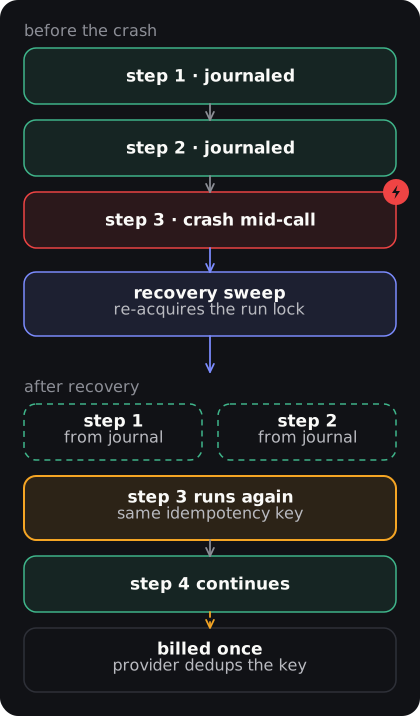
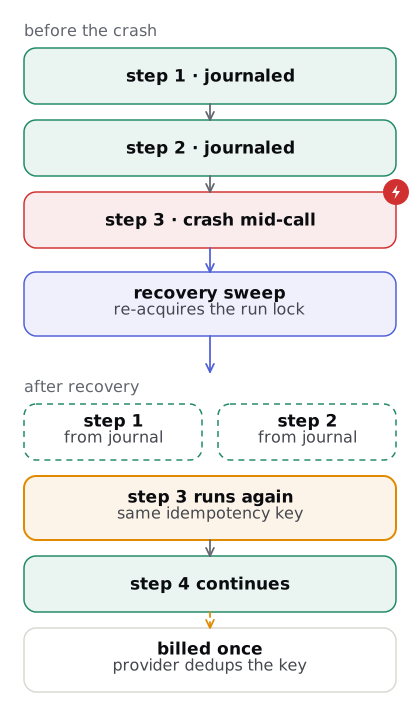
When the run is an in-VM agent, the re-drive injects PAL_RESUME=1 into its environment so the agent knows it is being resumed (recovery.go). The picture of this flow is on Durable execution.
The durable engine
Section titled “The durable engine”The workflow engine (services/workflow-engine) applies the same rules to its own steps.
| Step kind | Behavior | File |
|---|---|---|
| Any attempt | executeAttempt checks the replay cache (HasStepResult, keyed stepID:attempt) and returns the cached result without re-executing |
internal/engine/step_executor.go |
llm_call |
Dispatched through the model router with key run_id:step_id:attempt |
internal/engine/step_executor.go |
tool_call |
Dispatched to the runtime manager with the same key | internal/engine/step_executor.go |
child_run |
The engine creates and drives the child itself | internal/engine/child_run.go |
child_run has three properties that matter for recovery:
- Depth comes from the database. It is computed from the
parent_run_idchain and capped atmaxChildRunDepth = 5. It is not a context value, because a context value resets to 0 when the engine replays. - Adoption covers the gap the cache cannot. A crash after the child row is created but before
step_completedleaves nothing cached. The child recordsparent_run_idandparent_step_idintrigger_meta, and the re-run adopts it instead of creating a second child. - No split brain. The child is created
running, notqueued, so the scheduler’s poll forqueuedandresumableruns cannot claim it while the parent drives it inline.
A child that stops on an approval or a signal fails the parent step with ErrChildRunPaused. The parent does not wait for the approval, so nested approvals do not work yet.
Limits
Section titled “Limits”- Idempotency covers the side effects PAL performs itself. A tool that talks to a third party must tolerate a repeated call.
- The sweep runs every 30 s by default, so a crashed run resumes after up to that interval plus the lease expiry.