

Architecture
Principle: own the judgment, depend on the plumbing. Every box below is either ours because it’s the moat or someone else’s because they’re better at it.
Refreshed 2026-11-01 against 1.3.4. The datapath is a Rust gateway (ADR-0007) that sits in the request path only while migrating (ADR-0015). The control plane is Python with zero runtime dependencies in onpar fit.
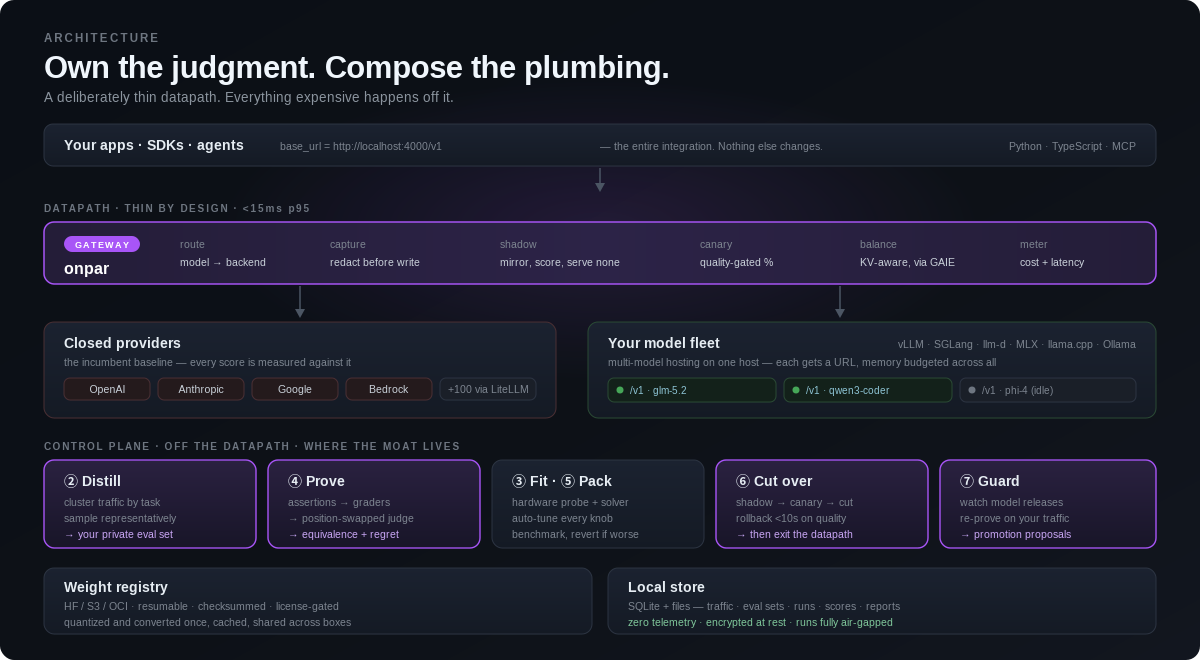
System view
Section titled “System view”┌──────────────── your app (unchanged, base_url swapped) ─────────────────┐└──────────────────────────────────┬──────────────────────────────────────┘ ▼ ┌────────── onpar proxy (datapath) ──────────┐ │ capture · redact · shadow · canary · gate │ ← ours (thin, Rust) │ OpenAI chat · OpenAI Responses · Anthropic │ │ Messages, captured as one record │ └───────┬──────────────────────────┬────────────┘ ▼ ▼ closed provider open model runtime (OpenAI/Anthropic) (vLLM · vLLM-TPU · SGLang · llm-d · llama.cpp · MLX · Ollama) │ │ └──────────┬───────────────┘ ▼ ┌──────────── control plane (off datapath) ────────────┐ │ │ │ ┌─────────┐ ┌────────┐ ┌───────┐ ┌────────────┐ │ │ │ DISTILL │→ │ FIT │→ │ PROVE │→ │ GENERATE │ │ │ │ cluster │ │ solver │ │ judge │ │ config │ │ │ └─────────┘ └────────┘ └───────┘ └────────────┘ │ │ ▲ ▲ ▲ │ │ │ └────────────┴──────────┴─────────────┘ │ │ GUARD (drift watch) │ └───────────────────────────┬───────────────────────────┘ ▼ ┌──────── store (local, on disk) ────────┐ │ SQLite: traffic, runs, scores │ │ files: eval sets, reports, artifacts │ └────────────────────────────────────────┘ ▲ surfaces ───────────────────┴─────────────────── CLI · TUI · local web console · MCP serverBuild vs. depend
Section titled “Build vs. depend”| Component | Decision | Why |
|---|---|---|
| Multi-provider routing | LiteLLM, if you want it | Solved. onpar’s gateway forwards to one upstream per run and does not replace a router. Run it in front of or behind LiteLLM |
| Benchmark runner | none bundled | The eval set is a plain JSON file (evalset.json) that onpar prove runs directly. Exporters for Inspect AI and promptfoo are specified (PRD FR-5) and not yet shipped. promptfoo has been OpenAI-owned since 9 Mar 2026, which is conflicted for a product about leaving OpenAI |
| Capability screening | lm-eval-harness | The academic standard; use for catalog priors only |
| Inference engines | all of them | Never compete |
| Production routing | GAIE / llm-d EPP | KV-cache-aware, 3× tok/s, 2× TTFT — measured. Adopt. |
| K8s serving | KServe / llm-d | We emit their CRDs |
| — | — | — |
| Task clustering | ours | Moat |
| Fit solver | ours | Moat |
| Grader stack | ours | Moat — and the highest-risk component |
| Equivalence matrix | ours | Moat — the hero artifact |
| Migration router logic | ours | Moat — quality-gated canary is unowned |
| Config generation | ours | Moat — hardware-aware tuning is the differentiator |
| Drift watch | ours | Moat |
Our datapath code is deliberately thin. Everything expensive happens off-path in the control plane. NFR-1 (<15 ms) is only achievable if we resist putting judgment in the proxy.
The runtime abstraction (the load-bearing decision)
Section titled “The runtime abstraction (the load-bearing decision)”Dev is Apple Metal. Prod is CUDA. They share nothing but the OpenAI wire format.
class Runtime(Protocol): name: str def supports(self, hw: Hardware, model: ModelSpec) -> Feasibility: ... def plan(self, hw: Hardware, model: ModelSpec, wl: Workload) -> RuntimePlan: ... def render(self, plan: RuntimePlan, target: Target) -> list[Artifact]: ...Seven engines have adapters today: vLLM, vLLM-TPU, SGLang, llm-d, llama.cpp, MLX and Ollama. The Runtime trait lives in onpar-core/src/runtime/, and no engine-specific type escapes it (ADR-0002).
Three rules:
renderemits native config, never a wrapper. BentoML’s rebuild-push-redeploy friction and one-release upstream lag are the failure mode we’re avoiding. The user gets a realvllm servecommand or a realInferencePool.supportsis honest. Returning “yes, degraded” beats a runtime error on a customer’s cluster.- No engine type leaks above this Protocol. The moment
PROVEimportsvllm, portability is gone.
The planner: thirteen knobs, each with a reason
Section titled “The planner: thirteen knobs, each with a reason”onpar build and onpar run turn what you need into flags. The planner sets thirteen settings per engine: context length, max concurrent, chunked prefill, prefix reuse, speculative decoding, memory fraction, tensor parallel, structured output, quantisation, KV-cache dtype, LoRA fleet and tool-calling parser. Every knob carries a why. Three forks decide most of it.

- Prefix sharing picks the engine. Shared long prefixes favour SGLang’s radix reuse. Otherwise vLLM’s PagedAttention is the better-supported default.
- Concurrency decides speculative decoding. Drafting is disabled past the batch cliff, where the verify step competes with real tokens.
- Latency budget decides chunked prefill. It protects time-to-first-token at a small throughput cost.
If the roofline says the inter-token budget is unreachable on the host, the plan says so in its warnings rather than shipping authoritative-looking flags. Throughput figures are roofline estimates, not measured. Measurement ratifies them (ADR-0004).
Data model (sketch)
Section titled “Data model (sketch)”Project one app/workload boundary (cf. AnythingLLM workspaces) └ Capture raw request/response, redacted, cost, latency, tool calls └ Cluster task type — the unit everything else is measured in └ EvalItem sampled prompt + incumbent baseline response HardwareProfile detected target, versioned (hardware changes) ModelSpec catalog entry: params, layers, kv_heads, head_dim, license, quants FitResult model × hw × quant → feasible, max_ctx, max_concurrency, projected tok/s EvalRun candidate × eval_set → scores, judge config, engine revision Equivalence cluster × model → score, CI, regret notes Rollout shadow/canary/cut state, gates, rollback historyCluster is the atomic unit. Not “the model is 94% as good” — that’s meaningless. “The model is 96% on codegen and 62% on long-context refactor” is actionable, and it’s what makes hybrid routing and regret analysis possible.
Fit solver math
Section titled “Fit solver math”weights_bytes = params × bits_per_weight / 8kv_bytes = 2 × layers × kv_heads × head_dim × seq_len × dtype_bytes × batchoverhead ≈ activations + fragmentation + runtime (engine-specific factor)required = weights + kv + overheadfeasible ⟺ required ≤ usable_memoryNotes that matter:
- MoE (Kimi K3: 2.8T total, ~16 of 896 experts active): weights need total params resident, compute scales with active. Getting this wrong is the most common sizing error in the wild.
- GQA:
kv_heads≪attn_heads. Using attention heads overestimates KV by up to 8×. - MLA (DeepSeek family): the cache stores a compressed
kv_lora_ranklatent. The GQA formula overestimates KV by about 64×. A catalog entry withkv_scheme: mlamust setkv_lora_rank, and a test enforces it. - Quantisation levels are fp16, bf16, fp8, q8, q6, q5, q4 and q3. Bits per weight are effective figures (q4 is 4.5).
- Apple unified memory is shared with the OS and GPU. Usable ≈ 75% of total, and
iogpu.wired_limit_mbcan raise it — surface that as a tunable, don’t silently assume. - Solve at observed context lengths from stage ②, not the model’s advertised max. Nobody actually sends 1M tokens.
Grader stack (highest-risk component)
Section titled “Grader stack (highest-risk component)”Three tiers, cheapest first, escalating only when needed:
1. programmatic JSON schema · tool name+args match · format/regex · exit code → deterministic, free, catches most regressions2. task graders exact match · unit-test execution (codegen) · retrieval overlap → cheap, high signal, cluster-specific3. pairwise judge open vs. incumbent, position-swapped, judge model disclosed → expensive, subjective, LAST RESORT
Agentic steps are the unit (ADR-0020).
A captured request inside an agent loop is replayed teacher-forced: the whole
redacted conversation, the tool schemas offered and the output format go back to
the candidate, and it is graded on the one move it makes. Tier 1 then also
covers: arguments valid against the offered JSON schema (ToolArgsSchema), a
tool call that arrived as text because the server’s parser missed it
(ToolLeak — a serving-config fault, named as such), and a tool that was never
offered. Tier 3 sees tool calls rendered into both answers. Across all steps the
report adds decision agreement — Cohen’s κ over the per-step action, with
the two asymmetric failures counted apart and a per-tool Wilson table — and the
receipt carries it. Sessions are linked structurally from message prefixes, and
the share of prompt tokens that were a re-sent prefix is handed to the planner’s
prefix-reuse decision.
Guardrails, because a wrong verdict here breaks a customer’s production system:
- Position-swap every pairwise comparison; disagreement between orderings = low confidence, flagged not averaged.
- Report judge–human agreement on a sampled subset. If we can’t state it, we don’t ship the verdict. The subset is produced by
prove --judge-sampleand graded blind withonpar label; the rate is measured from that ledger, never typed. - Measure and disclose judge length bias (how often the longer answer won) beside position bias, because the swap cannot catch a verbosity preference.
- Never let tier 3 alone authorize a cutover. Shadow mode (⑥) is the real gate — it scores against live traffic before anything is served.
- The judge model is disclosed in every report. Using a closed model to judge whether you can leave closed models is an obvious conflict; it must be visible and swappable.
Evidence flow, end to end
Section titled “Evidence flow, end to end”capture (3 API shapes) → redact → encrypt → distill (or distill --import) → eval set → prove: step replay · session replay · judge → Wilson interval · κ · receipt (v3, content-addressed, local) → onpar label (blind human grades the judge) → measured agreement on the receipt → onpar migrate: shadow → canary → rollbackA whole-session replay answers tool calls from the recording. A call the recording cannot answer stops the session as a miss. It never reaches a live tool. Receipts re-verify with onpar receipt, and onpar guard says whether one still holds.
Security & privacy
Section titled “Security & privacy”- Redaction before persistence. PII detection runs in the gateway write path; unredacted text never touches disk. Redaction failures fail closed (drop the capture). Tool-call arguments are redacted too. A non-2xx upstream response is never captured.
- Measured overhead. +0.07 ms added at p95 against a 15 ms budget.
- Local-first, zero telemetry default (NFR-2). Ollama and Jan set this bar; LM Studio’s opt-out default is the anti-pattern.
- Encrypted at rest with XChaCha20-Poly1305. Captured traffic is the most sensitive data a customer has — it’s their production prompts.
- Captured content is data, never instructions. Traffic is untrusted by definition; a prompt in the corpus that says “ignore previous instructions” is a row in a table, not a directive. This applies to the clustering agent, the judge, and every report renderer.
- No egress without explicit action. Export is a command, never a background sync.
- Air-gap support (NFR-7): everything after model download works offline.
Surfaces
Section titled “Surfaces”| Surface | For | Priority |
|---|---|---|
CLI (onpar) |
primary; scriptable, CI-native, non-interactive flags on everything | P0 |
| TUI | live loop status, shadow-mode scoring, cutover gates | P1 |
| Local web console | equivalence matrix, drill-down, shareable report | P0 for stage ④ — the matrix needs pixels |
MCP server (onpar-mcp) |
Claude Code / Cursor analyse and recommend. Eleven read-only tools; none can move production traffic | P1 |
Conversation (bare onpar) |
one question at a time, only when it changes the plan. A usage error (exit 2) in CI | P0 |
Onboarding and teaching sit beside these: onpar doctor reports the gateway, extension and engine and prints the next command, and onpar learn walks 36 lessons in five tracks on the host’s own numbers.
Detail in 40-ux.md.