

The receipt
A receipt is the file onpar prove writes: what was proven about each task in
your traffic, with its confidence, and what was not. You can hand it to someone
who does not trust you. The format lives in src/onpar/prove/receipt.py.
It is content-addressed, not signed
Section titled “It is content-addressed, not signed”The file is {"receipt": {...}, "digest": "..."}. The digest is a SHA-256 over
the receipt body as canonical JSON, with sorted keys and no whitespace.
- A file whose digest does not match its content is refused as altered since it was issued.
- A file with no digest is refused, because nothing about it can be verified.
- A digest says the file is unchanged. It does not say who wrote it.
- The stronger claim is reproduction: re-run the same eval set and the evidence
must match.
onpar receipt --againstchecks exactly that.
The current format is onpar.receipt/v3. Readers accept v1, v2 and v3, and
refuse any other format rather than guess at its fields.
Bad news is printed first
Section titled “Bad news is printed first”There is no field that can hold a bare PASSED. regret and unproven are
required, and the rendered receipt shows them above the proven clusters: what
must stay on the incumbent, then what is not proven either way, then what moved.
$ onpar receipt receipt.json

Migration receipt · gpt-4o-mini → qwen3-30b-a3bissued 2026-11-03 · eval set da030c9c5fb9 · digest 9c476cc9bf93
NOT PROVEN either way — not enough evidence:  · tools offered, unused · free text · <=1k context 100% [76%–100%] over 12 items — needs 35 to clear the bar at this rate  · free text · <=1k context #1  92% [80%–97%] over 40 items — needs 525 to clear the bar at this rate  · tool-calling (2 tools) · empty response · <=1k context 100% [76%–100%] over 12 items (12 duplicate prompt(s) merged) — needs 35 to clear the bar at this rate  · free text · <=1k context #2  86% [72%–94%] over 37 items (3 duplicate prompt(s) merged)  · free text · <=1k context #3  100% [88%–100%] over 29 items (11 duplicate prompt(s) merged) — needs 35 to clear the bar at this rate  · free text · <=1k context #4  100% [21%–100%] over 1 items — needs 35 to clear the bar at this rate
Proven at or above the 90% bar:  · structured JSON · <=1k context 100% [91%–100%] over 40 items
Movable: 20% of captured trafficSaving: unknown — no cost rate configured; pass --incumbent-cost and --candidate-costCoverage: incomplete — 6 cluster(s) unresolvedJudge: none used — every claim is from deterministic gradersAgentic: same move on 90%–100% of 36 tool-context steps · κ=1.00 · 0 answered where a tool was called, 0 called a tool where an answer wasDrawn from 197 captured requests


# recorded 2026-11-03 on M4 Max · 128 GB · onpar 1.5.2
This receipt moves one cluster. Structured JSON is proven at 100% [91–100]
over 40 items, and six clusters lack the evidence to decide, so Movable reads
20% and not more. Each unproven line says how many graded items it would need,
or that more will not help. The saving reads unknown because no cost was
passed, rather than showing an invented figure.
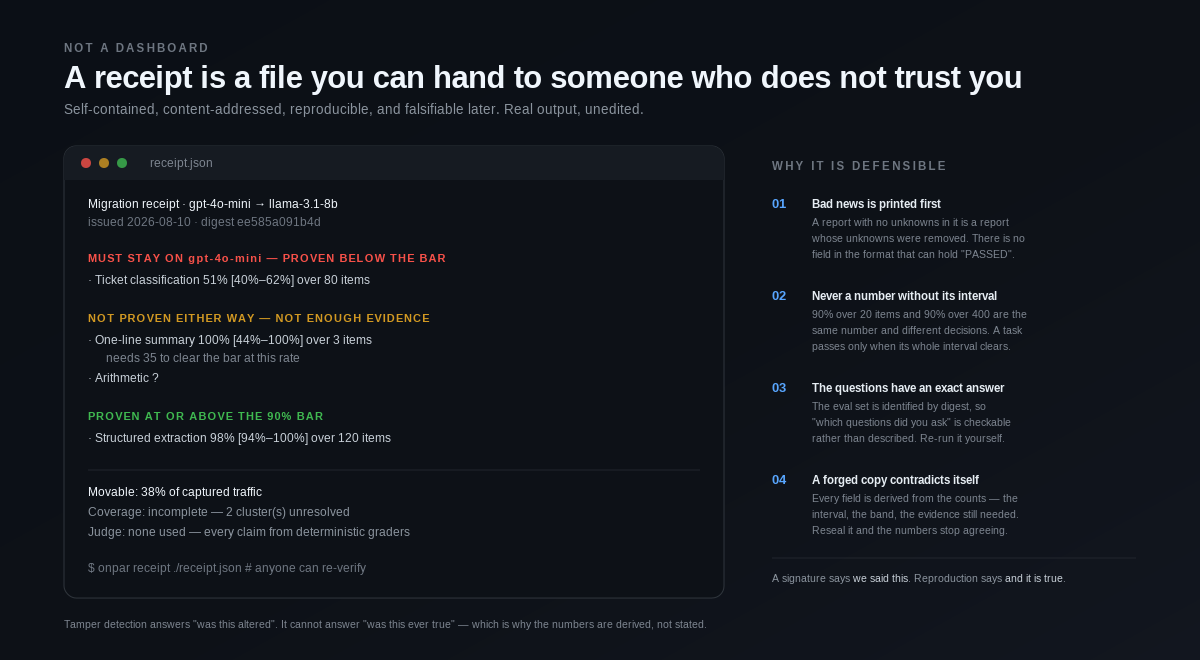
Read the receipt in the diagram top to bottom: the regret cluster comes before the proven one, and each line carries its interval.
The fields
Section titled “The fields”| Field | What it holds |
|---|---|
format |
onpar.receipt/v3. |
incumbent |
The model being replaced. |
candidate |
The open model under test. |
issued |
ISO date, passed in, so the same evidence issues the same receipt. |
eval_set |
Digest of the eval set: exactly which questions were asked. |
bar |
The equivalence threshold every claim was measured against. |
proven |
Clusters whose whole interval clears the bar. |
regret |
Clusters proven below the bar. They stay on the incumbent. |
unproven |
Clusters with too little evidence to say either way. |
traffic_captures |
How many captured requests the eval set was drawn from. |
traffic_window |
The capture period you stated with --traffic-window. |
judge_model |
The LLM judge, if one was used. null means deterministic graders only. |
judge_agreement |
How often a human agreed with that judge. |
judge_trustworthy |
Whether onpar treats that agreement as enough to trust the judge. |
judge_calibration |
How often the judge reproduced the deterministic graders. |
redacted |
What redaction removed, by kind. |
incumbent_cost |
Monthly dollars on the incumbent. 0.0 means not supplied. |
candidate_cost |
Monthly dollars the candidate would cost. 0.0 means not supplied. |
fingerprints |
What identified each model’s weights, so a silent swap is detectable. |
tool_version |
The onpar version that issued it. |
agentic |
Decision agreement over tool-using steps. Empty when there were none. |
Each entry in proven, regret and unproven is a claim:
| Field | What it holds |
|---|---|
cluster |
The task shape’s stable key. |
name |
Its readable name. |
share |
Fraction of captured traffic in this cluster. |
passed, total |
Graded items that passed, out of all graded items. |
low, high |
The confidence interval on the pass rate. |
ungraded |
Items that could not be graded, disclosed rather than dropped. |
duplicates |
Items merged because an identical prompt already appeared. |
needed |
Graded items this cluster would need to clear the bar at its observed rate. |
What onpar receipt re-verifies
Section titled “What onpar receipt re-verifies”onpar receipt receipt.jsononpar receipt receipt.json --against rerun.json- On read, it checks the digest and refuses an altered file.
- On read, it refuses a claim that is the right shape and an impossible measurement, such as a share above 1.
- With
--against, it compares evidence: the eval set, the bar, both model names, every fingerprint both files carry, and every cluster’s claim. - It leaves out
issuedandtool_version, because an honest rerun happens on a later day and often a newer build. - It prints
verifiedorDOES NOT VERIFYwith each disagreement, and exits 1 when they disagree. --jsonprints the receipt and its digest for a program.
What onpar guard voids
Section titled “What onpar guard voids”A receipt describes a moment. onpar guard checks whether that moment still
describes production, and separates three kinds of stale:
- The model moved. A fingerprint changed behind the model’s name. The receipt
is void. Found with
--fingerprints. - Your traffic moved. More than a fifth of volume moved between task shapes,
or more than 10% of current traffic sits in clusters the receipt never scored. The eval
set answers questions nobody asks anymore. Found with
--traffic. - The field moved. A new candidate was released. The receipt is still true.
Found with
--available.
The first two print as [void]. The third prints as [note], as does a receipt
older than 90 days and a receipt with no fingerprints to compare against. The
thresholds are TRAFFIC_DRIFT_LIMIT, UNCOVERED_SHARE_LIMIT and
MAX_RECEIPT_AGE_DAYS in src/onpar/guard.py.
Run with no current fingerprints, traffic or releases to compare, guard has
nothing that moved to report:
$ onpar guard receipt.json

receipt still holds · 9c476cc9bf93

→ nothing — the receipt still holds


# recorded 2026-11-03 on M4 Max · 128 GB · onpar 1.5.2
guard exits 1 when the receipt no longer holds. --fail-on any also exits 1
on notes, which suits a release gate that should not deploy on an unreviewed
proof. The strongest thing it can propose is a re-prove. It never moves
traffic.
Next: the eval set, the file a receipt’s eval_set digest
names.