

Prove: per task, with intervals, or `?`
Is the open model on par with the one you pay for, task by task, and how sure can you be?
onpar prove replays every eval item against the candidate and grades the reply
against your incumbent’s answer. A replay is the whole step, not the bare prompt:
the system prompt, the earlier turns, the tool results and the tools offered all
go back exactly as the incumbent saw them. Grading is deterministic first.
Structural checks ask whether there is an answer and whether JSON is valid.
Task checks compare tool choice, arguments, exact matches and numbers. An LLM
judge is consulted only where those cannot decide, and only if you name one.
Every task shape gets a pass rate and a 95% Wilson score interval. A shape is
proven only when the whole interval clears the bar, 90% by default. The interval
is the point. At a perfect score the Wilson lower bound is n / (n + z²), with z²
about 3.84. Fifteen flawless items give a lower bound of about 0.80. It takes 35
flawless items, at about 0.901, to clear 90%. samples_needed in
src/onpar/prove/stats.py carries that arithmetic, and the report prints it for
every open shape.
The headline is a traffic-weighted verdict across shapes. Wilson does not cover a weighted sum of proportions, so that figure is simulated from Jeffreys posteriors and labelled as such. Scoring several shapes against one bar also raises the chance that one passes by luck, so the report adds a Bonferroni line.
The run
Section titled “The run”The candidate is qwen3-30b-a3b, served on this machine by onpar run through
llama.cpp at q8, with thinking off and structured output enforced by grammar.
--replay-sessions adds the whole-session check for the refund agent.
$ onpar prove evalset.json --candidate-endpoint http://127.0.0.1:8001/v1 --candidate qwen3-30b-a3b --candidate-model Qwen/Qwen3-30B-A3B-GGUF:Q8_0 --incumbent gpt-4o-mini --replay-sessions --collect-workers 4 --resume ~/.onpar/story --out receipt.json
  candidate: 197/197 replies
  COLLECTED  candidate 197/197 replies · http://127.0.0.1:8001/v1 · served: Qwen/Qwen3-30B-A3B-GGUF:Q8_0 · 0.00s · 5,119 completion tokens
                        tools offered, u  free text · <=1k  tool-calling (2   free text · <=1k  free text · <=1k  free text · <=1k  structured JSON                                    (6%)             (20%)             (12%)             (20%)             (20%)              (1%)             (20%)----------------------------------------------------------------------------------------------------------------------------------------------------qwen3-30b-a3b              100% [76–100]       92% [80–97]     100% [76–100]       86% [72–94]     100% [88–100]   100% [21–100] ⚠     100% [91–100]   96% [90–97] weighted----------------------------------------------------------------------------------------------------------------------------------------------------gpt-4o-mini (incumbent)              100%              100%              100%              100%              100%              100%              100%
weighted verdict 96% [90–97] — Jeffreys posterior simulation, 2000 draws, seed 20260728  per-cluster cells above are Wilson score intervals, 95%; the weighted figure is a sum of proportions, which Wilson does not covermultiplicity: 7 clusters scored against the same 90% bar; the intervals above are UNADJUSTED. Under Bonferroni (α=0.05/7, z=2.69), 0 of the 1 that clear it would still clear it.to settle the open clusters:  · tools offered, unused · free text · <=1k context: needs 35 graded items to clear the 90% bar at its observed 100% (has 12, 23 to go)  · free text · <=1k context #1: needs 525 graded items to clear the 90% bar at its observed 92% (has 40, 485 to go)  · tool-calling (2 tools) · empty response · <=1k context: needs 35 graded items to clear the 90% bar at its observed 100% (has 12, 23 to go)  · free text · <=1k context #2: 86% [72–94] — the observed rate is at or below the 90% bar; more items will not clear it  · free text · <=1k context #3: needs 35 graded items to clear the 90% bar at its observed 100% (has 29, 6 to go)  · free text · <=1k context #4: needs 35 graded items to clear the 90% bar at its observed 100% (has 1, 34 to go)
judge: not used — verdicts are from deterministic graders only
AGENTIC — did the candidate make the same moves?  decision agreement 100% [90–100] over 36 tool-context steps · κ=1.00 (almost perfect), chance-corrected  per tool, how often the candidate also called it:    lookup_order                   100% [76–100] of 12    refund                         100% [76–100] of 12⚠ underpowered clusters (too few samples to conclude): free text · <=1k context #4⚠ 26 duplicate prompt(s) collapsed — tool-calling (2 tools) · empty response · <=1k context (12), free text · <=1k context #2 (3), free text · <=1k context #3 (11). A prompt repeated within a cluster is one observation asked twice, and every interval here assumes independent ones, so the copies are merged rather than counted. An item passes only if every copy of it passed.
Move 20% of traffic to qwen3-30b-a3b.  Not yet proven: tools offered, unused · free text · <=1k context, free text · <=1k context #1, tool-calling (2 tools) · empty response · <=1k context, free text · <=1k context #2, free text · <=1k context #3, free text · <=1k context #4    → tools offered, unused · free text · <=1k context: needs 35 graded items to clear the 90% bar at its observed 100% (has 12, 23 to go)    → free text · <=1k context #1: needs 525 graded items to clear the 90% bar at its observed 92% (has 40, 485 to go)    → tool-calling (2 tools) · empty response · <=1k context: needs 35 graded items to clear the 90% bar at its observed 100% (has 12, 23 to go)    → free text · <=1k context #2: 86% [72–94] — the observed rate is at or below the 90% bar; more items will not clear it    → free text · <=1k context #3: needs 35 graded items to clear the 90% bar at its observed 100% (has 29, 6 to go)    → free text · <=1k context #4: needs 35 graded items to clear the 90% bar at its observed 100% (has 1, 34 to go)  Saving: unknown — no cost rate configured; pass --incumbent-cost and --candidate-cost
SESSION REPLAY — the whole loop, tool results answered from the recording  12/12 sessions followed the incumbent's path to the end · 100% [76–100] · 36/36 steps completed  A different route to the same outcome counts as diverged — this measures whether the candidate takes the incumbent's path, not whether it would succeed.
  receipt written to receipt.json


# recorded 2026-11-03 on M4 Max · 128 GB · onpar 1.5.2
How to read it
Section titled “How to read it”- Structured JSON is the one proven shape.
100% [91–100]over 40 items, every reply the JSON object the request asked for. The collector sends a capturedjson_objectrequest as ajson_schemafor any object, which is the form grammar-constrained engines enforce. Had the server ignored it, the warning line would say so, and the shape would score as a server finding, not a model verdict. - The weighted verdict is
96% [90–97]. It is a sum over shapes, each counted by its share of traffic. The multiplicity line is the honest footnote: seven shapes scored against one bar, and under Bonferroni the one that clears it would not. - Free text #1 scored
92% [80–97]. It needs 525 graded items to clear a 90% bar at that rate. Free text #2, at 86%, cannot clear the bar with more items. - Free text #3 scored
100% [88–100]over 29. It needs 35 items, so 6 more. - 26 duplicate prompts were collapsed. A prompt repeated within a shape is one observation asked twice. Every interval assumes independent items, so the copies merge, and an item passes only if every copy passed.
- The judge was not used. Every verdict above comes from deterministic graders.
- COLLECTED reads 76 s for 197 replies.
--resumerecords each one under that prefix as it lands, so a second run asks nothing twice.
The engine probe confirms, in three requests to the same server, that it answers, enforces the format and returns structured tool calls:
$ python3 tools/engine_probe.py --endpoint http://127.0.0.1:8001/v1 --model Qwen/Qwen3-30B-A3B-GGUF:Q8_0
probing http://127.0.0.1:8001/v1 · model Qwen/Qwen3-30B-A3B-GGUF:Q8_0  ok    answers   answered 'billing' in 2 tokens  ok    json      a JSON object came back even for a prose prompt: the server enforces the format  ok    tool-call structured tool call to 'lookup_order'

# recorded 2026-11-03 on M4 Max · 128 GB · onpar 1.5.2
The agentic block asks whether it made the same moves
Section titled “The agentic block asks whether it made the same moves”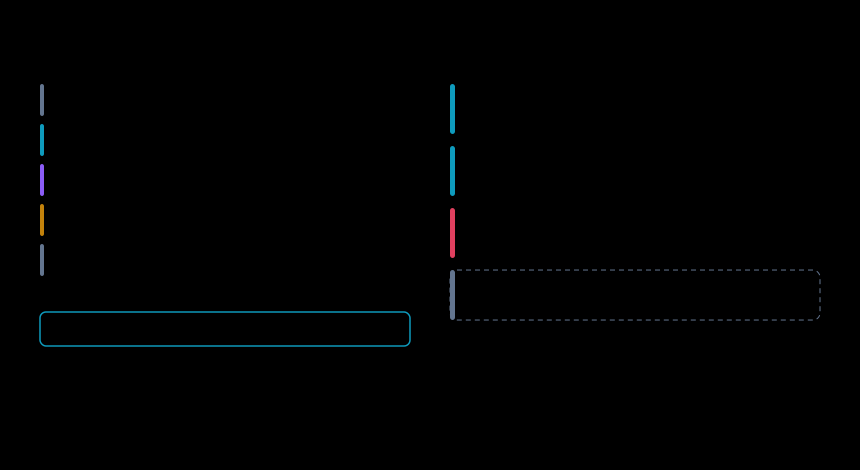
On the left, look at what goes back to the candidate: everything the incumbent saw. On the right, look at where the session stops: at the first call the recording cannot answer.
Each agent step is teacher-forced (ADR-0020). The candidate gets the exact prefix the incumbent saw and is asked for one move. Three graders read that move:
- Tool choice. Did it call the same tool, or answer in text where the incumbent called one?
- Arguments against the schema. Every argument object must satisfy the tool schema the request offered. A right tool with a wrong argument fails here.
- Tool leak. A call that arrives as text, with no
tool_calls, is a server parser fault. The detail names the server flag, not the model.
Decision agreement is Cohen’s kappa over the action at each step, so a workload
dominated by one action cannot flatter it. Here it is 100% [90–100] over 36
steps, κ=1.00. Both tools were called on all 12 of their steps.
--replay-sessions then runs each session end to end. When the candidate makes
the incumbent’s call, the recorded tool result is fed back and the next step is
asked. A different call, a text answer where a tool was called, or a call the
recording cannot answer ends the session there. A miss is a stop, never a live
tool call. It is a path metric: a different route to the same outcome reads as
diverged, and the report says so. Here 12 of 12 sessions followed the
incumbent’s path to the end.
The collector names server faults
Section titled “The collector names server faults”Collection is the one step that sends anything, to the one endpoint you name.
A failed collection is not a failed answer. An item that got no reply is dropped,
the interval widens, and the count lost is printed beside the verdict. Two
faults get their own lines, from src/onpar/prove/collect.py:
- Format not enforced. Replies that ignore
response_formatare counted and named as a server setting, as in the run above. - Thinking exhausted the token budget. A reasoning model that spends the
whole budget thinking returns no content. The collector counts those replies
and says to serve with thinking off, which
onpar rundoes by default, or to raise the token limit. Onlycontentis ever graded, never the reasoning.
A judge, and what this run’s judge did
Section titled “A judge, and what this run’s judge did”No judge is built in. --judge-endpoint URL --judge-model NAME names one, and
the model is stamped on the receipt. Each comparison runs twice with positions
swapped, and a judge that changes its answer with the order is recorded as
uncertain, never averaged. This run added one, at no cost: the candidate’s own
server, scoring the candidate against the incumbent.
$ onpar prove evalset.json --candidate-endpoint http://127.0.0.1:8001/v1 --candidate qwen3-30b-a3b --candidate-model Qwen/Qwen3-30B-A3B-GGUF:Q8_0 --incumbent gpt-4o-mini --replay-sessions --collect-workers 4 --resume ~/.onpar/story --judge-endpoint http://127.0.0.1:8001/v1 --judge-model Qwen/Qwen3-30B-A3B-GGUF:Q8_0 --judge-sample judged.jsonl --out receipt-judged.json
  candidate: 197/197 replies
  COLLECTED  candidate 197/197 replies · http://127.0.0.1:8001/v1 · served: Qwen/Qwen3-30B-A3B-GGUF:Q8_0 · 0.00s · 5,119 completion tokens
                        tools offered, u  free text · <=1k  tool-calling (2   free text · <=1k  free text · <=1k  free text · <=1k  structured JSON                                    (6%)             (20%)             (12%)             (20%)             (20%)              (1%)             (20%)----------------------------------------------------------------------------------------------------------------------------------------------------qwen3-30b-a3b              100% [76–100]       92% [80–97]     100% [76–100]       86% [72–94]     100% [88–100]   100% [21–100] ⚠     100% [91–100]   96% [90–97] weighted----------------------------------------------------------------------------------------------------------------------------------------------------gpt-4o-mini (incumbent)              100%              100%              100%              100%              100%              100%              100%
weighted verdict 96% [90–97] — Jeffreys posterior simulation, 2000 draws, seed 20260728  per-cluster cells above are Wilson score intervals, 95%; the weighted figure is a sum of proportions, which Wilson does not covermultiplicity: 7 clusters scored against the same 90% bar; the intervals above are UNADJUSTED. Under Bonferroni (α=0.05/7, z=2.69), 0 of the 1 that clear it would still clear it.to settle the open clusters:  · tools offered, unused · free text · <=1k context: needs 35 graded items to clear the 90% bar at its observed 100% (has 12, 23 to go)  · free text · <=1k context #1: needs 525 graded items to clear the 90% bar at its observed 92% (has 40, 485 to go)  · tool-calling (2 tools) · empty response · <=1k context: needs 35 graded items to clear the 90% bar at its observed 100% (has 12, 23 to go)  · free text · <=1k context #2: 86% [72–94] — the observed rate is at or below the 90% bar; more items will not clear it  · free text · <=1k context #3: needs 35 graded items to clear the 90% bar at its observed 100% (has 29, 6 to go)  · free text · <=1k context #4: needs 35 graded items to clear the 90% bar at its observed 100% (has 1, 34 to go)
⚠ judge: Qwen/Qwen3-30B-A3B-GGUF:Q8_0 · human agreement UNMEASURED — below the trust bar; its verdicts are counted in the cells above but cannot advance any clusterjudge calibration: Qwen/Qwen3-30B-A3B-GGUF:Q8_0 matched the deterministic graders on 100% [95–100] of 78 items scored both ways (calibrated, floor 70% over 10+ items)judge length bias: Qwen/Qwen3-30B-A3B-GGUF:Q8_0 · not measurable (0 decisive verdicts, 10 needed)
AGENTIC — did the candidate make the same moves?  decision agreement 100% [90–100] over 36 tool-context steps · κ=1.00 (almost perfect), chance-corrected  per tool, how often the candidate also called it:    lookup_order                   100% [76–100] of 12    refund                         100% [76–100] of 12⚠ underpowered clusters (too few samples to conclude): free text · <=1k context #4⚠ 26 duplicate prompt(s) collapsed — tool-calling (2 tools) · empty response · <=1k context (12), free text · <=1k context #2 (3), free text · <=1k context #3 (11). A prompt repeated within a cluster is one observation asked twice, and every interval here assumes independent ones, so the copies are merged rather than counted. An item passes only if every copy of it passed.
Move 20% of traffic to qwen3-30b-a3b.  Not yet proven: tools offered, unused · free text · <=1k context, free text · <=1k context #1, tool-calling (2 tools) · empty response · <=1k context, free text · <=1k context #2, free text · <=1k context #3, free text · <=1k context #4    → tools offered, unused · free text · <=1k context: needs 35 graded items to clear the 90% bar at its observed 100% (has 12, 23 to go)    → free text · <=1k context #1: needs 525 graded items to clear the 90% bar at its observed 92% (has 40, 485 to go)    → tool-calling (2 tools) · empty response · <=1k context: needs 35 graded items to clear the 90% bar at its observed 100% (has 12, 23 to go)    → free text · <=1k context #2: 86% [72–94] — the observed rate is at or below the 90% bar; more items will not clear it    → free text · <=1k context #3: needs 35 graded items to clear the 90% bar at its observed 100% (has 29, 6 to go)    → free text · <=1k context #4: needs 35 graded items to clear the 90% bar at its observed 100% (has 1, 34 to go)  Saving: unknown — no cost rate configured; pass --incumbent-cost and --candidate-cost
SESSION REPLAY — the whole loop, tool results answered from the recording  12/12 sessions followed the incumbent's path to the end · 100% [76–100] · 36/36 steps completed  A different route to the same outcome counts as diverged — this measures whether the candidate takes the incumbent's path, not whether it would succeed.
  receipt written to receipt-judged.json


# recorded 2026-11-03 on M4 Max · 128 GB · onpar 1.5.2
The cells did not move, and the three judge lines say why. The judge agreed with
the deterministic graders on all 78 items both could score, so it is calibrated.
Its human agreement is unmeasured, so nothing it says can advance a cluster. And
it produced no decisive verdict at all. The ledger --judge-sample wrote shows
what happened: across 378 swapped comparisons the judge chose position A 156
times and position B never, and called the rest ties. Every preference flipped
when the order flipped, so every one was position bias, and the swap check
turned every one into “uncertain”. A 30B model with thinking off, judging its
own family, is a coin that always lands on the side it was shown first. The
product’s answer to that is the right one: count nothing.
A judge’s word counts only once a human has checked it:
onpar prove ... --judge-sample judged.jsonlappends every comparison the judge sees, and its answer, to a ledger.onpar label judged.jsonlwalks you through those comparisons blind, in the same order, with no sight of the judge’s answer.onpar prove ... --judge-labels judged.jsonlmeasures the human-agreement rate from that ledger.
Below 20 labelled comparisons or 75% agreement, judge cells render as unknown.
An unmeasured judge is reported as UNMEASURED, and the gate refuses to
advance on it. Evidence that rests on the judge alone never moves traffic.
When it says no
Section titled “When it says no”Look at the agentic block again: 100% decision agreement, κ=1.00, 12 of 12 sessions to the end, and five shapes at 100%. The verdict moves 20% of traffic, the one shape with 40 items, and holds the rest.
A perfect score over 12 items is a lower bound of 76%, not a pass. Each open shape says how many more graded items would settle it, or that more items will not: free text #2 is at or below the bar, so collecting more cannot clear it. The saving reads unknown because no cost was passed.
The knobs that matter
Section titled “The knobs that matter”--candidate-endpoint URLcollects the candidate’s replies. Without it, a freshly distilled set has nothing to grade and is refused.--candidate-model NAMEis the name the endpoint knows the model by, when it differs from--candidate.--replay-sessionsadds the whole-session replay for agent workloads.--resume PREFIXrecords each reply as it lands and reuses it next time. Collection is the only step that spends real money.--barsets the equivalence bar. The default is 0.9.--incumbent-cost,--candidate-costand--traffic-windowturn the saving into a range. Without them the saving reads unknown.--fingerprints FILErecords what identified each model, soonpar guardcan catch a silent swap later.--out receipt.jsonwrites the receipt.
Next: migrate, shadow first.