Architecture
Every component below is a real process and every arrow a real call. For each one this page gives what it does, the port it listens on, and the trust boundary it enforces. The runtime manager and the harness are broken out into their own component sections.
System map
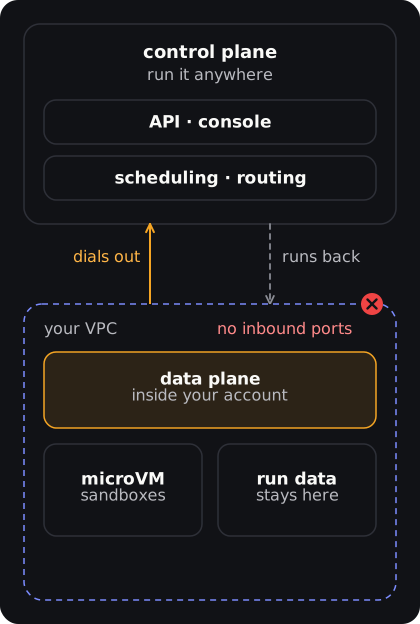
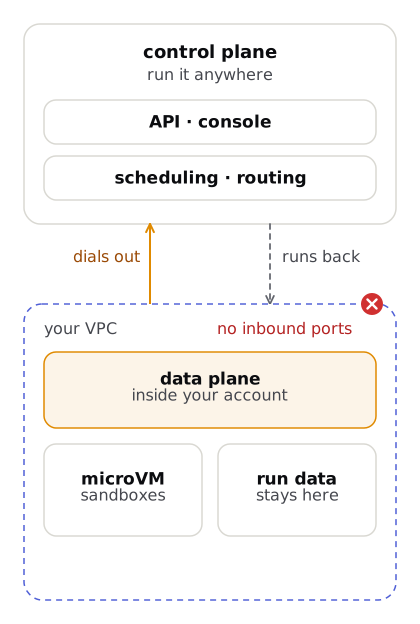
Section titled “System map”The system has three zones: callers outside, a control plane, and a data plane that runs in your VPC. The microVM sits inside the data plane. Data stores (Postgres, Redis, S3/MinIO) are shared.
Callers and external services
Section titled “Callers and external services”| Component | Language / port | Role and boundary |
|---|---|---|
| SDKs | TypeScript, Python 3.11+, Go | Typed clients for the REST API. Each reads its base URL from LANTERN_API_URL. Untrusted caller: every request carries a Bearer JWT or API key that the control plane validates. Models are addressed by capability (auto, reasoning-large), never by vendor name. |
lantern CLI |
Go (Cobra) | Static binary that wraps the same REST API: runs, sandboxes (lantern vm ...), onboarding. Authenticates like the SDKs. |
| Dashboard | TypeScript (Next.js), :3001 (dev) |
Operator UI over the same REST endpoints: agents, runs and their journal waterfall, sandboxes, budgets. Browser session, JWT-authenticated like any other caller. |
| LLM providers | Anthropic, OpenAI (external HTTPS) | Reached directly by the control plane’s failover chain (the default) or through the model router. Calls carry an Idempotency-Key so a retry or crash-replay is deduplicated at the provider. Tenant provider keys are AES-256-GCM encrypted at rest and never logged. |
| Internet | External | Whatever the sandbox’s egress rules allow. Everything else is denied and audited. Deny by default; private and metadata ranges (including 169.254.169.254) are refused even when a hostname resolves to them. |
Control plane
Section titled “Control plane”| Component | Language / port | Role and boundary |
|---|---|---|
| Gateway | Rust (Axum), :8443 TLS |
Edge ingress. Terminates TLS, validates API keys by asking the control plane (cached 60 s by key hash), and calls the control plane over gRPC. Sends x-lantern-service-token on its gRPC calls; refuses API-key auth when introspection is not configured. |
| Control plane | Go, :8080 HTTP (REST + SSE), :50051 gRPC |
Owns agents, runs, budgets and tenants. Gates every run (auth, budget, isolation), runs shared-tier agents inline, and journals every step to Postgres. Trust boundary on :50051: only callers presenting x-lantern-service-token may set a tenant_id. |
| Model router | Rust, :50053 gRPC |
ModelService: Complete, CompleteStream, Embed, Tokenize. Maps a capability to a concrete provider model, with caching. Service-token gate on :50053; it carries tenant provider keys, so it refuses to start in prod without the token. |
Control plane invariants:
- Hard-fail budgets block a run with HTTP 402 before any compute or tokens are spent.
- Every tenant-scoped query runs through
WithTenantso Postgres RLS can enforce it. - A crashed run is re-driven from its journal by a 30 s recovery sweep.
- It refuses to start in prod without the service token.
Model router invariants:
- The control plane uses it only when
LANTERN_USE_MODEL_ROUTERis on (default off); any router error falls through to the direct provider chain. - Workflow-engine
llm_callsteps always go through it.
Gateway invariant: without LANTERN_TLS_CERT/LANTERN_TLS_KEY it serves plaintext and warns. Never run that way in production.
Data plane (your VPC)
Section titled “Data plane (your VPC)”| Component | Language / port | Role and boundary |
|---|---|---|
| Data-plane agent | Go | Runs in your VPC. Opens a RunStream to the control plane, receives run assignments, and drives each one on the local workflow engine. It dials out: the control plane never connects into your network. Each plane is bound to one tenant. If no plane is connected for a tenant, the run executes inline in the control plane instead. |
| Workflow engine | Go, :50052 gRPC |
Durable step executor: llm_call via the model router, tool_call via the runtime manager, child_run in-engine. Each attempt is replay-checked before it runs. Service-token gate on :50052; Cancel/Resume/Signal also filter by the verified tenant_id and return NotFound on mismatch. |
| Runtime scheduler | Go, :50055 gRPC, :8085 REST |
Places sandboxes on nodes (warm pool, capacity, fair share) and owns their lifecycle: pause, resume, fork, and the idle-suspend sweeper. Service-token gate on :50055. Tenant quota is reserved atomically (all-or-nothing for forks). |
| Runtime manager | Rust (tonic), :50054 gRPC (mTLS), one per node |
The only thing that touches microVMs: spawn, stop, snapshot/restore, exec, ExecTool. Serves RuntimeHarness for the guests on its node. Refuses any peer presenting a per-VM cert (OU=lantern-vm) on RuntimeManager methods and requires the service token from everyone else. |
| Host egress broker | Rust (inside runtime-manager), opt-in | Per-VM proxy on the host end of vsock port 3128. Applies the allowlist, dials upstream from the host, and injects credentials into requests to hosts whose rule says so. New trust boundary: host code parsing guest bytes. Heads capped at 64 KiB; error strings returned to the guest are static. |
| Harness | Rust (musl, static), PID 1 in the VM, :50056 exec (in guest) |
Init process inside every microVM: supervises the workload, serves exec and tool calls, vends short-TTL secrets, and enforces egress. The last in-VM boundary. The secrets socket only answers the workload uid (kernel-attested via SO_PEERCRED); the workload runs as its own uid with LANTERN_* env withheld. |
| Untrusted code | Anything: Python, Node, shell | Code the agent wrote or downloaded. It sees /workspace, the proxy env, and nothing that identifies the control plane. Contained by the microVM wall and, in broker mode, has no network device at all. |
Workflow engine invariants:
- Idempotency key for every side effect:
run_id:step_id:attempt. - A missing router or manager address fails the step with a typed error, never a fabricated result.
Runtime scheduler invariants:
- A PAUSED VM holds no concurrent-VM slot.
- Lifecycle mutations on one VM are serialized by a per-VM lock; only the leader replica mutates.
Runtime manager invariants:
- A VM owned by another tenant is indistinguishable from an absent one (
NOT_FOUND). - Untrusted code runs in Firecracker or Kata, never a bare pod.
Host egress broker invariants:
- Opt-in:
LANTERN_EGRESS_MODE=brokeron the manager, Firecracker only. Default is guest mode. - HTTPS is terminated only for hosts whose rule injects a credential; every other host is an opaque tunnel.
- The credential never enters the VM.
Harness invariant: security audits are logged locally before forwarding and survive a manager outage. Tool file operations are confined to /workspace with openat2 RESOLVE_BENEATH, as the workload’s own uid.
Data stores
Section titled “Data stores”| Store | Port | Role |
|---|---|---|
| Postgres 16 + pgvector | :5432 |
System of record: tenants, agents, runs, the journal_events log, run_locks, budgets and usage rollups. Every tenant table has a tenant_isolation RLS policy, enforced when LANTERN_RLS_ENFORCE=1. journal_events is append-only: step_started, then step_completed or step_failed, keyed (run_id, seq). |
| Redis | :6379 |
Caching, rate limiting and session event pub/sub for SSE. Internal only. |
| S3 / MinIO | :9000 |
Agent bundles, attachments, and the optional second tier of microVM snapshots. Snapshot uploads are best-effort: the local copy on the node is authoritative. |
Calls between components
Section titled “Calls between components”- SDK to gateway: HTTPS
:8443. SDK, CLI and dashboard to control plane: REST/v1. Gateway to control plane: gRPC:50051. - Control plane to model router:
Complete, behind a flag. Control plane to LLM provider: direct (default). Router to provider: provider call. - Data-plane agent to control plane:
RunStream, dialed out. Data-plane agent to workflow engine:ExecuteRun. - Workflow engine to model router:
llm_call. Workflow engine to runtime manager:ExecTool. - Control plane to scheduler: Schedule, Pause, Resume, Fork. Control plane to runtime manager: exec and files. Scheduler to runtime manager: Spawn, Stop, Snapshot.
- Runtime manager to control plane: report and secret relay.
- Harness to runtime manager: Heartbeat and Report upward, Exec on
:50056downward. - Workload to harness:
:3128. In guest mode the harness proxies to the internet over the TAP device. In broker mode it forwards over vsock3128to the broker, which allows and injects before dialing upstream. - Control plane, workflow engine and scheduler to Postgres (SQL with RLS, journal). Control plane to Redis and S3. Manager to S3 for optional snapshots.
Runtime manager
Section titled “Runtime manager”One per node, the only process that touches microVMs. Callers cross the authz interceptor; guests reach only RuntimeHarness. The manager listens on :50054 and is a trusted host.
| Part | Role and boundary |
|---|---|
Authz interceptor (authz.rs) |
Per-call authorization for RuntimeManager (ADR 0025). The TLS handshake alone cannot tell a guest from the scheduler, because every per-VM cert is signed by the trusted CA. A peer presenting OU=lantern-vm is refused outright; everyone else needs the service token (constant-time compare). Token unset: prod refuses to start, dev warns and allows. |
RuntimeManager service |
Spawn (fresh or restore_snapshot_id), Stop, Logs, Exec (bidi stream), ExecTool, Stats, Snapshot. ExecTool resolves the VM by vm_id or run_id; a tenant mismatch returns NOT_FOUND. Tool output buffered in manager memory is capped at 1 MiB; tool timeout defaults to 30 s, capped at 900 s. |
RuntimeHarness service |
What guests call: a 5 s heartbeat stream (also how the manager learns the guest’s dial-back address), secret vending, and the report stream. Methods bind the cert CN/SAN to the request’s vm_id per message, pinned to this incarnation’s cert. VendSecret only resolves URIs declared in the VM’s own spawn record. |
| Handle registry | Every live sandbox on the node: tenant, backend, declared secrets, the incarnation’s cert pin and exec token. The source of truth for VM ownership checks. |
| Isolation backends | One RuntimeBackend trait (schedule, cancel, snapshot, restore, exec) with Firecracker, Kata, Kubernetes, Wasmtime and Docker implementations. Fail-closed: an isolation class the backend cannot satisfy is refused, never downgraded. Only Firecracker VMs run the in-guest tool registry; ExecTool on other backends returns TOOL_STATUS_UNAVAILABLE. |
| Warm pool | Pre-booted handles keyed by (isolation class, bundle digest, tenant), published to the scheduler for warm-start scoring. The tenant is part of the key: a warm handle booted with one tenant’s env and cert is never handed to another. |
| Snapshot store | vmstate and mem files under SNAPSHOT_DIR, mirrored to S3 when configured. The mem file is made read-only so forks can hard-link it. Forks share mem pages through the host page cache (MAP_PRIVATE copy-on-write) until a guest writes. S3 upload failures are warn-logged, never fatal. |
| Reaper | Polls backend liveness and deregisters workloads that exited on their own, so finished VMs stop counting against quota. Only reaps on an affirmative “not running”; an error keeps the handle. |
| Scheduler heartbeat | Posts node capacity and warm-pool inventory to the scheduler’s REST gateway (:8085) every 30 s. |
| Secret resolver | Resolves lantern.secret/... URIs at request time through the control-plane relay (POST /v1/runtime/secrets/resolve), or env in dev. The relay authenticates with X-Lantern-Runtime-Token; the control plane fails closed without it. |
| Report forwarder | Forwards each harness report (logs, OTLP traces, metrics, audit events) to POST /v1/runtime/report. A forward failure never crashes the workload; failed audit forwards are logged at ERROR. |
| Egress broker (broker mode only) | Per-VM listener on the Firecracker vsock UDS for guest port 3128: allowlist, upstream dial from the host, credential injection. At most 128 concurrent connections per VM; 10 s limits on head read, TLS, DNS and connect; 300 s idle close. Production refuses broker mode without the relay resolver. |
Harness
Section titled “Harness”The harness is the in-VM side. It starts as PID 1 and is the last trust boundary around the workload.
| Part | Role and boundary |
|---|---|
| Init and boot env | Mounts /run/lantern, sets rlimits, reads spawn.json (workload command, env, egress rules, workload uid/gid) from the read-only cert drive. Unknown spawn.json versions are rejected; in prod the harness refuses to start without a workload uid. |
| Supervisor | Spawns the workload as the workload uid, tails stdio, restarts on crash up to N times, injects the proxy env. Every LANTERN_* key is withheld from the child except a short allowlist of non-secret identifiers. |
| Signals and reaper | PID 1 duties: reaps orphaned zombies, drains on SIGTERM, prepares for snapshots on SIGUSR1. |
| Heartbeat | Bidi stream to the manager every 5 s with resource usage, has_active_exec and last_activity_unix_ms; the scheduler’s idle sweeper reads the last two. mTLS with this incarnation’s per-VM cert. |
| Activity tracker | Atomic count of running workload and exec children, plus the time the last one exited. Idle means no child alive: the basis for idle-suspend. |
| Report stream | Client-streaming RuntimeHarness.Report to the manager, with reconnect. Security audits (secret_vend, egress deny, secret_access_denied, egress_preflight) are logged locally first and never dropped on a full buffer. |
| Exec server | :50056, Bearer token. Serves RuntimeHarness.Exec: one-shot or TTY commands, and the __lantern_tool_call__ envelope for tool calls. Rejects calls without this incarnation’s bearer token, so a token frozen into a snapshot is refused after restore. |
| Tool runner | Five built-in tools: shell_exec, http_fetch (through the egress proxy), read_file, write_file, list_dir. File tools are confined to the fixed /workspace root via openat2 RESOLVE_BENEATH, running under the workload’s fsuid. Every captured output is capped at 1 MiB and marked truncated. |
| Secrets socket | /run/lantern/secrets.sock. Vends short-TTL secret values to the workload, fetched from the manager’s VendSecret. Peer uid comes from the kernel (SO_PEERCRED) and must be the workload uid; denials emit secret_access_denied. |
| Egress proxy (guest mode) | 127.0.0.1:3128, in-guest CONNECT allowlist proxy. Enforcing only with the image’s iptables REDIRECT rule, which the harness checks at boot. Prod is always fail-closed when rules are declared and REDIRECT is missing; the workload is not started. |
| Egress forwarder (broker mode) | 127.0.0.1:3128. Bridges each proxy connection byte for byte to vsock CID 2 port 3128. Nothing in the guest enforces or terminates anything; the VM has no NIC and the host broker is the enforcement point. |
| Re-identify | A restored guest wakes up believing it is the source VM. This mints the new incarnation’s vm_id, cert and agent identity before anything else runs. |
The workload talks to the harness only through the proxy port, the secrets socket, and its own stdio.
Sequences
Section titled “Sequences”Each sequence below is one message per step. Scenario variants cover the failure and refusal paths.
A run, end to end
Section titled “A run, end to end”From POST /v1/runs to a journaled result, including the budget gate, the optional model router, and what happens when the process dies mid-step.
Managed (inline)
POST /v1/runs: the SDK sends{ agentName, input }. The route requires theruns:executescope.CheckBudget(tenant, agent, 0): before anything is created, daily cost, run-count and token limits from prior runs are read from the usage rollup.CreateRun: the run is created queued. No data plane is connected for this tenant, so it executes inline.201 Created { run }: the caller gets the run id immediately; execution continues on a background goroutine.- Status becomes
running. checkCachedLLMStep: is there already astep_completedfor this LLM step? On a first attempt, no.- Journal
step_started, written before the call so the waterfall shows the step in flight and recovery knows it began. ModelService.Complete, only whenLANTERN_USE_MODEL_ROUTERis on (default off). Otherwise the control plane calls the provider directly, and any router error falls through to that direct chain.- The provider request carries an
Idempotency-Keyderived from the run, so a retry or crash-replay is deduplicated by the provider. - The completion returns text, model used, tokens in and out.
- Journal
step_completed. The full output payload is persisted: this row is what makes replay skip the call next time. - Status becomes
succeeded, with output, tokens andcost_usdon the run row. RecordUsage: the daily rollup for the budget gate, recorded exactly once per run.GET /v1/runs/{id}/events: SSE replaysjournal_eventsinseqorder, then tails until the run is terminal.
Budget exhausted
POST /v1/runs.CheckBudgetfinds a hard-fail limit for this agent already exceeded.402 Payment Requiredwith{ error: "agent budget limit reached - ...", reason }. No run row, no compute, no tokens.
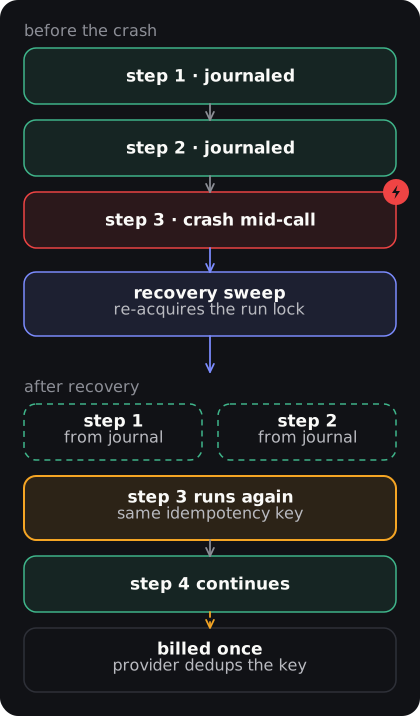
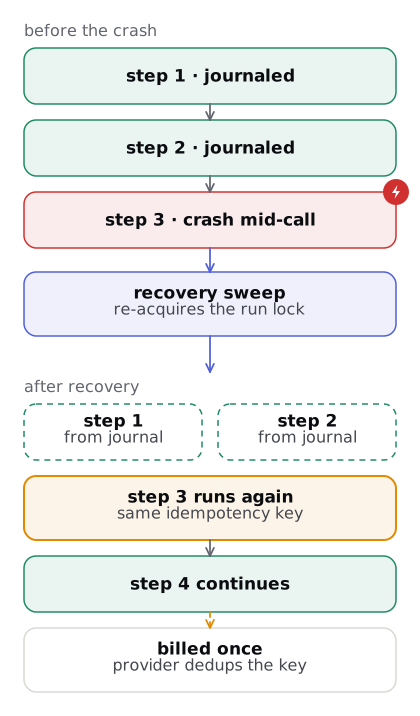
Crash and re-drive
- A run is mid-step: the LLM step has journaled
step_started. - The process dies (restart, deploy or crash) before
step_completedis written. The run row still saysrunning. - Every
LANTERN_RECOVERY_INTERVAL(default 30 s) the recovery sweep finds runs inrunning/queuedwhoserun_locksrow is absent or expired. acquireRecoveryLock: an UPSERT onrun_locksthat only steals an expired lock, so two replicas never re-drive the same run.redriveRunre-enters the executor (or the workflow interpreter) for that run.checkCachedLLMStep: astep_completedrow means reuse the stored output with no LLM call. Workflow nodes do the same viajournalCompletedStep.- The provider call is made only if not cached. If the crash came before
step_completed, the call is made again under the same idempotency key derivation, so the provider can dedup it. - Journal
step_completed. The run resumes from the first incomplete step; it does not restart.
Data plane (engine)
POST /v1/runs.RouteRun: a data plane is connected for this tenant, so the assignment goes down theRunStreamthat the agent opened outbound.ExecuteRun: the agent drives the run on the local workflow engine and streams its events back.- Replay check:
executeAttemptfirst looks for a cached result keyedstepID:attempt; a completed step is never re-dispatched. Complete { idempotency_key }:llm_callalways goes through the model router, capability-addressed, keyedrun_id:step_id:attempt.- The router maps the capability to a concrete vendor model and calls the provider.
- The completion returns;
model_used, tokens and cost map into the step result. journal.Append: the engine is the only thing that mutates run state; the journal write and status update share a transaction.StreamEventmessages stream back to the agent, which reports status to the control plane.
A tool call into a microVM
Section titled “A tool call into a microVM”The workflow engine never runs tools itself: it asks the runtime manager, which hands a JSON envelope to the harness inside the guest.
Succeeds
- Workflow engine to manager:
ExecToolwithtool_name,args(Struct),run_id,step_id,vm_id, timeout, idempotency keyrun_id:step_id:attempt,tenant_id. - Authz interceptor: service token required; any peer presenting a per-VM cert (
OU=lantern-vm) is refused. - The manager resolves the VM by
vm_id, or by scanning forrun_id. The owning tenant must match. - Manager to harness:
Exec __lantern_tool_call__. The envelope{ tool, args, idempotency_key, timeout_sec }goes inargv[0], with this incarnation’s Bearer exec token. On broker VMs the same gRPC rides host-initiated vsock. - The exec server intercepts the sentinel before its generic exec audit, so args are never logged, and calls
run_tool_call. - The tool runner acts, for example
read_fileunder/workspace:openat2withRESOLVE_BENEATHas the workload’s fsuid, so no..or symlink escape.shell_execruns/bin/sh -cas the workload uid. - Bytes return, at most 1 MiB; every captured output is capped and flagged truncated.
- The runner writes
{ ok: true, result }to stdout before the done frame. - The manager returns
TOOL_STATUS_OKplus the result to the engine. The status is typed, with no string matching. The manager audits tool name, duration and status, never args.
Tool fails. The runner returns { ok: false, error } (the tool ran and failed, or the name is unknown, for example read_file outside /workspace). The manager returns TOOL_STATUS_ERROR and the step fails with the manager’s detail.
No harness. If the VM is not Firecracker, or has no heartbeat yet, the manager returns TOOL_STATUS_UNAVAILABLE. Only Firecracker guests run the tool registry, and the guest address comes from its heartbeat. It is never a fabricated success; the engine fails the step wrapping ErrRuntimeManagerUnavailable.
Wrong tenant. A caller asks for a VM that belongs to another tenant. The mismatch is audited under lantern_audit as exec_tool DENIED, and the manager returns NOT_FOUND, indistinguishable from a VM that does not exist: no existence leak (ADR 0025).
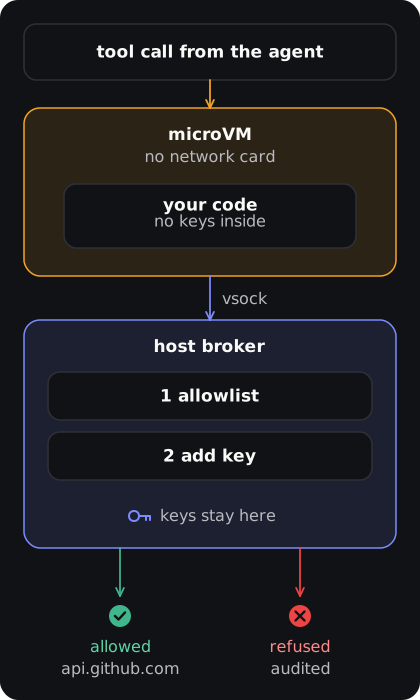
Egress in broker mode
Section titled “Egress in broker mode”The workload’s request leaves the VM over vsock; the host broker decides, dials, and adds the credential. The VM never holds it. See Egress.
Allowed, credential injected (example: api.github.com)
- The workload sends
CONNECT api.github.com:443usingHTTPS_PROXY=http://127.0.0.1:3128as usual. - The forwarder splices bytes over vsock
:3128. The VM has no network device; the forwarder connects to vsock CID 2 (the host), port 3128. - The broker reads the head (at most 64 KiB, 10 s). A slow or silent guest is dropped;
CONNECTgoes tohandle_connect, anything else tohandle_plain. Policy.evaluate: port inLANTERN_EGRESS_ALLOWED_PORTS(default 443), not a private/metadata IP literal, first matching rule.- The broker answers
200 Connection Established. This rule injects, so the broker terminates TLS with a leaf from the per-VM ephemeral CA. Nothing is dialled yet. - The workload sends its real request (
GET /user) inside TLS, with a placeholder or noAuthorizationheader. - Preflight: not
TRACEorCONNECT; the target and exactly oneHost:header must nameapi.github.com. - The broker resolves
lantern.secret/...through the secret relay on the host at request time, scoped to the VM’s tenant. The ref comes from the manager’s spawn record, not the guest. - The secret value is held for one header write, then dropped. Never logged, traced or audited.
- The broker dials upstream with TLS and the header injected: DNS checked against private ranges, upstream verified against native roots, same-named header replaced,
Connection: close. - Audit
egress_inject: header names only, logged locally first, then the report path. - The response is spliced back, rate-limited by the rule’s
rate_bps; idle connections close after 300 s.
Allowed, no injection (example: pypi.org). Same steps through Policy.evaluate. The rule has no inject list, so TLS is not terminated. The broker resolves once, refuses private/metadata answers, dials the checked address, and answers 200 Connection Established (audited as passthrough). Then it is an opaque TLS tunnel end to end between the workload and the upstream; the broker only splices bytes.
Not allowlisted (example: paste.example). Policy.evaluate returns the deny reason. The deny is always logged locally, and goes into the shared audit channel at a burst of 20, then 5 per second per VM. The workload gets 403 Forbidden, with X-Lantern-Reason carrying the static reason. Nothing was dialled.
Plain HTTP with a credential. A plain-HTTP proxy request goes to a host whose rule injects a credential (port 80 opened in the allowlist). handle_plain allows it by policy, but the broker returns 403 plain-HTTP injection refused: a credential would cross the network in cleartext. Only LANTERN_EGRESS_PLAIN_INJECT=1 allows it, and only to port 80.
Host mismatch. After 200 and TLS termination, the workload sends GET / with Host: evil.example inside an approved tunnel. The Host is not bound to the approved host, which is checked before any secret is resolved or anything dialled and audited as an egress_inject deny. The workload gets 403 Forbidden: the credential never rides a request addressed elsewhere.
Sandbox lifecycle
Section titled “Sandbox lifecycle”Schedule, idle-suspend with transparent resume, explicit pause and resume, and copy-on-write forks. See Sandbox lifecycle.
Schedule
POST /v1/runtime/schedule: an AgentSpec with image, isolation, limits, egress, secrets, and optionalidleTimeoutSecs.RuntimeScheduler.Schedule. Over the tenant’s quota, the control plane answers HTTP 402.- The scheduler places the VM (PENDING, then SPAWNING). Warm pool, region, fair share, cost and health pick the node.
Spawn { spec, handle }: the manager writesspawn.jsonto the read-only cert drive and boots the VM.- The harness sends a heartbeat every 5 s. PID 1 is up: RUNNING. Each beat carries
has_active_execandlast_activity_unix_ms. - The control plane returns
{ vm_id }. The sandbox is addressable byvm_idfrom here on.
Idle suspend and auto-resume
- The guest reports
has_active_exec = false: no workload or exec child alive; the tracker stamps when the last one exited. - The idle sweeper ticks every 10 s (leader only). Eligible: RUNNING,
idle_timeout_secs > 0, idle longer than the timeout. Snapshot { vm_id }, the same crash-safe path as an operator pause, markedscheduler:idle-pausing.Stop: the VM is gone from the node; its snapshot stays.- The VM becomes PAUSED and its slot is freed. Reason “auto-suspended (idle timeout)”. Snapshot storage is still kept.
- The client sends
POST .../vms/{id}/exec, not knowing or caring that the VM is suspended. ensureVMRunningcalls Resume becauseidle_timeout_secs > 0.FailedPreconditionmeans already running.Spawn { restore_snapshot_id }: quota reserved first (402 if over); samevm_id, restored from its snapshot.- The original exec proceeds; the control plane audits
auto_resume.
Pause and resume
POST .../vms/{id}/pause: manual pause. Exec on a manually paused VM returns 409, never auto-resumes.- The scheduler pauses under the per-VM lock; only a RUNNING VM can be paused.
Snapshot: the snapshot id is persisted beforeStop, then the VM is marked DRAINING (scheduler:pausing).Stop { reason: paused }. If Stop fails the VM goes back to RUNNING and keeps its slot.- PAUSED plus
snapshot_idreturns. Exactly one of the RPC or reconciliation releases the quota slot. - Later,
POST .../vms/{id}/resume. The scheduler runsTryReserveTenantVMs, then SPAWNING (scheduler:resuming). Spawnfrom snapshot, samevm_id. A failed spawn leaves the VM PAUSED and resumable again.- Re-identify: the restored guest takes a new incarnation’s cert and exec token, so the snapshot’s frozen credentials are refused.
Fork x N
POST .../vms/{id}/fork { count }: count is 1..LANTERN_MAX_FORK_COUNT(default 100, ceiling 1000).- The control plane forks with one identity per child. Each child gets its own agent identity; inheriting the source’s would let N sandboxes act as one.
- The scheduler reserves N slots, all-or-nothing, before any snapshot I/O.
Snapshot { keep_running }: a RUNNING source keeps running; a PAUSED source forks from its pause snapshot.Spawnx N with newvm_ids. Concurrency is bounded; a child that fails is reported and its slot released.- The manager hard-links the read-only mem file:
MAP_PRIVATEcopy-on-write via the host page cache. Lima nested-virt, indicative: fork spawns took 131, 145 and 160 ms. - The response is
forks [{ vmId, state }]; each child is RUNNING or FAILED with its error.
Sandbox states
Section titled “Sandbox states”| State | Meaning |
|---|---|
PENDING |
Scheduler accepted the request, awaiting placement. |
SPAWNING |
Node assigned, bootstrapping. Also the state a resume or fork child is in while the manager restores it. |
RUNNING |
The harness is reporting heartbeats. Holds one concurrent-VM quota slot. |
DRAINING |
Graceful shutdown initiated. A pause in progress is persisted here with the scheduler:pausing marker, so a crash never reloads it as PAUSED. |
PAUSED |
Snapshotted and stopped. Holds no quota slot; resumable. Snapshot storage is still kept. |
FAILED |
Spawn or health failure; the reason is in the StatusEvent. |
TERMINATED |
Resources released. |
Transitions:
- schedule: start to
PENDING. placed:PENDINGtoSPAWNING. - heartbeats:
SPAWNINGtoRUNNING. spawn fails:SPAWNINGtoFAILED. - pause, idle or delete:
RUNNINGtoDRAINING. - snapshot and stop ok:
DRAININGtoPAUSED. stop failed:DRAININGback toRUNNING. drained:DRAININGtoTERMINATED. - resume or auto-resume:
PAUSEDtoSPAWNING. restore fails:SPAWNINGback toPAUSED. - fork x N:
RUNNINGtoSPAWNING(children).