Security
Each hop between the caller, the control plane, the data-plane host and the microVM is a trust boundary with its own credential, and untrusted code sits behind all of them.
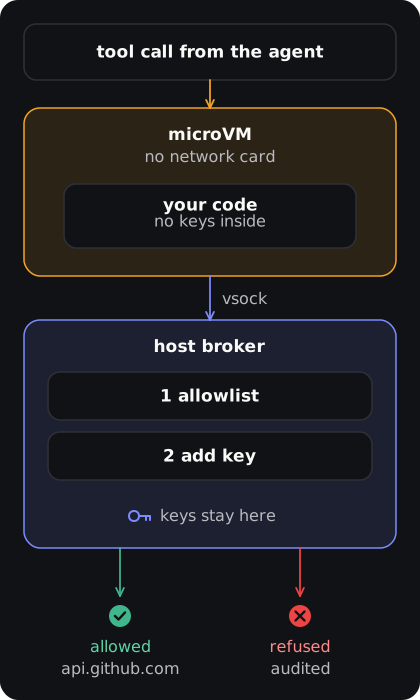
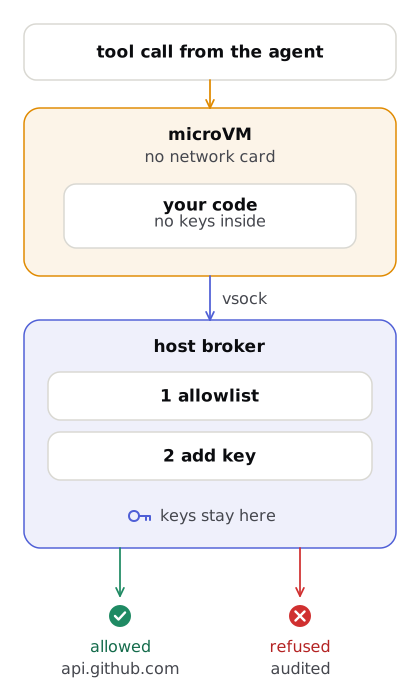
How a sandbox reaches the network, and why it never holds a credential in broker mode: Egress and credentials.
This page answers three questions.
- Can one customer’s agent see another customer’s data? No. Every record is fenced by tenant, enforced down to the database row.
- What happens if an agent runs malicious code? It runs inside a microVM, with egress limited to a per-sandbox allowlist: structurally in broker mode, where the VM has no network device, and in default mode when the image installs the iptables REDIRECT rule.
- Can you prove what an agent did? Yes. You can issue a signed receipt for any completed run; with an Ed25519 seed configured, anyone can verify it.
Everything below is labeled shipped or planned.
What is shipped today
Section titled “What is shipped today”- AES-256-GCM encryption at rest for connector credentials and LLM provider keys. Active only when
LANTERN_CREDENTIAL_KEYis set. When unset, these columns are stored as plaintext pass-through, so set the key in any real deployment. - HttpOnly session cookie. Dashboard auth uses an HttpOnly session cookie; the JWT is also kept in
localStoragefor client-side API calls. - Row-Level Security (RLS) policies on every tenant-scoped table (
USING+WITH CHECK), guarded by a catalog gate-test: a new tenant table without RLS (or an explicit exemption) fails CI. Enforcement is staged per environment viaLANTERN_RLS_ENFORCE=1; the handler cutover is complete andmake rls-validateproves the policies end to end against a live database. - Per-endpoint API-key scopes. Mutating endpoints are annotated with required scopes (
agents:write,runs:execute, and so on). Enforcement is flag-gated viaLANTERN_AUTHZ_ENFORCEand defaults to off; when off, missing scopes are logged, not rejected. Production enforces them (LANTERN_AUTHZ_ENFORCE=1in the Helm prod values): a key missing the endpoint’s scope gets 403. Dashboard/owner JWT sessions and unscoped legacy keys keep full access. - gRPC service-token auth on every internal gRPC port: control plane
:50051, workflow engine:50052, model router:50053, runtime manager:50054and runtime scheduler:50055. Constant-time check, runs before tenant extraction, fail-closed in production. - Runtime report binding. Step events and exit reports from a microVM are bound to that VM’s own run: a report carrying another run’s
run_idis rejected with 403, so a compromised harness cannot spoof another tenant’s audit or log stream. - Signed run receipts. Issued on request for a completed run (
POST /v1/runs/{id}/receipt). A SHA-256 of the run’s fulljournal_eventsstream is signed with Ed25519 whenLANTERN_RECEIPT_ED25519_SEEDis set (verifiable with no PAL account at/proofagainst the key at/.well-known/lantern-receipts), with an HMAC-SHA256 dev fallback otherwise (verifiable only by the deployment). - Fail-closed token gate. The gateway’s API-key introspection endpoint refuses (403) in production when
LANTERN_GRPC_SERVICE_TOKENis unset (dev allows it with a warning). Token comparisons are constant-time when set. - A2A tenant isolation.
GetAgentCard/InvokeAgentgate onis_publicOR caller tenant; private agents return 404 to cross-tenant callers. - Bridge retry and surface-gateway tenant resolution. The surface gateway resolves a real
LANTERN_TENANT_IDinstead of using platform IDs; unknown installs are rejected. - LLM idempotency keys on all provider calls, derived from
(run_id, step_id, attempt)and reused across same-provider retries. - Dependency vulnerability gate.
govulncheck,cargo-audit, andnpm auditrun on every CI build. - OTel traces with
tenant_id. Every control-plane HTTP request and gRPC call carries a span enriched withtenant_id,run_id, andstep_id.
Privacy levels (planned)
Section titled “Privacy levels (planned)”The following privacy levels are part of the architecture design and are not yet implemented. They are documented here for reference.
- Standard. The default level. Data is encrypted at rest and in transit. Logs include input/output for debugging. Suitable for most use cases.
- Strict (planned). Inputs and outputs are not logged. PII is automatically detected and redacted in traces. Audit log entries are created for all data access.
- Paranoid (planned). End-to-end encryption. Data is encrypted before leaving the client and decrypted only inside the microVM. The control plane never sees plaintext data. Designed for healthcare, finance, and legal use cases.
Privacy levels can be set per agent and per connector once the feature ships.
Runtime controls
Section titled “Runtime controls”These constraints are enforced by the platform, outside the model, so a prompt injection cannot talk its way past them.
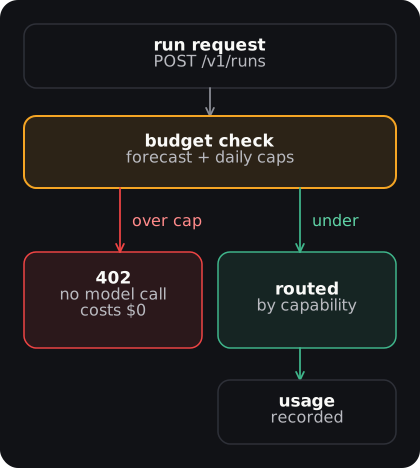
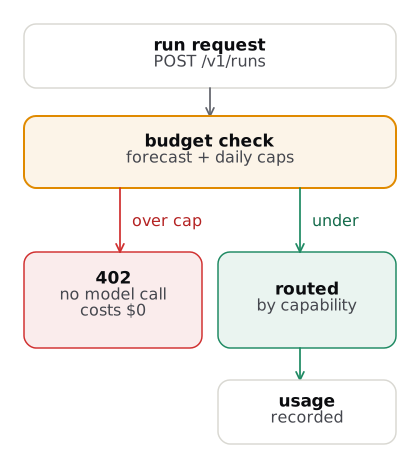
- Budgets. Per-agent caps on cost per day and runs per day, and a tenant-wide daily cost cap. A hard-fail budget returns HTTP 402 before the run starts. Tokens/day is enforced at the same gates. The per-run cap is enforced mid-run in workflows and reported after the fact elsewhere; per-tool limits apply to workflow tool and connector nodes. Hard-fail budgets fail closed (503 on run create) when the budget cannot be read.
- Egress allowlist. Declared per spawn. In broker mode anything not on the allowlist is denied structurally (there is no network device). In default mode the allowlist binds only when the VM host/image installs the iptables REDIRECT rule. See Egress and credentials.
- Human approval. Workflow approval nodes block on a takeover request until an operator grants it. Nested approvals inside child runs fail today rather than wait.
- Confidence gate. Low-confidence tool and connector steps divert to approval. Off by default (
LANTERN_CONFIDENCE_GATE).
PII redaction (planned)
Section titled “PII redaction (planned)”Automatic PII detection and redaction in agent inputs, outputs and traces is not implemented. Do not rely on it.
Data encryption
Section titled “Data encryption”At rest
Section titled “At rest”- Connector credentials and LLM provider API keys are AES-256-GCM encrypted at the application layer when
LANTERN_CREDENTIAL_KEYis configured; when it is unset they are stored unencrypted (plaintext pass-through). - Other Postgres columns use standard Postgres storage. Disk-level encryption is the responsibility of the host.
- S3/MinIO objects (agent bundles, snapshots): encryption is a bucket setting you configure on your storage. PAL does not set it.
In transit
Section titled “In transit”- All external traffic uses modern TLS. The gateway is built on rustls safe defaults (TLS 1.2 and 1.3).
- Internal gRPC traffic is authenticated with a pre-shared service token (
LANTERN_GRPC_SERVICE_TOKEN) validated via constant-time compare. AUnaryServiceAuthInterceptorruns before tenant extraction, fail-closed in production. mTLS is the planned stronger follow-up and is not yet implemented. - Default egress mode: in-VM secret vending uses kernel-attested peer auth (
SO_PEERCRED) on the Unix domain socket. Only the expected workload uid may receive secrets, and the harness refuses any other peer at the kernel level.
Bring your own key (BYOK) (planned)
Section titled “Bring your own key (BYOK) (planned)”Enterprise customers will be able to provide their own encryption keys via AWS KMS, Google Cloud KMS, or Azure Key Vault. This feature is on the roadmap and not yet available.
Audit logging (partial)
Section titled “Audit logging (partial)”Run-level events are recorded in journal_events (the run event journal). A full immutable audit log covering secret access, role changes, and dashboard actions is on the roadmap. The following are tracked today:
- Run start, completion, and failure (via
journal_events). - A2A agent card access (tenant-scoped; cross-tenant requests return 404).
SIEM export via webhook or S3 is planned but not yet available.
Isolation
Section titled “Isolation”Agent runs execute inside isolated sandboxes. The isolation class depends on the workload type. The default backend is Kubernetes (RUNTIME_BACKEND=k8s); Docker is available for local development (RUNTIME_BACKEND=docker). In production, the runtime manager supports gVisor (standard), Kata microVM (hostile), and Firecracker-backed Kata for the highest isolation tier.
Fail-closed: untrusted or hostile workloads are refused unless the appropriate RuntimeClass is configured, and are never silently downgraded to a bare pod.
All isolation tiers provide:
- Process isolation. Separate filesystem and network namespace per run; microVM classes add their own guest kernel.
- seccomp filtering. Syscall restriction is a property of the configured RuntimeClass (gVisor / Kata), not a PAL-shipped profile.
- Egress control. Default mode: an in-guest allowlist CONNECT proxy, fail-closed in production, which needs the iptables REDIRECT rule on the VM host/image (proxy env vars alone are advisory). Opt-in broker mode (
LANTERN_EGRESS_MODE=broker, Firecracker only): the VM has no network device and a host broker enforces the allowlist and injects credentials, so they never enter the VM. - Resource limits. CPU, memory, and disk are capped per run.
Secret management
Section titled “Secret management”Secrets (API keys, OAuth tokens, credentials) are referenced via the lantern.secret/... form and resolved at execution time by the runtime manager’s secret resolver (via the control-plane relay). Stored credentials are AES-256-GCM encrypted when LANTERN_CREDENTIAL_KEY is configured. Resolved values never appear in:
- Logs or traces
- Run state or step outputs
- Dashboard UI
- API responses