

Components
Halos ships six binaries from cmd/. Two more surfaces run inside one of them or next to it: the MCP server and the Claude Code plugin. Every claim on this page links to the code it comes from. Defaults are the values in the flag definitions.
| Component | Plane | Runs where | Listens on (default) |
|---|---|---|---|
halo |
Policy / release | Laptop, CI | None (the MCP server uses stdio) |
halod |
Client | Every managed machine, as root | None (outbound only) |
halo-proxy |
Traffic | Cluster or VM | :8088 traffic, 127.0.0.1:9090 admin |
halo-kong |
Traffic | Inside Kong | Kong’s own listeners |
halo-shadow |
Evidence | Cluster | 127.0.0.1:8090 |
halo-server |
Control / evidence | Cluster | 127.0.0.1:8080 |
| MCP server | Agents | Agent host | stdio |
| Claude Code plugin | Agents | Claude Code | n/a |
Purpose: the operator CLI. It validates policy, builds and publishes signed releases, moves ring pointers, drives experiments, rollouts and toggles, runs evals, and serves MCP.
- Inputs:
- a policy repo directory, loaded by
policy.Load - an ed25519 signing key (
--key) - an OCI registry
- ClickHouse, for
exp analyzeandmcp serve --clickhouse
- a policy repo directory, loaded by
- Outputs:
- release tarballs (
release build) - OCI artifacts and signed pointers (
release publish,cmd/halo/cmd_release.go:181-236) - git branches and pull requests
- JSON (
--output json)
- release tarballs (
- Key internal packages:
internal/policy: types, strict loader, validation and the default guardrails.internal/release: renders every harness for every OS into a content-addressed tar.internal/bundle: OCI push and pull, ed25519 and cosign signing, signed ring pointers.internal/harness/*: adapters for Claude Code, Codex, Gemini CLI, Copilot CLI, Cursor CLI and OpenCode.internal/promote,internal/rollout,internal/controller: verdicts, rollout state and PRs.internal/mcpserver:halo mcp serve.internal/eval,internal/stats: replay evals, scorecards and statistics.
- State and storage: the signer’s pointer state file,
$XDG_STATE_HOME/halos/pointers.json(~/.local/state/halos/pointers.jsonwhen unset) (internal/bundle/state.go:36-48). It refuses replayed or forked pointers on later writes. - Trust boundary:
haloholds the release private key.- Publishing refuses any primary signer that is not ed25519 (
internal/bundle/pointer.go:82-92). - A policy with validation errors is refused before any build (
cmd/halo/root.go:184-198).
- Config: flags only. See the CLI reference.
- Ports: none.
halo mcp servespeaks MCP over stdio (cmd/halo/mcp.go:35). - Tests:
- unit tests:
cmd/halo/*_test.go,internal/{policy,release,bundle,harness/...}/*_test.go - e2e:
TestPolicyReleaseDelivery,TestSimpleMode,TestRollout,TestRolloutSimpleModeCompletion,TestTogglesandTestObsEvidencePlaneintest/e2e - UAT:
TestK8sUAT
- unit tests:
Purpose: the fleet agent. It runs as root on each machine, pulls the ring’s signed release, verifies it, and applies it atomically to an allowlisted set of paths.
- Inputs:
halod.yaml(cmd/halod/config.go:17-56)- the OCI registry, read-only
- the ring endpoint
GET /api/v1/fleet/ring - the signed kill list
GET /api/v1/fleet/killswitch
- Outputs:
- harness config files under each adapter’s managed directories
- verified CLI installs
- one JSON status line per cycle on stdout, also POSTed to
reportURL(cmd/halod/agent.go:660-692)
- Key internal packages:
internal/bundle:PullRingverifies the pointer and the release.internal/release: manifest and blobs.internal/policy:ResolveVariantfor client-axis experiments.internal/gateway:KillSwitch, the same verifier the gateways use.internal/toggle: client toggle evaluation.internal/harness/all: managed paths come from the adapters.internal/fsutil: atomic writes.
- State and storage:
- Fixed root-owned layout per OS (
cmd/halod/paths.go:25-38). On Linux that is/etc/halos/halod.yaml,/var/lib/halos/state.json,/usr/local/lib/halos/{bin,npm}and shims in/usr/local/bin. state.jsonholds the applied digest, the files it owns, the last pointerseqand digest per ring and channel (anti-rollback), installed artifacts, and the last accepted kill list (cmd/halod/agent.go:74-91).
- Fixed root-owned layout per OS (
- Trust boundary:
- Trusts only releases signed by a configured ed25519 key that has not been revoked (
cmd/halod/keys.go:40-65). - Refuses to start if its own binary, its config or a parent directory could be modified by a non-root user (
cmd/halod/main.go:110-122). - Writes only inside the per-harness allowlist, with mode at most
0644, under root-owned and symlink-safe parent directories (cmd/halod/agent.go:537-547). - Authenticates to
halo-serverwith a device token (cmd/halod/agent.go:695-699).
- Trusts only releases signed by a configured ed25519 key that has not been revoked (
- Config:
registry,org,ringorringEndpointpubkey/pubkeys/revokedKeysinterval(default15m,cmd/halod/config.go:233-242)reportURL,deviceTokenFile,subject,maxBundleBytes,allowShellInstall(default false)killSwitch.{url,pubkey,interval}(interval default60s,cmd/halod/config.go:70-71)- Flags:
--config,--state,--install(default true),--log-level(cmd/halod/main.go:77-82).
- Ports: none. halod makes outbound calls only.
- Tests:
- unit tests:
cmd/halod/{agent,experiment,killswitch,toggles,npm,service,main}_test.go, plustrust_windows_test.goon Windows - e2e:
TestPolicyReleaseDelivery,TestClientAxisExperiment,TestPortalEnrollment,TestToggles - UAT:
TestCLIs(installs through the Dev Container Feature;test/uat/clis_env_test.go)
- unit tests:
halo-proxy
Section titled “halo-proxy”Purpose: the standalone gateway. It verifies the caller, decides ring, toggle and experiment per model alias, and routes to the provider with failover. It can also mirror requests to halo-shadow and export halo.gateway.* metrics. Every step is shown on the low-level design page.
- Inputs:
- model API calls (Anthropic Messages, Bedrock invoke, OpenAI Responses, Gemini)
- the compiled policy snapshot, hot-reloaded (
internal/gateway/snapshot.go:32-61) - the signed kill list
- the issuer’s JWKS
- Outputs:
- upstream requests carrying the gateway’s own credential
- streamed responses
x-halo-ring|release|experiment|variantheaders set on the upstream request- shadow jobs
- OTLP metrics to the collector’s gateway receiver
- Prometheus text on
/metrics
- Key internal packages:
internal/identity: JWT via OIDC, trusted proxy header, or none.internal/gateway:PrepareVerified,Decide,RouteOrder,Breaker,KillSwitch,BuildOutbound.internal/gateway/upstreamauth: SigV4, Vertex tokens and API keys.internal/shadow: the mirror queue.internal/telemetry/gwmetrics: the OTLP exporter.internal/bundle: kill-list key parsing.
- State and storage: none on disk. In memory it keeps the policy snapshot, the last accepted kill list, breaker state and per-target token caches.
- Trust boundary:
- Cohort comes only from the verified subject.
- Every client
x-halo-*header and the identity and groups headers are dropped (cmd/halo-proxy/proxy.go:324-329). - Client credentials are stripped unless
--forward-authis set (cmd/halo-proxy/proxy.go:340-348). - Provider credentials come only from the gateway host, never from the client (
cmd/halo-proxy/route.go:233-253). Vertex, Azure OpenAI, and OpenAI or Gemini upstreams with a policycredentialget the gateway’s credential. Bedrock is SigV4-signed. Anthropic and orchestrator upstreams get only the operator’supstreamHeaders(YAML,${ENV}-expanded), or the caller’s own credential with--forward-auth. - SigV4 signs only for AWS hosts or a
signHostsallowlist (cmd/halo-proxy/route.go:77-89).
- Config: precedence is defaults, then YAML (
--config, or envHALO_PROXY_CONFIG), thenHALO_PROXY_<FLAG>env vars, then flags (cmd/halo-proxy/config.go:118-213). Some keys are YAML only:signHosts,upstreamHosts,allowInsecureUpstreams,upstreamHeaders,route.*andshadow.maxBytes. The flags (cmd/halo-proxy/config.go:145-186), including:--policy--identity-mode jwt|trusted_header|none,--issuer,--audience,--allow-anonymous--killswitch-{url,token-file,pubkey-file,interval}(interval default 10s)--halo-shadow-{url,token}--telemetry-{otlp-endpoint,token-file,interval,unit-salt-file}--max-body-bytes(32 MiB)--upstream-header-timeout(10m)- Routing defaults: 3 attempts, breaker opens after 5 failures, 30 s cooldown (
cmd/halo-proxy/config.go:113).
- Ports:
:8088: model traffic only. Plain HTTP, so terminate TLS in front of it. No write timeout, so long SSE streams are not cut (cmd/halo-proxy/main.go:39-48).127.0.0.1:9090:/healthzand/metrics, unauthenticated (cmd/halo-proxy/proxy.go:168-185).
- Tests:
- unit tests:
cmd/halo-proxy/{proxy,route,bedrock,gemini,killswitch,telemetry,config}_test.go,internal/gateway/*_test.go,internal/gateway/upstreamauth/*_test.go - e2e:
TestGatewayTrafficPlane,TestRoutes,TestGeminiWire,TestToggles - UAT:
TestCLIs(real CLIs behind halo-proxy) andTestK8sUAT(Helm)
- unit tests:
halo-kong
Section titled “halo-kong”Purpose: the same gateway decision, packaged as a Kong Go plugin for the Access phase. It is a thin adapter over internal/gateway. Plugin version 0.1.0, priority 900 (cmd/halo-kong/main.go:64-67).
- Inputs: the request via the Kong PDK (headers capped at 1000, path, raw body, peer IP) (
cmd/halo-kong/main.go:314-320), the policy snapshot atpolicy_path, and the kill list. - Outputs:
- The service request is rewritten: headers, scheme, target, path and body.
- Or the request is answered with
kong.response.exitfor 401, 404, 413 or 400. - Shadow jobs.
- Key internal packages:
internal/gateway,internal/identity,internal/policy,internal/shadow, andinternal/bundle(key parsing). - State and storage: none. Snapshots are cached in memory per
policy_path(cmd/halo-kong/main.go:118-129). - Trust boundary: the same rules as halo-proxy.
- JWT mode answers 401 to unverified model calls unless
allow_unverifiedis set. - Trusted-header mode honours headers only from
trusted_proxy_cidrs. - Caller credentials are removed unless
forward_client_credentialsis set (cmd/halo-kong/main.go:1-35). - Multi-target routes (weights, failover) are halo-proxy only. Kong uses each route’s first target (
internal/policy/types.go:93-96).
- JWT mode answers 401 to unverified model calls unless
- Config: plugin JSON fields
policy_path,identity_mode,issuer,audience,trusted_proxy_cidrs,shadow_url/shadow_token, andkillswitch_url/killswitch_token/killswitch_pubkey. Secrets can be{vault://env/NAME}references (cmd/halo-kong/main.go:70-113). - Ports: none of its own. It runs as a Kong plugin server process (
cmd/halo-kong/main.go:376). - Tests:
- unit tests:
cmd/halo-kong/{access,killswitch,main}_test.go,internal/gateway/kong - UAT:
TestKongwith subtestsrouting,identity,experiments,limits,killswitch,latencyandkong, run inside real Kong OSS 3.9 (test/uat/kong/kong_test.go:327-637,make uat-kong)
- unit tests:
halo-shadow
Section titled “halo-shadow”Purpose: receives mirrored requests (first turns, or every step of a sampled session with turns: all), replays each against control and candidate, and stores the pairs for the LLM judge.
- Inputs:
POSTmirror jobs from halo-proxy or halo-kong, carrying a shared bearer token, and the compiled policy snapshot. - Outputs:
pairs.jsonl, mode0600, optionally AES-256-GCM encrypted (--pair-key-file), and counters. - Key internal packages:
internal/shadow(queue, workers, replay, budget) andinternal/gateway(snapshot). - State and storage:
--out pairs.jsonl--retention 720h(30 days)--budget-usdstops intake at the estimated spend
- Trust boundary:
- A job carries no URL or model. halo-shadow resolves both upstreams from its own policy, so the token only lets a caller spend, within the budget, on upstreams the policy already names.
- Credentials are per upstream (
--upstream-headers), and redirects are not followed (cmd/halo-shadow/main.go:1-9). HALO_SHADOW_TOKENis required (cmd/halo-shadow/main.go:79).
- Config: flags with
HALO_SHADOW_*env defaults (cmd/halo-shadow/main.go:56-69):--policy,--upstream-headers,--out,--pair-key-file,--retention--queue 64,--workers 4--price-in 3,--price-out 15
- Ports:
127.0.0.1:8090- optional
--metrics-listen, which serves/metricswithout the token
- Tests:
- unit tests:
cmd/halo-shadow/main_test.go,internal/shadow/*_test.go - e2e:
TestGatewayTrafficPlane(mirror path)
- unit tests:
halo-server
Section titled “halo-server”Purpose: the control plane. It serves the console and the API, enrollment, the fleet ring and report endpoints, and the signed kill list. With --controller it also runs the automated experiment and rollout loop.
- Inputs:
- the served policy directory, reloaded on
SIGHUP(cmd/halo-server/main.go:244-256) - OIDC logins
- halod reports
- ClickHouse evidence, when
--controlleris set
- the served policy directory, reloaded on
- Outputs:
- JSON API (routes in
internal/server/server.go:166-218) - signed kill lists
- policy PRs, from the portal writer and the controller
- Slack and webhook notifications
halo_controller_*metrics
- JSON API (routes in
- Key internal packages:
internal/server: HTTP handlers, OIDC sessions, devices, audit and portal.internal/controller: the loop, the kill store and the state log.internal/promote: verdicts, ClickHouse source and PRs.internal/rollout: rollout evaluation and hash-chained state.web: the console, embedded with-tags=webdist.- Operator pages (read role): Fleet (per-ring compliance, a drift count per device and an “in sync” filter; the device page lists the drifted settings from halod’s last report), Releases, Rollouts (
#/rollouts[/name]: step timeline with the live step, per-gate status, bake countdown, halt and rollback events, and the ring-to-release pointers; the controller state is shown only whenhalo-server --controllerkeeps it in the data dir) and Cost & budgets (#/budgets, see cost budgets).
- Operator pages (read role): Fleet (per-ring compliance, a drift count per device and an “in sync” filter; the device page lists the drifted settings from halod’s last report), Releases, Rollouts (
- State and storage: files under
--data-dir:reports.jsonldevices.jsonlaudit.jsonlrequests.jsonlsession-revocations.jsonlkillswitch.jsonl, append-only and fsynced (internal/controller/killstore.go:112-149)controller-state.jsonlrollouts/<name>.json, hash-chained (internal/rollout/state.go:154-186)- Without
--data-dir, reports are kept in memory only. Neither the kill switch nor the controller can run without it (cmd/halo-server/main.go:116-135).
- Trust boundary:
- Console users: OIDC login with state and nonce checks (
internal/server/auth.go:322-400). - Devices: per-device tokens minted at enrollment and stored hashed (
internal/server/devices.go:110-139), or the shared fleet token for MDM and devcontainer fleets (internal/server/server.go:296-300). - Gateways: the gateway token, compared in constant time (
internal/server/killswitch.go:130-148). - Failed attempts are rate limited per IP.
- halo-server holds the kill-list private key and never the release key.
- Console users: OIDC login with state and nonce checks (
- Config: flags (
cmd/halo-server/main.go:59-135):--policy-dir,--token-file,--data-dir--portal-config--killswitch-key-filetogether with--gateway-token-file(or--gateway-killswitch-token-file); optional per-capability--gateway-{killswitch,posture,budget,directory}-token-file--controller,--interval(5m, minimum 1m)--clickhouse-*--notify-*--policy-repo-*--device-ttl,--trusted-proxy-cidrs--dev-insecure-user(demo only)
- Ports:
127.0.0.1:8080- optional
--metrics-listenfor controller/metrics
- Tests:
- unit tests:
cmd/halo-server/main_test.go,internal/server/*_test.go,internal/controller/*_test.go - e2e:
TestPortalEnrollment,TestClientAxisExperiment,TestRollout,TestToggles - UAT:
TestK8sUAT
- unit tests:
Controller
Section titled “Controller”This is the same loop as halo controller run. Every --interval it evaluates each running experiment and active rollout against ClickHouse. When the evidence says rollback, it trips the kill switch, but only on gateway-sourced evidence. It then opens a PR and notifies. It never merges. See the controller loop.
Console
Section titled “Console”web/ is a React, Vite and TypeScript SPA (tech stack), served by halo-server at / (internal/server/server.go:218). Admin routes are wrapped in s.admin(...) and developer routes in s.user(...).
MCP server
Section titled “MCP server”Purpose: lets coding agents read and propose Halos changes. It is halo mcp serve, not a separate binary.
- Inputs:
--policy-dir, and optionally--clickhouse, which enablesanalyze_experiment(cmd/halo/mcp.go:38-43). - Outputs: tool results,
halos://resources and prompts. With--allow-writes, it can also create local git branches. - Tools:
- Read:
validate,plan,render_preview,whoami,list_rings,list_experiments,show_experiment,harness_matrix,explain_release_diff,eval_scorecard(internal/mcpserver/tools_read.go:103-117), pluslist_rollouts,rollout_status,list_toggles,evaluate_toggle,eval_matrix,upgrade_candidates. - Write, only with
--allow-writes:start_experiment,pause_experiment,conclude_experiment,propose_promotion,propose_rollback(internal/mcpserver/tools_write.go:56-72),propose_toggle_change,propose_rollout_advance,propose_rollout_rollback. Each defaults todry_runand requires areason. None of them pushes or merges.
- Read:
- Key internal packages:
internal/mcpserver,internal/policy,internal/release,internal/promote,internal/rollout,internal/toggle,internal/eval,internal/upgrade. - State: none. Ports: none (stdio).
- Tests: unit tests in
internal/mcpserver/*_test.go; e2eTestMCPServe.
Claude Code plugin
Section titled “Claude Code plugin”Purpose: packages the MCP server and Halos workflows for Claude Code.
plugins/claude-code contains:
.mcp.json, which runshalo mcp serve --policy-dir ${HALOS_POLICY_DIR:-.}without--allow-writes.- Skills:
halos-author-policy,halos-autopilot,halos-onboard,halos-rollout,halos-triage. - Commands:
/halos:halo-onboard,/halos:halo-autopilot,/halos:halo-rollout,/halos:halo-status. - Agent:
halos-release-manager, which proposes but never publishes, retags, merges or pushes. - No hooks.
The plugin has no code of its own, so it has no tests. TestMCPServe covers the server it starts.
Package dependency map
Section titled “Package dependency map”Every package under cmd/ and internal/, with its direct, non-test imports of other Halos packages. The graph is built from go list across GOOS=linux, darwin and windows. Rows and columns are in dependency order: a dot in row r, column c means r imports c. Because Go forbids import cycles, every dot falls below the diagonal.
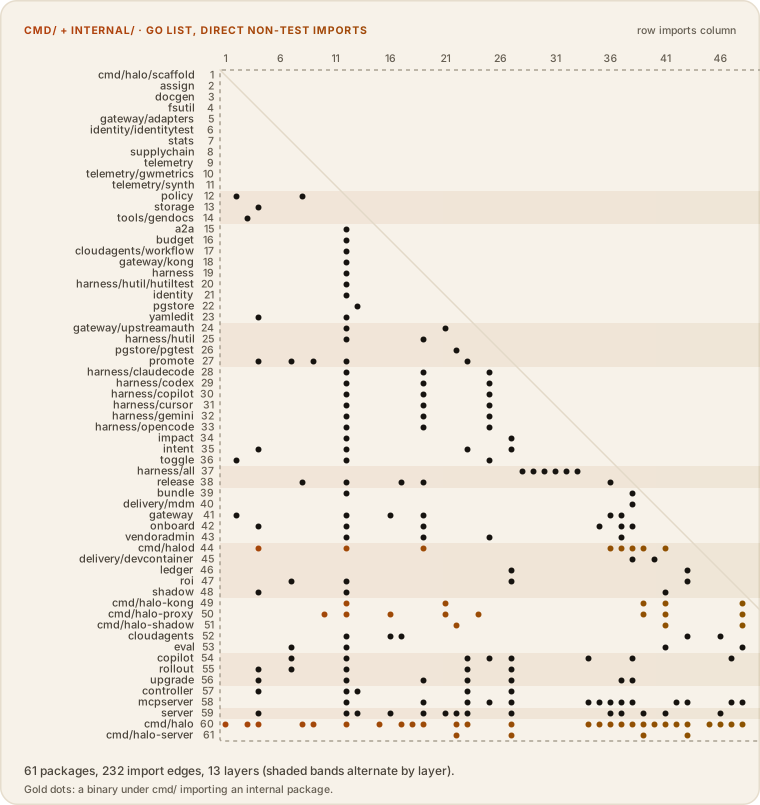
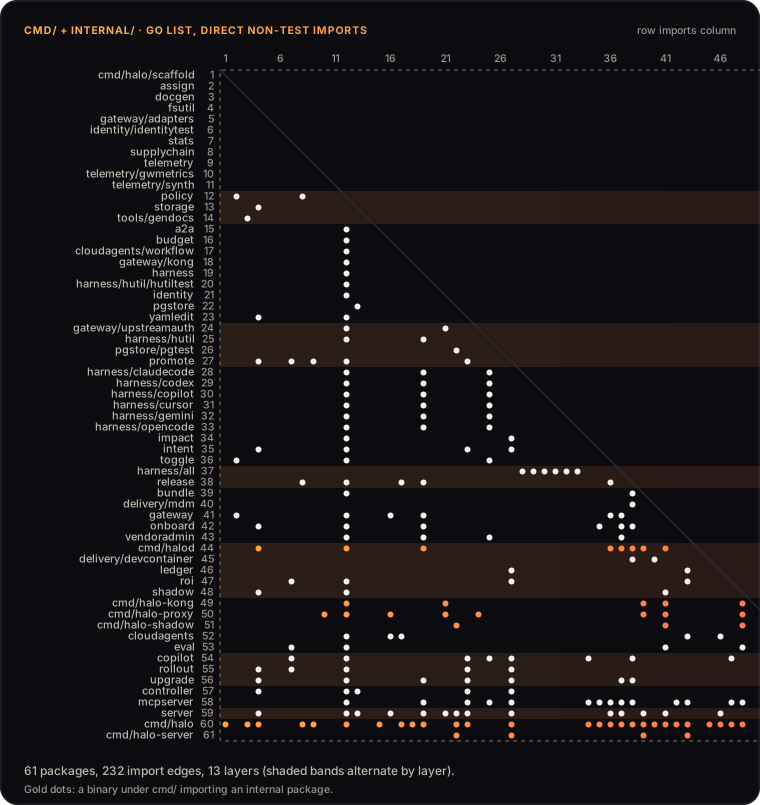
The data is in assets/src/pkgdeps.json. TestPackageGraph fails when that file no longer matches go list. To regenerate it and the diagram:
go test ./internal/docgen -run TestPackageGraph -updatepython3 assets/src/build.py