

Evidence plane
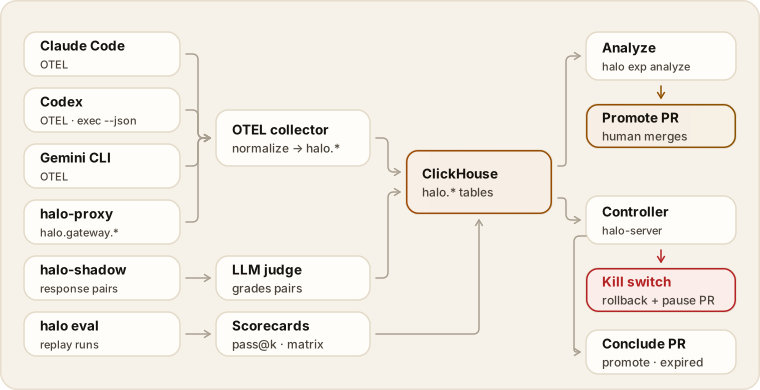
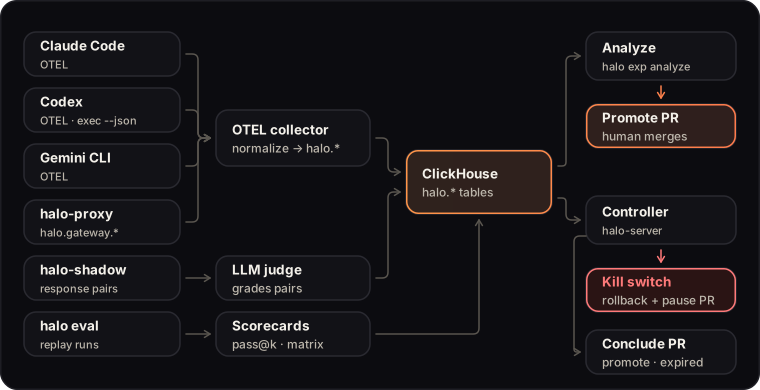
The evidence plane decides whether a change is safe. It has four parts, plus a consumer that acts on them: the controller.
1. Telemetry normalization
Section titled “1. Telemetry normalization”Harness-native metrics are mapped to one halo.* schema so an experiment can compare across harnesses. Ring, release and experiment identifiers ride along as resource attributes (OTEL_RESOURCE_ATTRIBUTES for Claude Code). See metrics reference.
The normalized table is halo.halo_metrics in ClickHouse, filled by materialized views over the collector’s raw otel_* tables:
| Source | Lands as |
|---|---|
| CLI metrics (sums, gauges, histograms) | halo.* rows, for example halo.cost.usd, halo.tokens, halo.edit.decision |
CLI log events (claude_code.api_request, gemini_cli.api_response, codex.api_request, tool results) |
One row per call: halo.api.request and halo.tool.call, value = duration in ms, attrs['error'] = 1 on failure. Prompts, tool input and error text are never kept |
halo-proxy per-request OTLP (--telemetry-otlp-endpoint) |
halo.gateway.requests (count by status_class) and halo.gateway.latency_ms (histogram). The gateway assigns ring and variant itself, so this is the best-attributed source and the only online one for traffic-axis experiments. Sent to the collector’s authenticated gateway receiver (telemetry.tokenFile / --telemetry-token-file). The unit is halo.unit, a salted hash of the verified subject; requests without one are counted but are not experiment units. Client session ids never define units, and no prompts, headers, session or user ids are exported |
Derived per-unit metrics
Section titled “Derived per-unit metrics”Experiments name registry metrics such as halo.cost.usd_per_session; ClickHouse holds the raw rows. halo exp analyze and the controller compute one value per unit (per user for CLI data, per hashed verified user for gateway data) and compare the two arms’ samples:
| Registry metric | Per-unit value |
|---|---|
halo.cost.usd_per_session |
The unit’s halo.cost.usd divided by its distinct sessions |
halo.tokens.per_session |
The unit’s input+output halo.tokens divided by its distinct sessions |
halo.edit.accept_rate |
Accepted / total halo.edit.decision |
halo.api.error_rate |
Gateway: non-2xx / all halo.gateway.requests. CLI fallback: failed / all halo.api.request |
halo.latency.p50_ms, halo.latency.p95_ms |
Gateway: quantile interpolated from halo.gateway.latency_ms buckets, 2xx only. CLI fallback: exact quantile of successful halo.api.request durations |
halo.tool.error_rate |
Failed / total halo.tool.call |
Sources are tried in that order and never mixed in one analysis, because their units differ. Gateway rows count only if the collector stamped attrs['halo.source'] = 'gateway' on them (see evidence trust); the source that decided a verdict is reported as source in halo exp analyze --output json and per guardrail. Metrics not listed there (and not eval-only) are read as the unit’s mean of the raw metric. halo.session.duration_s has no online source yet, and halo.task.success is offline-eval only. Source of truth: internal/policy/metrics.go and internal/promote/source.go.
Evidence trust
Section titled “Evidence trust”Developer machines must reach the collector, so the CLI receiver is effectively open: anyone can post metrics carrying any halo.experiment / halo.variant. The generated collector config therefore splits receivers:
| Receiver | Port | Auth | Collector action |
|---|---|---|---|
otlp (CLIs) |
4317 gRPC, 4318 HTTP | none by default; per-device bearer tokens with --cli-token-file (one per line, re-read on change; recommended) |
drops every halo.gateway.* metric, overwrites halo.source=cli, caps requests at 4 MiB |
otlp/gateway (halo-proxy) |
4319 HTTP (--gateway-endpoint changes the listen address) |
bearer token from HALO_OTLP_GATEWAY_TOKEN (the collector refuses to start without it) |
stamps halo.source=gateway |
halo.source is stamped on every data point by the receiver it arrived on; a client-supplied value is overwritten, never kept. --cli-token-file takes a path as the collector sees it (mount the file into the collector pod) and gives each device its own token, so one leaked token can be removed without touching the rest. Even with tokens the CLI plane is client-controlled: a token holder can still send forged CLI metrics, which is why only the gateway plane may kill.
The controller trips the kill switch only when the deciding evidence is gateway-sourced. A rollback decided by CLI telemetry (or by a source that can’t say where its data came from) still opens the pause PR and notifies, and a human decides. Promote and expiry never act without a merged PR. Known limits: maxSpendUSD reads CLI-reported halo.cost.usd, so forged cost can make an experiment expired early (a conclude PR, never a kill); and rows written before this split have no halo.source, so their gateway rows stop counting. There is no per-experiment opt-in to trust CLI telemetry for kills.
2. Replay evals
Section titled “2. Replay evals”halo eval run <suite.yaml> runs each task in a Docker container with a headless driver and scores the outcome by a shell check. It is the only way to compare whole agent tasks, because tool calls really execute in the sandbox. Trials run with no network egress by default (--network none).
| Harness | Driver |
|---|---|
| Claude Code | claude -p --restricted --output-format stream-json --max-budget-usd |
| Codex | codex exec --json (JSONL events) |
| Gemini CLI | gemini -p |
Guide: writing evals.
3. Statistics
Section titled “3. Statistics”halo exp analyze uses mSPRT for always-valid sequential testing and bootstrap confidence intervals. Guardrails abort on maxRegression. Hard ceilings: maxDays, maxSpendUSD.
4. Gated promotion
Section titled “4. Gated promotion”halo exp promote requires a promote verdict and opens a PR that moves the ring pointer in policy YAML. A human merges; a human or CI then runs halo release promote. Auto-rollback is allowed; auto-promote never.
Scorecard
Section titled “Scorecard”A scorecard is the output of halo eval run (text, or --output json): per-task, per-variant pass rate, cost, latency and turns, with bootstrap confidence intervals against the control variant. The MCP tool eval_scorecard reads the JSON form.
5. The controller
Section titled “5. The controller”The controller is a ClickHouse consumer: on a timer it runs the same evaluation as halo exp analyze for every running experiment and acts on the verdict (kill switch and pause PR on rollback, conclude PR on promote or expiry). It reads halo_metrics over ClickHouse’s HTTP interface with server-side bound parameters. Auto-rollback is allowed; auto-promote and auto-merge never. The kill switch is tripped only on gateway-sourced evidence (evidence trust).
Running the pipeline
Section titled “Running the pipeline”halo telemetry collector-config --clickhouse tcp://clickhouse:9000 -o otel-collector.yaml# collector env: HALO_OTLP_GATEWAY_TOKEN=<secret>; halo-proxy: --telemetry-otlp-endpoint http://collector:4319 --telemetry-token-file <file with the same secret>
# optional: require a per-device bearer token on the CLI receiver (one token per line)halo telemetry collector-config --clickhouse tcp://clickhouse:9000 --cli-token-file /etc/otelcol/cli-tokens -o otel-collector.yamlSet the same --telemetry-unit-salt-file on every halo-proxy replica so one user stays one halo.unit; without it each process picks a random salt and units split across restarts.
The stack in deploy/observability/ (otel-collector-contrib, ClickHouse, Grafana) uses the schema in deploy/observability/clickhouse/schema.sql and the dashboard in deploy/observability/grafana/dashboard.json.
OpenTelemetry GenAI semantic conventions
Section titled “OpenTelemetry GenAI semantic conventions”halo-proxy also exports the OpenTelemetry GenAI conventions next to halo.gateway.*, for teams that standardise on them. They never replace the halo.* series: those stay the stable API the controller reads. Implemented against semantic-conventions v1.40.0. Every GenAI convention is still Development stability upstream, so attribute names can change. Upstream has since moved the spec to open-telemetry/semantic-conventions-genai and reworked the token instruments (gen_ai.client.inference.*); Halos keeps the v1.40 names until that settles.
| Signal | Type | Notes |
|---|---|---|
gen_ai.client.token.usage |
histogram, {token} |
gen_ai.token.type is input or output; recorded only when the provider reported usage |
gen_ai.client.operation.duration |
histogram, s |
error.type is the HTTP status for responses of 400 and above |
gen_ai.server.time_to_first_token |
histogram, s |
streams only; request receipt to the first body byte, a close proxy for the first token |
span {operation} {model} (e.g. chat claude-sonnet-5-5) |
client span | opt-in; joins the caller’s W3C traceparent when one is sent |
Every signal carries gen_ai.operation.name (chat, or generate_content on the Gemini wire), gen_ai.provider.name (anthropic, openai, aws.bedrock, gcp.vertex_ai, gcp.gemini, azure.ai.openai), gen_ai.request.model (the real model the policy routed to), gen_ai.response.model (when the response names one) and the cohort (halo.ring, halo.release, halo.experiment, halo.variant, halo.harness). Spans add gen_ai.usage.*_tokens, http.response.status_code and halo.unit, the same salted hash as the halo.gateway.* series. Token counts are read from the response as it streams (OpenAI chat and Responses, Anthropic, Gemini), without buffering or delaying it. Bedrock event streams and compressed bodies report duration only.
telemetry: genai: metrics: true # default; false drops gen_ai.* and the response-body scan traces: false # default; true sends one span per model call to <otlpEndpoint>/v1/traces (OTLP/JSON)Flags: --telemetry-genai-metrics=false and --telemetry-genai-traces (env HALO_PROXY_TELEMETRY_GENAI_METRICS / _TRACES). halo telemetry collector-config adds a traces/gateway pipeline on the authenticated gateway receiver that stamps halo.source=gateway and exports to ClickHouse. The metrics reach the exporter’s raw histogram table; the halo_metrics projection keeps halo.* names only. Add an exporter to these pipelines to forward them to your own backend.
Data handling. Prompts, completions, headers and raw user or session ids are never exported, and there is no content-capture option: the spec’s opt-in content attributes (gen_ai.input.messages and friends) are deliberately not implemented. Exporting content would be a data-handling decision for your security team, not a flag, and needs its own review.
What is proven
Section titled “What is proven”make obs-e2e (needs Docker and network) brings up that stack and runs test/e2e/obs_test.go with synthetic harness telemetry (internal/telemetry/synth, shaped like Claude Code, Codex and Gemini CLI output) plus gateway metrics sent by halo-proxy’s real OTLP emitter (internal/telemetry/gwmetrics). It asserts, end to end:
- rows land in
halo_metrics, no un-normalizedclaude_code.*rows reach ClickHouse, and the harness, ring, release, experiment and variant columns are populated; - CLI log events become
halo.api.requestandhalo.tool.callrows that carry only the allowed attributes (no prompt or error text), and gateway request and histogram counts match what was sent; halo exp analyzereturnsrollbackon the guardrail that was regressed on purpose: cost per session (+30%), API error rate (3% to 15%), p95 latency from CLI events (+40%), and p95 latency visible only in gateway data, which proves the gateway source takes precedence; an experiment with identical arms returnscontinue;- evidence trust:
halo.gateway.*metrics forged on the CLI receiver never land, the gateway receiver rejects a missing or wrong token with 401, CLI-decided rollbacks reportsource: cli(so the controller won’t auto-kill on them) and the gateway-decided one reportssource: gateway; - the verdicts file records them, and every panel query of the provisioned Grafana dashboard runs and returns data.
UNVERIFIED: real harness telemetry from real CLIs into a real collector at scale, and the controller acting on ClickHouse in the same stack (the controller and its kill switch are unit-tested; make obs-e2e stops at verdicts).