

Gateway headers
Headers owned by the gateway (from internal/gateway/decision.go):
| Header | Value | Set by |
|---|---|---|
x-halo-ring |
Ring name, or unknown if there is no verified identity or no ring matched |
halo-proxy / halo-kong |
x-halo-release |
Release digest of the ring, if the ring’s release is set |
halo-proxy / halo-kong |
x-halo-experiment |
Active A/B or canary experiment the request is in, if any. Never set for a killed experiment | halo-proxy / halo-kong |
x-halo-variant |
Variant name within that experiment. Never set for a killed experiment | halo-proxy / halo-kong |
x-halo-actor |
The verified agent chain of a delegated credential, root side first (planner>reviewer). Absent for every other caller |
halo-proxy / halo-kong |
x-halo-actor-depth |
Length of that chain | halo-proxy / halo-kong |
x-halo-killswitch |
The literal misconfigured, set only when halo-kong’s kill-switch config is invalid (bad key, missing token, cleartext URL without killswitch_allow_insecure_in_cluster). While present, kills are not being enforced by that plugin; alert on it. Traffic is not blocked |
halo-kong |
x-halo-gate |
Warn-mode and unknown gate outcomes, comma-separated (version=warn,posture=unknown). Absent when every gate passed |
halo-kong |
- Everything under
x-halo-is owned by the gateway. Every client-suppliedx-halo-*header is discarded before anything is computed. Every name in the table above is cleared by name on every request, so a client copy is removed even if the host’s header list did not include it;halo-konganswers 431 when Kong’s header list reaches its 1000-line cap rather than derive identity from a possibly truncated list. - The cohort is derived from the identity the gateway verified: the caller’s OIDC JWT (issuer, audience, expiry), or, in
trusted_headermode, headers set by a proxy whose address is intrustedProxyCIDRs. It is never taken from a client-provided value. No verified identity means 401, or, withallowAnonymous/allow_unverified, ringunknown, default routing and no experiments. - The configured identity and groups headers are removed from the forwarded request once the subject is derived. In
trusted_headermode a request carrying either header twice is a 400. The identity header may not be anx-halo-*name. - Upstream services (auth gateway, orchestrator) may trust
x-halo-*only if they are unreachable except through the gateway.
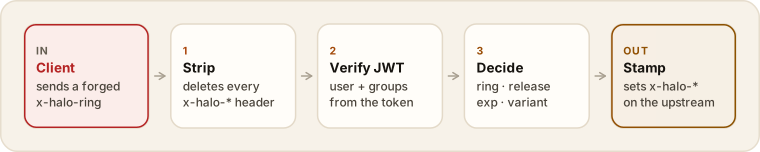
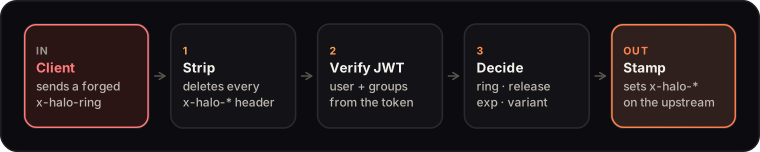
The stamps go on the upstream request. They are not added to the response the client receives.
Killed experiments
Section titled “Killed experiments”When an experiment is on the gateway’s kill list, the gateway treats it as not running: the request gets control routing, is not mirrored, and carries no x-halo-experiment or x-halo-variant header. The ring and release stamps are unaffected. Downstream analysis that groups by these headers therefore sees killed traffic as un-experimented, which is the point: nothing is attributed to a treatment that is switched off. The effect lasts until the experiment is unkilled, not until the gateway’s next policy snapshot.
Errors
Section titled “Errors”Rejections are rendered in the caller’s wire format so the CLI prints the reason: 400 (invalid_request_error) for a model that is not a policy alias or for the batches API, 404 for an unknown model endpoint, 413 for an oversize or unreadable body, 431 when halo-kong sees 1000 or more header lines, 401 for a failed JWT (unless allowAnonymous), 503 while the policy is not loaded or when trusted_header has no CIDR pin.
Shadow authentication
Section titled “Shadow authentication”The gateway posts jobs to halo-shadow with X-Halo-Shadow-Token so only the gateway can enqueue mirrors. A job names only an experiment and variant; halo-shadow resolves the upstreams from its own policy copy and replays with its own credentials. Client credentials are never forwarded.
Client-side headers
Section titled “Client-side headers”For Claude Code, ANTHROPIC_CUSTOM_HEADERS can carry release stamping from the client, but these are informational: the gateway ignores and overwrites x-halo-*. Codex provider config supports http_headers. Gemini CLI and Copilot CLI cannot set custom request headers through managed settings. Claude Code also sends x-claude-code-session-id, which the shadow sampler uses to keep a whole session in or out of a mirror.
Try it
Section titled “Try it”Run the quickstart and send a forged header:
TOK=$(curl -s 'localhost:8081/token?user=alice@acme.com&groups=ai-platform')curl -s localhost:8080/v1/messages -H "Authorization: Bearer $TOK" -H 'x-halo-ring: ring3-ga' \ -H 'content-type: application/json' -H 'anthropic-version: 2023-06-01' -H 'x-claude-code-session-id: s1' \ -d '{"model":"sonnet","max_tokens":5,"messages":[{"role":"user","content":"hi"}]}'The demo upstream echoes the headers it received: x-halo-ring:ring0-harness-team, not ring3-ga.