

Feature toggles
A Toggle is a named switch with ordered targeting rules. It turns one capability on for a cohort (an MCP server, a hook, an env var, a model route) and can be killed everywhere within one poll interval (about 10 s at gateways, 60 s on devices by default) without cutting a release.
How a toggle decides
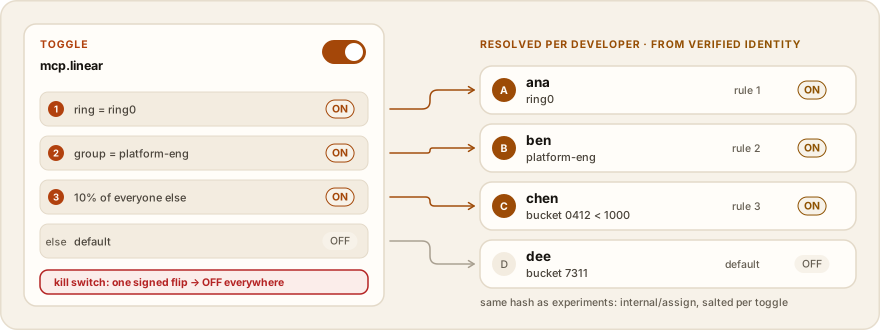
Section titled “How a toggle decides”- Rules run in order; the first match decides. A rule matches when every condition it sets holds:
rings,groupsanduserseach match if the subject is in any listed value, andpercentkeeps that share of the matching subjects. A rule with no conditions matches everyone. effectison(the default) oroff. When no rule matches,defaultapplies.- Percent rollouts hash through
internal/assignwith the salthalos/toggles/<name>. A toggle’s cohort is therefore independent of the ring and of every experiment. A caller with no subject id never lands in a percent rollout. - Identity, not headers. The subject is the authenticated user, their IdP groups and the ring they resolve to.
Two axes
Section titled “Two axes”| Axis | Payload | Applied by |
|---|---|---|
client |
Per-harness fragment: mcpServers, hooks, env, overrides |
halod, from fragments inside the signed release |
traffic |
routes: model alias to route |
halo-proxy / halo-kong. An experiment’s variant route still wins |
Client fragments go through the same adapter and guardrails as a profile. The build fails on a forbidden value (bypassPermissions, danger-full-access, literal secrets, reserved env prefixes), and an unsupported field becomes a manifest warning. The release’s own files are the toggle-off state; the fragments are deltas recorded in the signed manifest, so neither rules nor fragments can change in transit.
Example
Section titled “Example”apiVersion: halos.dev/v1kind: Togglename: github-mcpdescription: GitHub MCP server (issues, PRs) for a slice of the canary ringowner: ai-platform # requiredexpires: "2026-12-31" # past it, validate warns; `halo toggle stale` lists itdefault: falseaxis: clientrules: - name: ring1-ten-percent rings: [ring1-canary] percent: 10client: harnesses: claude-code: mcpServers: - name: github url: https://api.githubcopilot.com/mcp/ headers: Authorization: Bearer ${GITHUB_MCP_TOKEN}See what a user gets, and why
Section titled “See what a user gets, and why”$ halo toggle eval --user ana@acme.dev --groups acme-platform-eng --policy-dir examples/acme-corpuser ana@acme.dev ring ring3-ga groups [acme-platform-eng]on format-hook rule platform-eng matched (on) rule platform-eng: group ok ([acme-platform-eng] vs [acme-platform-eng])off github-mcp no rule matched; default off rule ring1-ten-percent: ring no ("ring3-ga" in [ring1-canary]), percent no (bucket 2056 < 1000 of 10000)off sonnet-next-route no rule matched; default off rule harness-team: ring no ("ring3-ga" in [ring0-harness-team])The ring is resolved the same way the gateway and the portal resolve it. --ring overrides it; --killed a,b previews a kill.
The kill path
Section titled “The kill path”$ export HALO_SESSION=... # admin halo_session cookie; never a flag$ halo toggle kill github-mcp --server https://halos.acme.example --reason "MCP 5xx storm"halo-serverappendstoggle:github-mcpto its kill store, with an audit entry, and re-signs the kill list with the kill-list ed25519 key (not the release key).- Traffic toggles: each gateway polls the signed list and verifies signature, freshness and replay order. A killed toggle drops out of routing on the next poll.
- Client toggles:
halodpolls/api/v1/fleet/killswitchwith its device token (killSwitch.interval, default 60s). A killed toggle is off whatever its rules say, and its files revert to the release’s toggle-off content.
No release, no ring move, no PR. --unkill clears it. The kill call requires https, or http to a loopback host, because it carries a session cookie.
In the console
Section titled “In the console”Admins get a Toggles page in the operator console: a searchable list with axis and status filters (on by default, killed, stale), and a detail drawer per toggle. The drawer shows the rules as sentences, what the toggle delivers (names only; header and env values are never sent to the browser), who killed it and why, the history from the audit log, and a Who gets it? tester that runs the same evaluator as halo toggle eval.
- Kill / Restore asks for a reason and takes effect at the next poll, exactly like
halo toggle kill. - Propose change opens a validated policy PR: default, a rule’s percent (
0matches nobody), rings, groups or users to add or remove, expiry. Nothing changes until a human merges it.
Commands
Section titled “Commands”| Command | Does |
|---|---|
halo toggle list |
Name, axis, owner, default, rule count, expiry; flags stale ones |
halo toggle eval --user U [--groups G] [--ring R] [--killed T] |
Per-toggle decision with the full rule trace |
halo toggle kill NAME --reason "..." [--unkill] |
Trip or clear the fleet-wide kill through halo-server |
halo toggle stale |
Toggles past expires |
Toggles are temporary by design: owner is required, and a toggle without expires draws a validation warning. Schema: schemas/toggle.schema.json. Related: experiments (the kill list is shared), security model.