

Delivery
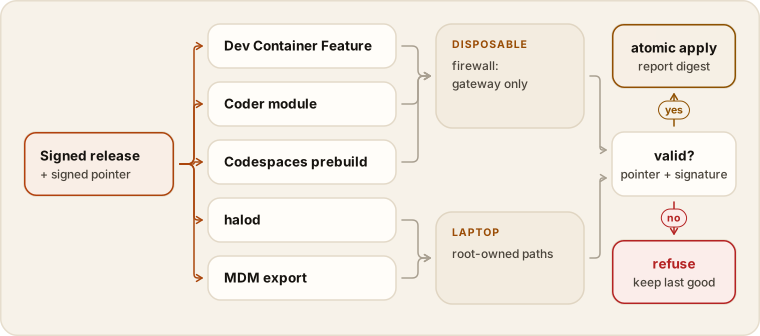
Delivery gets a verified release onto the machine where the harness runs. Rationale: ADR-0001.
Why this is necessary
Section titled “Why this is necessary”Claude Code’s server-managed settings are not fetched with Bedrock or a custom ANTHROPIC_BASE_URL. On that path configuration must be a file on disk (managed-settings.json), an MDM payload, or environment variables. Halos writes those from a signed release.
| Sink | Mechanism | Strength | Verification status |
|---|---|---|---|
Dev Container Feature (features/halos) |
Installs halod (sha256-pinned), embeds the release key, runs halod once --install at start, optional gateway-only firewall |
Strongest: rebuilt from release | Built with the devcontainer CLI in CI (pinned CLI and managed settings asserted); firewall option and a published Feature UNVERIFIED |
Coder module (features/coder) |
Terraform coder_script that installs halod (sha256-pinned) and runs halod once --install |
Strong | UNVERIFIED: tofu validate passes (by hand, not in CI); never applied, no Coder deployment |
| Codespaces | Prebuilds using the Feature; portal launcher builds a URL | Strong | UNVERIFIED in a real Codespace (the Feature and .devcontainer build in CI) |
halod agent |
run (loop, default every 15m), once, status; launchd unit, systemd unit |
Medium: root can stop it, but then loses gateway access on rings with posture: enforce |
Unit-tested with a fake root; CI runs it as a real launchd daemon (macOS runner) and a SYSTEM scheduled task (Windows runner), and as root in make uat-clis containers; not run on real fleets |
MDM exports (halo export jamf|intune|devcontainer) |
Jamf/Kandji .mobileconfig plus a halod postinstall; Intune PowerShell script writing the registry policy |
Medium: slow, coarse | UNVERIFIED: no real Jamf, Kandji or Intune tenant; the Intune script itself is not executed (install.ps1 and enroll.ps1 are, in CI) |
| Self-service portal | Launchers and one-time enrollment for the above | n/a | Implemented in halo-server; see portal |
Why dev containers are primary
Section titled “Why dev containers are primary”- Reproducible and disposable. Drift is corrected by rebuild, so it does not accumulate.
- Egress control. The reference firewall restricts the workspace to the gateway and the registry (default DROP for IPv4 and IPv6).
- Unattended agents live there. Coder Tasks and CI agents run in environments, not on laptops.
- Rollback is a rebuild from the previous release, or a new pointer.
Where the files land
Section titled “Where the files land”halod may write only under fixed, per-harness directories (a signed manifest naming anything else is refused). Files must be mode 0644 or tighter.
| Harness | macOS | Linux | Windows |
|---|---|---|---|
| Claude Code | /Library/Application Support/ClaudeCode/ |
/etc/claude-code/ |
C:\Program Files\ClaudeCode\ |
| Codex | /etc/codex/ (requirements.toml, managed_config.toml) |
/etc/codex/ |
C:\ProgramData\OpenAI\Codex\requirements.toml only (no system-wide managed_config.toml exists) |
| Gemini CLI | /Library/Application Support/GeminiCli/settings.json, /etc/profile.d/halos-*.sh |
/etc/gemini-cli/settings.json, /etc/profile.d/halos-*.sh |
C:\ProgramData\gemini-cli\settings.json |
| Copilot CLI | /Library/Application Support/GitHubCopilot/managed-settings.json |
/etc/github-copilot/managed-settings.json |
C:\Program Files\GitHubCopilot\managed-settings.json |
Copilot CLI is in halod’s write allowlist too (from its adapter’s harness.Meta), and make uat-clis verifies that halod writes its managed-settings.json and that the real CLI honours allowedMcpServers. Its disableBypassPermissionsMode and gateway routing remain UNVERIFIED; dev containers and MDM remain alternative delivery paths. Claude Code also supports MDM keys (com.anthropic.claudecode plist, HKLM\SOFTWARE\Policies\ClaudeCode).
halod’s own footprint is root-owned and fixed per OS:
| macOS | Linux | Windows | |
|---|---|---|---|
| Config | /Library/Halos/etc/halod.yaml |
/etc/halos/halod.yaml |
C:\Program Files\Halos\etc\halod.yaml |
| State | /Library/Halos/var/state.json |
/var/lib/halos/state.json |
C:\Program Files\Halos\var\state.json |
| Verified binaries | /Library/Halos/bin |
/usr/local/lib/halos/bin |
C:\Program Files\Halos\bin |
| npm-tgz artifacts | /Library/Halos/npm |
/usr/local/lib/halos/npm |
C:\Program Files\Halos\npm |
| Shims | /usr/local/bin |
/usr/local/bin |
none: add the bin dir to PATH via MDM |
Version enforcement
Section titled “Version enforcement”- Claude Code: the release sets
requiredMinimumVersionandrequiredMaximumVersion; the CLI refuses to start outside that range. - Codex, Gemini CLI, Copilot CLI and OpenCode: no CLI-side pin.
halodand the Feature install the exact version and report drift (for OpenCode the release also rendersautoupdate: false). - Cursor CLI: its installer cannot pin a version, so
halodcannot install it and warns. - The gateway checks the version on every model call. With
versionGate: enforceon a ring,halo-proxyandhalo-kongparse the CLI version from the User-Agent and refuse (403) a version the ring does not pin, and a missing or unrecognised User-Agent. For Claude Code this is defence in depth. Copilot CLI’s User-Agent is not known, so it counts as unrecognised. Defaultwarn: logged and counted, not refused. See gateway gates. - Installs are verified artifacts, not shell scripts. The release carries, per OS and architecture, an https URL with an exact size and a sha256 (binary) or sha512 integrity (npm tarball).
halodstreams it under a size cap, refuses non-https redirects, checks the hash, and only then renames it into place. npm tarballs install with--ignore-scriptsand empty user and global npmrc using a root-owned Node. The legacyinstallCommand(curl | bash,npm install -gwith lifecycle scripts) runs only whenallowShellInstall: trueis set inhalod.yaml, andhalodlogs a warning each time. Offline builds (halo release build --no-artifacts) therefore install nothing unless you opt in.
Gateway gates
Section titled “Gateway gates”halod runs on a machine the developer administers. The gateway is the part they do not control, so two per-ring policies move enforcement there (ADR-0011):
| Ring field | Checks | Needs |
|---|---|---|
posture: off | warn | enforce |
Every enrolled device of the caller reported to halo-server within --posture-max-age (default 45m), with no drift, on the ring’s current release or one of its experiment channels |
halo-server --gateway-token-file; halo-proxy posture.url and posture.tokenFile (halo-kong: posture_url, posture_token) |
versionGate: off | warn | enforce |
The User-Agent’s CLI version is one the ring pins (its profile or a variant profile of its running client-axis experiment) | Nothing extra |
Both default to warn: the request goes through, the request log line carries gates=, and halo_proxy_gate_total{gate,ring,outcome} counts it (halo-kong logs at NOTICE, tags the upstream request x-halo-gate and counts posture decisions in halo_kong_posture_total{ring,outcome} when HALO_KONG_METRICS_LISTEN is set). enforce answers 403 in the CLI’s wire format with the reason and what to do: run halod status, make sure halod is running and current, retry.
The posture gate fails closed on a verdict halo-server returned and on a lookup it refused (a non-200 status below 500, such as 401 for a wrong gateway token or 404 when posture is not configured on the server). A posture config that is set but invalid never disables the gate: halo-proxy refuses to start, and halo-kong refuses every caller on enforce rings and tags warn rings posture=unknown. If the server is unreachable (a transport error or 5xx), the last verdict serves for grace (default 15m, halo-proxy posture.grace); after that the posture is unknown, the request passes and is counted outcome="unknown". Verdicts are cached per user for posture.cacheTTL (default 1m).
So root can still stop halod or edit managed config, but on an enforce ring the next report is missing or shows drift, and model access stops until halod runs clean again. Revoke devices you retire: a device that stops reporting keeps its user non-compliant.
Immutable managed files
Section titled “Immutable managed files”Set immutable: true in halod.yaml to have halod set the system-immutable flag on every managed file after writing it (chflags schg on macOS, chattr +i on Linux) and clear it just before a rewrite or removal. Edits then fail even for tools running under sudo, until someone clears the flag. A missing tool or permission (some filesystems do not support chattr +i; macOS clears schg only at securelevel 0) is logged once per run and halod carries on. Ignored on Windows.
Guides: dev containers, Coder, laptops and MDM.