

Shadow traffic
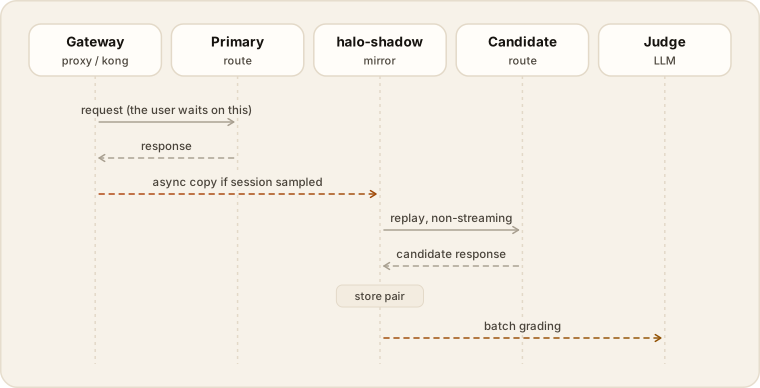
The shadow mirror (halo-shadow) sends a sampled, asynchronous copy of production requests to a candidate route and stores request/response pairs for grading. Kong OSS has no request-mirroring plugin, so Halos ships its own. halo-proxy and halo-kong both enqueue mirror jobs.
What a shadow can and cannot measure
Section titled “What a shadow can and cannot measure”A coding agent’s turns are linked by tool calls with side effects: edit a file, run the tests, read the output. A shadow candidate’s tool calls are never executed. Running them would double side effects and is unsafe. So no shadow can tell you where the candidate’s own trajectory would have gone. That is what replay evals are for: they run whole tasks in a sandbox where tools really execute.
What a shadow can measure is every decision the candidate would make on real traffic. Each request a coding agent sends after the first carries the real conversation so far: the developer’s prompt, the actions production took, and the real tool results (terminal output, test failures, file contents). Replaying that request asks both arms one question: given exactly this state, what do you do next? The comparison is teacher-forced, which means both arms always answer a prefix production really produced.
turns |
Mirrors | Use it to catch |
|---|---|---|
first (default) |
The opening request of a sampled session | Format, refusal, latency and cost regressions on fresh tasks (ADR-0004) |
all |
Every step of a sampled session | The above, plus: misreading terminal output, hallucinated tools, invalid arguments, giving up early, and drift deep into long sessions (ADR-0014) |
halo-shadow:
- samples per session, so a sampled session is mirrored on every eligible step and an unsampled one on none,
- replays each step to both the control and the candidate route (non-streaming, with halo-shadow’s own credentials; client credentials are never forwarded),
- resolves both upstreams from its own copy of the compiled policy (
-policy, hot-reloaded). A mirror job names only an experiment and variant, so the shadow token cannot be used to point halo-shadow, or its per-upstream credentials, at an arbitrary URL, - stores the pair, and executes nothing either arm returns.
halo eval online then reads each pair at two levels: an LLM judge with a pinned rubric, and a step-level reading that needs no judge (below).
Config
Section titled “Config”apiVersion: halos.dev/v1kind: Experimentname: opus-5-5-shadowtype: shadowaxis: trafficrings: [ring0-harness-team]sampleRate: 0.05turns: all # every step of a sampled session; default: firstvariants: - {name: control, weight: 1, control: true} - name: candidate weight: 1 routes: opus: {upstream: orchestrator, model: us.anthropic.claude-opus-5-5-v1:0}metrics: primary: {metric: halo.task.success, direction: increase}stopping: {method: fixed, minSamples: 500, maxDays: 7, maxSpendUSD: 200}sampleRate is the fraction (0-1) of sessions mirrored. turns picks which of their requests are eligible. With turns: all, cost grows with session length, because every step replays the whole prefix to two arms. Bound it with maxSpendUSD, halo-shadow’s -budget-usd, and the proxy’s mirror maxBytes. That last one defaults to 1 MiB: longer requests are not mirrored, so raise it to cover long sessions (halo-shadow accepts up to 8 MiB).
Reading a multi-turn shadow
Section titled “Reading a multi-turn shadow”halo eval online reads every pair whose both sides answered. For each pair it extracts the arm’s action: the multiset of tool calls with canonical arguments, or “ended its turn”. It does this for Anthropic Messages, Bedrock (invoke and Converse), OpenAI Responses and Gemini. When the session’s next step was mirrored too, that request contains the action production actually took. It is used as a reference only when its history extends this step’s: subagent and compacted conversations share the session id but not the prefix, and are skipped.
| Reading | Meaning |
|---|---|
| Tool / argument agreement | Candidate’s next action vs the control replay, on the same prefix |
| Fidelity (control) | Control replay vs production’s real action: the noise floor (the same model, re-sampled) |
| Fidelity (candidate) | Candidate vs production’s real action. Read it against the control’s, never alone |
| Fidelity delta | Candidate minus control, paired by step, with a 95% CI. Below zero with the CI excluding zero = regression |
| Invalid-call rate | Steps calling a tool the request did not offer, or missing a required argument |
| Premature stop | Production kept working; the arm ended its turn |
| Divergence | Share of sessions where the candidate’s action differed from the control’s, and the mean first step it did |
| By depth | Tool agreement at steps 0, 1-4, 5-19 and 20+: catches models that degrade deep into long sessions |
EXPERIMENT STEPS SESS TOOL AGREE FIDELITY ctl FIDELITY cand INVALID / STOP ctl/cand FIRST DIVERGENCEopus-5-5-shadow 4120 212 81% (77..85) 88% (85..91) 86% (82..89) 0.2/0.9% 1/4% 64% of sessions, step 7.3Statistics. Steps of one session are correlated, so a naive per-step interval would be falsely narrow. Every interval resamples sessions (a cluster bootstrap), and that includes the judge-score delta. Exported analysis samples are one per session and arm (halo.eval.agent.fidelity, halo.eval.agent.invalid_call_rate, unit = hashed session id). That keeps halo exp analyze’s per-unit tests valid, and raw session ids never leave the eval host. Both are registered metrics, so a shadow experiment can use them as guardrails:
metrics: primary: {metric: halo.eval.agent.fidelity, direction: increase} guardrails: - {metric: halo.eval.agent.invalid_call_rate, direction: decrease, maxRegression: 0.10} - {metric: halo.eval.judge.score, direction: increase, maxRegression: 0.05}A breach opens a pause or rollback PR. Shadow evidence never promotes: it measures decisions, not outcomes.
What is not a step. Requests that offer no tools, such as compaction summaries, are not steps. Neither are steps where an arm hit its output cap, or byte-identical retries. Each of these is counted separately in the result. A malformed call (Gemini MALFORMED_FUNCTION_CALL, Converse malformed_tool_use) counts as an invalid call, not a stop.
Two numbers, two estimands. The printed rates weight every step equally. The exported samples are per session, and halo exp analyze compares per-session means, which weights sessions equally. Each step’s samples are exported once: the history file records them. A step whose next step has not arrived yet waits an hour before it is exported without fidelity.
Trust. Production’s action is read from the history the developer’s CLI sends with the next step, so it is client-supplied. A developer in the rings could fabricate it for their own sessions. That moves one sample per fabricated session, and eval evidence only opens PRs that a human merges (ADR-0014).
From a regressed step to a regression test
Section titled “From a regressed step to a regression test”A shadow reading says the candidate regressed; halo eval harvest turns the steps where it did into tests that run again on every future candidate (ADR-0020).
- Read.
halo eval onlineshows, for example, a fidelity delta below the noise floor and a premature-stop rate of 4% against the control’s 1%. - Harvest.
halo eval harvest --pairs pairs.jsonl --pair-key-file pair.key --experiment opus-5-5-shadow --out evals/steps/opus-5-5selects the steps where the candidate diverged, made an invalid call or stopped early (addjudge-losswith--history, or asampleby depth), and writes one case per step: the real prefix, the offered tools and the action production took. Redaction runs first and cannot be turned off: identifiers outside an allowlist of request fields are dropped, and credentials, JWTs, private keys, high-entropy strings and emails are replaced. Files are 0600, sessions appear only hashed, and any redaction failure writes nothing. - Review and commit. The cases still hold real prompts and terminal output with their secrets removed by pattern. Read them before they enter a repository.
- Replay.
halo eval steps run --suite evals/steps/opus-5-5 --model opus-next --url https://gateway.example.comasks each candidate the same question at the same step and grades the next action deterministically, with session-clustered CIs.
A step suite is still teacher-forced: it tests decisions, not outcomes, and like shadow evidence it never promotes. See Writing evals for the case format.
Running halo-shadow
Section titled “Running halo-shadow”halo gateway compile --policy-dir policy-repo -o policy.jsonhalo-shadow -policy policy.json -listen 127.0.0.1:8090 -out pairs.jsonl \ -pair-key-file pair.key -upstream-headers upstream-headers.yaml \ -budget-usd 50 -retention 720h| Flag | Default | Purpose |
|---|---|---|
-policy |
Compiled policy snapshot; upstreams are resolved from it | |
-listen |
127.0.0.1:8090 |
Loopback by default; put it behind your network policy |
-out |
pairs.jsonl |
JSONL pair file, mode 0600 |
-pair-key-file |
Base64 32-byte key: encrypt pairs at rest (AES-256-GCM) | |
-upstream-headers |
YAML/JSON {upstreamName: {Header: value}}; ${ENV} expanded |
|
-budget-usd |
50 | Stop accepting jobs at this estimated spend (each job reserves its worst case first) |
-price-in, -price-out |
3, 15 | USD per million input and output tokens for the estimate |
-queue, -workers |
64, 4 | Bounded queue (excess dropped) and replay workers |
-retention |
720h | Prune pairs older than this (0 = keep forever) |
The auth token is read from the environment (HALO_SHADOW_TOKEN) and sent by the proxy as X-Halo-Shadow-Token; the proxy takes it from --halo-shadow-token or HALO_PROXY_HALO_SHADOW_TOKEN.
Guarantees and non-guarantees
Section titled “Guarantees and non-guarantees”| Primary response and latency unaffected | Design goal: the mirror is async, bounded and dropped when the queue is full (halo_proxy_shadow_dropped_total). The effect on primary latency was not measured. |
| Candidate cost bounded | sampleRate, maxSpendUSD and halo-shadow’s -budget-usd (an estimate from token prices, not a billing figure) |
| Prompts stored | Pairs contain prompts and responses. Encrypt at rest with -pair-key-file, set -retention, restrict the file. Treat as sensitive. |
| Client credentials | Never included in jobs; only `anthropic-version |
| Tool calls | Never executed, on either arm. Pairs store responses only |
| Multi-turn quality | Measured per step, on the real prefix (turns: all). Whole-task success is not: use replay evals |
Recommended recipe
Section titled “Recommended recipe”- Shadow,
turns: all. Every step of real sessions, with fidelity vs the noise floor, invalid calls and premature stops. Zero user impact. - Replay evals. Whole tasks in a sandbox, where tools really run. Gates the candidate on outcomes.
- Canary. Real sessions with gateway guardrails and auto-rollback. The only evidence that promotes.
Never promote on shadow alone.