

Rollouts
A Rollout takes one change (a release on the client axis, a model route on the traffic axis) through ordered steps. Each step has a strategy, an exposure, a minimum bake, a sample floor and gates. The controller judges the live step on every tick: a breached gate acts at once, and a passed step only ever opens a PR.
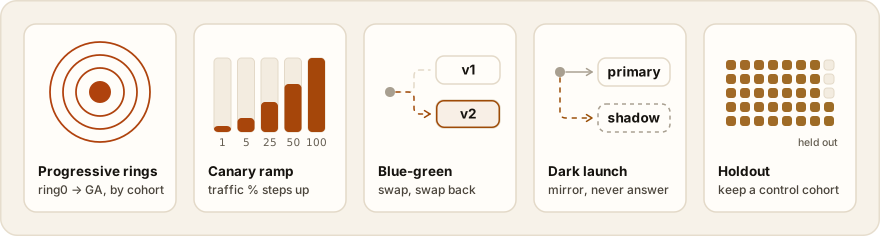
Strategies
Section titled “Strategies”| Strategy | Axis | percent means |
Moves |
|---|---|---|---|
progressive |
client | whole ring (unset or 100) | Ring.release to change.release |
blue-green |
client | whole ring | Ring switches to the pre-staged release; rollback switches back to baseline.release |
canary |
both | treatment share; may never go down between steps | Backing experiment’s weights |
dark-launch |
traffic | share of requests mirrored by halo-shadow; nobody is served it |
Shadow sample rate |
holdout |
both | share kept on control for the bake | Experiment weights |
Percent steps carry their exposure on the backing experiment (two arms, one control), so assignment stays in internal/assign and the experiment’s kill switch is the fast rollback. Ring-wide steps have no control arm, so they cannot carry metric guardrails or minSamples. A client-axis rollout needs at least one ring-wide step; a traffic-axis rollout re-points change.alias when it completes.
Steps and gates
Section titled “Steps and gates”# examples/acme-corp/rollouts/opus-5-5-upgrade.yaml (excerpt)kind: Rolloutname: opus-5-5-upgradeaxis: trafficstatus: active # draft | active | paused | aborted | completedstep: canary-5 # live step, set by merged advance PRsexperiment: opus-5-5-canary # two arms: exposure, evidence, kill switchchange: {alias: opus}steps: - name: dark-launch strategy: dark-launch percent: 10 bake: 2d # Go duration or Nd minSamples: 500 # per arm gates: guardrails: [{metric: halo.latency.p95_ms, direction: decrease, maxRegression: 0.15}] scorecard: {file: evals/opus-5-5.scorecard.json, variant: opus-5-5, minPass1: 0.75, maxRegression: 0.01} onFailure: pause # rollback (default) | pause - name: canary-50 strategy: canary percent: 50 bake: 1d minSamples: 4000 gates: guardrails: - {metric: halo.api.error_rate, direction: decrease, maxRegression: 0.05} - {metric: halo.latency.p95_ms, direction: decrease, maxRegression: 0.15} approval: trueAll gates must pass before a step advances:
- bake and samples: time in the step, and per-arm samples, reach their minimums.
- guardrails: the experiment’s arms compared with the
internal/statssequential test. A confident regression pastmaxRegressionfails; an inconclusive one stays pending. - scorecard: a
halo eval run --output jsonscorecard. It fails when the variant’s pass@1 is underminPass1, the comparison is significantly worse or drops more thanmaxRegression, orcomparisons[variant].gate.verdictis block. hold keeps the gate pending; ship passes. - approval: the step waits until a human runs
halo rollout advance.
The controller loop
Section titled “The controller loop”rollout.Evaluate is pure and deterministic: rollout, state, evidence and time in, one decision out (advance, hold, rollback, pause, complete). The controller acts on that decision asymmetrically:
- A failed gate acts immediately, before bake or samples finish.
rollbackon a traffic-axis rollout trips the experiment’s signed kill switch, so gateways send everyone to control. It only does that when the breach comes from gateway-sourced evidence; CLI-reported metrics or a scorecard never auto-kill.pausestops further steps without changing exposure. Both open a PR that records the halt, and the rollout holds until the policy leavesactive. - Advance and complete only open a PR, once per step. A merged PR moves
step:; the controller never merges.
State lives in <data-dir>/rollouts/<name>.json. The step, entry time and halt are derived by replaying a hash-chained history: each entry is a sha256 over its fields and the previous hash. A partially edited file fails verification and is rejected. The chain is unkeyed, so it detects edits, not a complete rewrite of the file: protect the data dir. Actions carry idempotency keys per step, so a retried tick does not open a second PR or trip the kill twice.
Plan it
Section titled “Plan it”$ halo rollout plan opus-5-5-upgrade --policy-dir examples/acme-corpRollout opus-5-5-upgrade (traffic axis, active)Change: gateway alias opus -> treatment route of experiment opus-5-5-canaryExperiment: opus-5-5-canary
# START STEP STRATEGY TREATMENT EXPOSURE BAKE MIN N GATES ON FAIL 1 T+0 dark-launch dark-launch [#.........] 10% 10% of ring1-canary requests mirrored, none served 2d 500 latency.p50_ms<=10%, latency.p95_ms<=15%, eval:opus-5-5 pause 2 T+2d canary-1 canary [#.........] 1% 1% of ring1-canary on treatment 6h 200 latency.p50_ms<=10%, latency.p95_ms<=15%, api.error_rate<=5% rollback> 3 T+2d6h canary-5 canary [#.........] 5% 5% of ring1-canary on treatment 12h 500 latency.p50_ms<=10%, latency.p95_ms<=15%, api.error_rate<=5% rollback 4 T+2d18h canary-25 canary [###.......] 25% 25% of ring1-canary on treatment 1d 2000 latency.p50_ms<=10%, latency.p95_ms<=15%, api.error_rate<=5% rollback 5 T+3d18h canary-50 canary [#####.....] 50% 50% of ring1-canary on treatment 1d 4000 latency.p50_ms<=10%, latency.p95_ms<=15%, api.error_rate<=5%, approval rollback 6 T+4d18h holdout holdout [##########] 95% 5% of ring1-canary held on control 14d 1000 latency.p50_ms<=10%, latency.p95_ms<=15%, api.error_rate<=5%, approval rollback
Earliest completion: T+18d18h (sum of bakes; samples and approvals add time). Every step is a PR a human merges.On completion: gateway.models.opus has failover targets: re-point it to orchestrator/arn:aws:bedrock:us-east-1:123456789012:application-inference-profile/z9w5opus55dd by hand in this PRThe GATES column is what each step is judged on: the backing experiment’s guardrails (here latency.p50_ms and latency.p95_ms), each overridden by the step’s own guardrail on the same metric, plus the step’s other guardrails. An active rollout owns its experiment, so dropping the experiment’s guardrails would silently disable their auto-rollback. Shadow-only metrics count only on a dark-launch step.
Rehearse a regression
Section titled “Rehearse a regression”$ halo rollout simulate opus-5-5-upgrade --scenario regression --policy-dir examples/acme-corpSimulating opus-5-5-upgrade (scenario regression, tick 1h, 1000 users/h, seed 1; PRs assumed merged at once)
AT STEP DECISION WHYT+0 - advance not started: propose step dark-launchT+1h dark-launch hold bake: baking, 1d23h left; samples: 100/100 of 500 per arm; guardrail:halo.latency.p50_ms: inconclusive, upp...T+5h dark-launch hold bake: baking, 1d19h leftT+2d dark-launch advance all gates passed: propose step canary-1T+2d1h canary-1 hold bake: baking, 5h left; samples: 990/10 of 200 per arm; guardrail:halo.latency.p50_ms: inconclusive, upper b...T+2d6h canary-1 hold samples: 5940/60 of 200 per arm; guardrail:halo.latency.p50_ms: inconclusive, upper bound +34.1% vs limit 1...T+2d20h canary-1 rollback guardrail:halo.latency.p50_ms failed: +21.3% [+14.8%, +27.9%] (threshold regression <= 10.0%)
Outcome: rollback after 2d20hsimulate runs the same state machine on synthetic evidence (or recorded evidence) and writes nothing. In regression, the first guardrail is twice its limit worse from --breach-step on (default: the second guardrailed step).
Commands
Section titled “Commands”| Command | Does |
|---|---|
halo rollout list / plan / status |
Steps and timeline; live gate values vs thresholds and the next action |
halo rollout simulate --scenario healthy|regression |
Rehearse the state machine; writes nothing |
halo rollout advance |
Open the PR for the next step, or completion. Counts as the approval gate |
halo rollout pause / rollback |
Open a PR pausing, or aborting (experiment paused, rings back on baseline.release) |
Related: experiments, rings and releases, evals, toggles.