

Introduction
Halos (halo) is a control plane for AI developer tools in organizations. It treats configuration of Claude Code, Codex, Gemini CLI, Copilot CLI, Cursor CLI, OpenCode and similar harnesses as a signed, ring-deployed release, gates promotion on evidence, and routes model traffic through a plane you control so the most common rollback needs no release: a signed kill reaches gateways at their next poll (about 10 s).
The problem
Section titled “The problem”AI coding CLIs have become production infrastructure, but they are still managed like personal tools. A vendor release or a model change reaches the whole engineering organization at once, unmeasured. When behaviour regresses behind a corporate gateway, platform teams lack three answers: who is running which version, whether the change made outcomes worse, and how to reverse it without asking every engineer to act.
- Settings sprawl. Each harness has its own config format and enforcement knobs.
- No central channel on gateways. Claude Code’s server-managed settings are not fetched with Bedrock or a custom
ANTHROPIC_BASE_URL, so config must be delivered as files, MDM profiles or environment definitions. - All-at-once upgrades. No way to A/B a CLI or model upgrade.
- No eval gate, no rollback.
What you get
Section titled “What you get”| Need | Halos feature |
|---|---|
| One source of truth | Policy repo validated by strict typed decoding and Go guardrails (JSON Schemas are for editors and CI) |
| Safe rollout | Rings and releases with signed pointers |
| Prove a model or CLI change | Experiments, shadow, evals |
| Enforce on every machine | Delivery: dev containers first, halod and MDM for laptops |
| Developers help themselves | Self-service portal |
| Any gateway, any IdP | Stack-agnostic traffic plane |
| Trust | Signed bundles and pointers, verified identity, stripped headers |
| Let an agent drive it, safely | Agentic operations |
Mental model
Section titled “Mental model”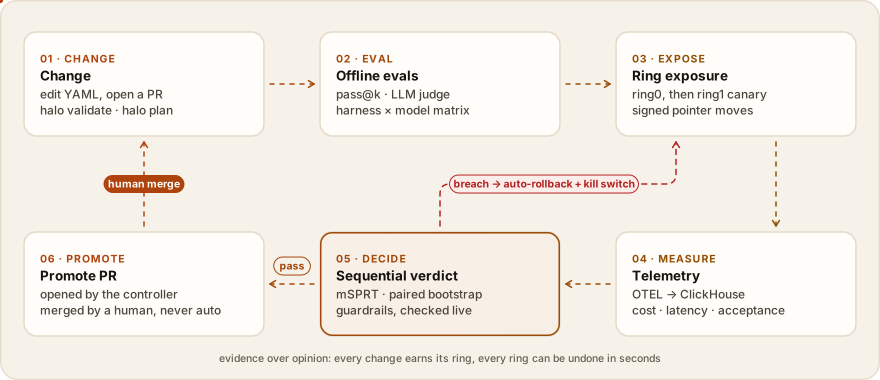
Where to go next
Section titled “Where to go next”- Quickstart.
- Architecture.
- The guide matching your setup: Bedrock via Kong or direct Anthropic.
- Going live: production deployment and the threat model.