

Stack-agnostic traffic plane
The traffic plane does five things for every model call: verify the caller, assign a ring and variant, rewrite the model alias, stamp x-halo-* headers, and mirror sampled sessions. halo-proxy does all five as one static Go binary that works with any gateway (or none), any OIDC identity provider, and any provider that speaks anthropic-messages, openai-responses or Bedrock invoke/converse paths, and it can sign Bedrock requests itself. The halo-kong plugin runs the same decision code inside Kong.
Deploy modes
Section titled “Deploy modes”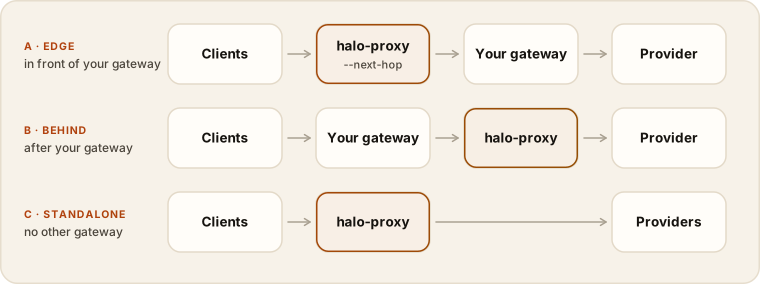
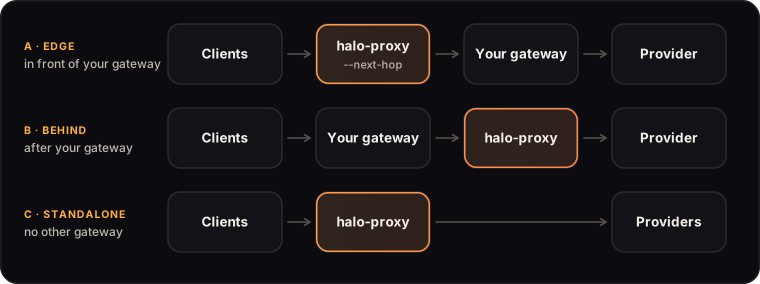
| (a) edge | (b) behind a gateway | (c) standalone | |
|---|---|---|---|
| Identity | JWT (default): the client’s token is what halo-proxy sees |
trusted_header with trustedProxyCIDRs = the gateway’s addresses, or JWT if the gateway forwards Authorization |
JWT |
| Upstream | nextHop: http://kong:8000 |
policy upstreams (or defaultUpstream) |
policy upstreams plus upstreamHeaders for provider keys |
forwardAuth |
true if the gateway behind must authenticate the same token |
usually false |
false; inject provider credentials via upstreamHeaders |
| Client IP | sees the real client | sees only the gateway | real client |
Pick (a) when the existing gateway must stay authoritative for auth and rate limits and you can change client base URLs to halo-proxy. Pick (b) when clients must keep hitting the gateway; there the gateway must overwrite the identity header and halo-proxy must be unreachable except from it. Model rewriting happens in every mode, including --next-hop: the next hop receives the upstream model id, not the alias.
Running halo-proxy
Section titled “Running halo-proxy”halo gateway compile --policy-dir policy-repo -o policy.json # hot-reloaded by halo-proxy (~1s)halo-proxy --policy policy.json --listen :8088 # (c), issuer from the policyhalo-proxy --policy policy.json --next-hop http://kong:8000 --forward-auth # (a)halo-proxy --config halo-proxy.yamlPrecedence: defaults, then YAML (--config or HALO_PROXY_CONFIG), then env HALO_PROXY_<FLAG> (for example HALO_PROXY_HALO_SHADOW_TOKEN), then flags. Unknown YAML keys are errors.
listen: ":8088"policy: /etc/halos/policy.jsonnextHop: "" # (a): forward everything heredefaultUpstream: "" # for paths the policy has no route for (for example /v1/models)forwardAuth: false # keep client Authorization / x-api-key on the forwarded requestupstreamHeaders: # per policy upstream name; ${ENV} expanded anthropic: {x-api-key: "${ANTHROPIC_API_KEY}", anthropic-version: "2023-06-01"}identity: mode: "" # jwt | trusted_header | none issuer: "" # default: policy identity.issuer audience: "" # default: policy identity.audience / clientID userClaim: "" # default email groupsClaim: "" # default groups identityHeader: "" # trusted_header only groupsHeader: "" trustedProxyCIDRs: [] allowAnonymous: falseshadow: {url: "", token: "", maxBytes: 1048576}maxBodyBytes: 33554432 # 32 MiB; larger => 413readHeaderTimeout: 10sreadTimeout: 5m # request only; responses are never time-limitedidleTimeout: 2mupstreamHeaderTimeout: 10m # wait for response headers; then the stream is unboundedshutdownTimeout: 30s # graceful drain of in-flight streamsEach YAML key has a flag of the same intent (--listen, --policy, --next-hop, --default-upstream, --forward-auth, --identity-mode, --issuer, --audience, --identity-header, --groups-header, --trusted-proxy-cidrs, --allow-anonymous, --halo-shadow-url, --halo-shadow-token, --max-body-bytes, --read-timeout, --upstream-header-timeout, --shutdown-timeout). Run halo-proxy --help for defaults.
Behavior worth knowing
Section titled “Behavior worth knowing”- Identity. With an issuer known (flag or policy) the default mode is
jwt. Failed verification returns 401 unlessallowAnonymous, in which case the caller gets default routing and ringunknown(useful when the token is an opaque API key meant for the next hop). With no issuer, no CIDRs and no explicit mode,halo-proxyfails closed with 503. - Model allowlist fails closed, 413 on oversize bodies, batches API 400. See security model.
- Streaming is never buffered: SSE and AWS eventstream stay incremental; there are no retries (a retried LLM call is a duplicated bill).
- Client credentials (
Authorization,x-api-key) are stripped unlessforwardAuth: true, and are never included in shadow jobs. - Endpoints: the public
listenaddress serves only proxied model calls andGET /v1/models(passthrough); every other path is 404.GET /healthz(503 until a policy snapshot loads) andGET /metricslive on a separate unauthenticated admin listener,--admin-listen/adminListen(default127.0.0.1:9090, empty disables); in Kubernetes set:9090and restrict it with a NetworkPolicy. Metrics (Prometheus:halo_proxy_requests_total{ring,variant,status}, TTFB and duration histograms, auth-failure and shadow counters). Access log is one JSON line per request with no bodies, headers or user ids. - TLS:
halo-proxyserves plain HTTP; terminate TLS in front of it.
Kill switch
Section titled “Kill switch”halo-proxy (and halo-kong) poll halo-server’s signed kill list and treat killed experiments as not running: control routing, no mirroring, no experiment headers. Configure it with killSwitch.url, tokenFile and pubkeyFile (flags --killswitch-*); all three are required together. A failed fetch keeps the last list, and a gateway that never fetched one kills nothing. Full behavior: experiments and the halo-proxy README.
Per-request telemetry
Section titled “Per-request telemetry”With --telemetry-otlp-endpoint (YAML telemetry), halo-proxy exports halo.gateway.requests and halo.gateway.latency_ms over OTLP/HTTP with the ring, variant and model it assigned. No prompts, headers, user ids or session ids are exported; the per-unit key is a salted hash. These feed halo.api.error_rate and halo.latency.* for experiments, and are the only online source for traffic-axis ones. See evidence plane.
Integrations
Section titled “Integrations”Starting points in deploy/integrations/, not turnkey deployments. Files marked “generated” come from internal/gateway/adapters; edit the templates and run go test ./internal/gateway/adapters -update.
| Stack | What is provided | Checked | UNVERIFIED |
|---|---|---|---|
| Kong (OSS, Enterprise, Konnect) | Route to halo-proxy (kong.yml, no plugin server), or the halo-kong plugin (halo gateway deck) |
kong config parse (3.8, db-less) OK, run by hand when the template was written and not part of CI; the deploy/compose demo runs Kong OSS + halo-kong end to end; make uat-kong runs Kong OSS 3.9.3 + halo-kong in CI (32 checks, test/uat/KONG-REPORT.md) |
Live traffic through the route-to-halo-proxy template; Kong Enterprise and Konnect |
| Envoy / Istio | Static bootstrap with route timeout: 0s and stream_idle_timeout |
envoy --mode validate (v1.32) OK, run by hand, not part of CI |
Live traffic |
| nginx | location with proxy_buffering off, HTTP/1.1, long timeouts; proxy_pass without a URI so encoded Bedrock paths survive |
nginx -t OK, run by hand, not part of CI |
Live traffic |
| AWS API Gateway | HTTP API to VPC link to internal ALB to halo-proxy (openapi.yaml) |
nothing | Everything: not imported into AWS. HTTP APIs cap integration time and do not stream; verify quotas before routing agent traffic through it |
| LiteLLM | halo-proxy in front of LiteLLM (--next-hop), or LiteLLM as a policy upstream |
nothing | Everything: written from LiteLLM’s documented config, not run |
Kong specifics worth keeping if you hand-edit the generated config: exact regex routes (prefix routes would let /v1/messages/batches bypass the allowlist), KONG_NGINX_HTTP_CLIENT_BODY_BUFFER_SIZE=32m (otherwise bodies spool to disk and are answered 413), https-only routes, and the shadow token as a Kong vault reference ({vault://env/halo-shadow-token} plus KONG_NGINX_MAIN_ENV=HALO_SHADOW_TOKEN). A literal token is refused by the generator. If a Kong auth plugin hides the Authorization header, either forward it or use trusted_header with the CIDR pin. Never put Kong in front of an auth gateway and trust its x-*-user header: it is client-controlled there.
Model routes and failover
Section titled “Model routes and failover”Clients ask for a stable alias (sonnet, opus, default); the Gateway document decides where it goes. A route is one {upstream, model}, or a list of targets grouped into priority tiers (lower first). Within a tier, weight splits traffic with a pick that is sticky per user and harness session (hashed by internal/assign), and the rest of the tier is the failover order. Later tiers are tried only after earlier ones fail.
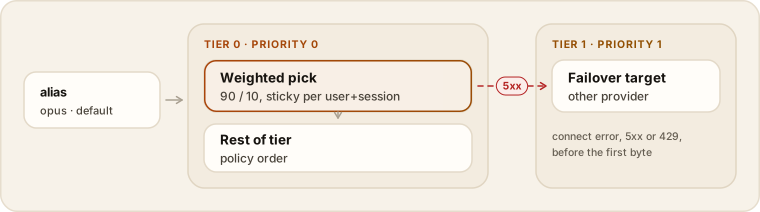
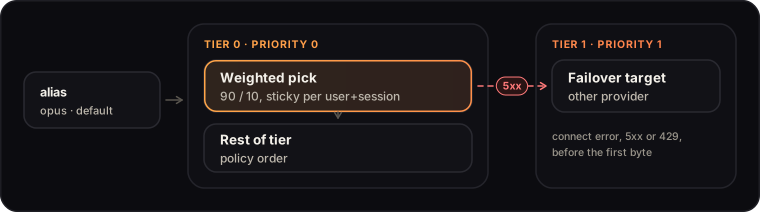
# examples/acme-corp/gateway.yaml (excerpt)models: opus: targets: - upstream: bedrock-use1 # priority 0: primary model: arn:aws:bedrock:us-east-1:123456789012:application-inference-profile/p7q2opus41bb timeoutSeconds: 30 # connect + response headers; streams are not time-limited - upstream: anthropic-direct # priority 1: failover model: claude-opus-4-1-20250805 priority: 1 default: targets: # 90/10 split, sticky per user + session - {upstream: anthropic-direct, model: claude-sonnet-4-5-20250929, weight: 90} - {upstream: anthropic-direct, model: claude-opus-4-1-20250805, weight: 10}halo-proxy moves to the next target on a connect error, a 5xx or a 429. Failover happens inside the round trip, before any response byte reaches the client: once a stream starts, it is never retried. Per-target circuit breakers skip a target after route.breakerFailures consecutive failures (default 5) and probe it again after route.breakerCooldown (default 30s). route.maxAttempts caps tries per request (default 3). These settings live in the halo-proxy config, not in policy. A target whose upstream kind cannot serve the client’s wire is skipped for that client.
See exactly what a user would hit:
$ halo gateway routes --user alice@acme.com --session s-42 --policy-dir examples/acme-corpRoutes for user "alice@acme.com" session "s-42"ALIAS ORDER UPSTREAM KIND MODEL WEIGHT PRIORITY TIMEOUT NOTESdefault 1 anthropic-direct anthropic claude-opus-4-1-20250805 10 0 - <- hit when healthy; skipped by gemini-clidefault 2 anthropic-direct anthropic claude-sonnet-4-5-20250929 90 0 - skipped by gemini-cliopus 1 bedrock-use1 bedrock arn:aws:bedrock:us-east-1:123456789012:application-inference-profile/p7q2opus41bb - 0 30s <- hit when healthy; skipped by codex,gemini-cliopus 2 anthropic-direct anthropic claude-opus-4-1-20250805 - 1 - skipped by gemini-cliOutput trimmed to two aliases; the NOTES column is verbatim (gemini-cli has no usable target for default or opus here). Without --user, weighted tiers are shown in policy order. A model upgrade or a provider move is a one-line policy change; toggles and canary experiments can switch a route for a cohort first.
Providers
Section titled “Providers”A policy upstream is a named backend with a kind; a model route maps a stable alias to one or more {upstream, model} targets. Same-wire kinds only get the model swapped. halo-proxy translates three cases (internal/gateway/translate.go), and skips any target whose kind cannot serve the client’s wire.
kind |
Serves clients speaking | What halo-proxy does |
|---|---|---|
orchestrator |
any (including gemini) |
Pass-through to your own LLM gateway; it handles provider auth |
anthropic |
any (use with anthropic-messages) |
Pass-through; auth via upstreamHeaders |
bedrock |
bedrock-invoke, anthropic-messages |
SigV4 with its own AWS identity (below). anthropic-messages is translated to invoke / invoke-with-response-stream, and the event stream is converted back to SSE |
vertex |
anthropic-messages |
Translated to rawPredict / streamRawPredict with the model in the path. Needs project and region (us-east5 or global); the URL is derived. Token from Google ADC: a service-account key file or the metadata server (GKE workload identity, GCE, Cloud Run) |
openai |
any (use with openai-responses) |
Pass-through; bearer key from credential.env or credential.file |
azure-openai |
openai-responses |
Rewritten to /openai/v1/responses, or /openai/responses?api-version= when apiVersion is set; model is the deployment. credential is required |
gemini |
gemini |
Pass-through of /v1beta/models/{model}:{generateContent,streamGenerateContent,countTokens} (alias in the path is rewritten). Optional credential (env or file) is sent as x-goog-api-key; with a credential the host must be generativelanguage.googleapis.com or an upstreamHosts entry |
Credentials never come from policy values or the client: client Authorization, x-api-key, api-key, x-goog-api-key and Proxy-Authorization are dropped even with forwardAuth. Credentialed kinds must use https on the provider’s own domain (*.googleapis.com, api.openai.com, *.openai.azure.com, …) or an exact upstreamHosts entry; other hosts are never sent a credential. count_tokens has no Bedrock or Vertex equivalent and is skipped for them. halo-kong does not translate or fail over: it routes each alias to its first target (verified in a real Kong).
Gemini CLI. gemini-cli cannot send Authorization to a custom base URL; it sends GEMINI_API_KEY as x-goog-api-key. On the gemini wire only, halo-proxy takes the Halos credential (the developer’s OIDC JWT) from x-goog-api-key, verifies it exactly like a bearer token, and strips it (and any ?key=) before forwarding. On every other wire that header is not a credential. The gemini adapter renders GEMINI_API_KEY="$(sh -c '<gateway.auth.helperCommand>')" into the login-shell profile, so the token is minted at shell start and never written to disk; it is short-lived, so open a new shell when it expires. vertex does not serve Gemini models yet (halo validate warns when no harness can use a target). halo-kong does not accept x-goog-api-key as identity.
Translations are covered by fixture tests. The provider-smoke workflow calls Anthropic and OpenAI nightly (scheduled runs on 2026-10-02 and 2026-10-03 passed); Bedrock, Vertex, Azure OpenAI and the Gemini API are UNVERIFIED against real accounts (their smoke jobs run once secrets are set).
Direct Bedrock (SigV4 in halo-proxy)
Section titled “Direct Bedrock (SigV4 in halo-proxy)”Point Claude Code at halo-proxy in Bedrock mode. halo-proxy verifies the developer’s JWT, rewrites the alias to the real model or inference-profile ARN, then signs the request with its own AWS identity. The developer needs no AWS credentials.
1. Policy. Declare a bedrock upstream and an alias (region comes from the host, or is set explicitly for a custom or VPC endpoint host):
protocols: {claude-code: bedrock-invoke} # renders the Bedrock env belowupstreams: bedrock: {url: "https://bedrock-runtime.us-east-1.amazonaws.com", kind: bedrock} bedrock-vpce: {url: "https://bedrock.corp.example", kind: bedrock, region: eu-west-1} # custom DNS name: also needs signHosts (step 4)models: sonnet: {upstream: bedrock, model: "arn:aws:bedrock:us-east-1:123456789012:inference-profile/us.anthropic.claude-sonnet-4-5-20250929-v1:0"}2. Claude Code environment. With protocols: {claude-code: bedrock-invoke} the adapter renders these into managed settings; set them by hand otherwise:
export CLAUDE_CODE_USE_BEDROCK=1export ANTHROPIC_BEDROCK_BASE_URL=https://halo-proxy.internal.example.com # gateway.baseURLexport CLAUDE_CODE_SKIP_BEDROCK_AUTH=1 # the CLI sends no SigV4; halo-proxy signsexport ANTHROPIC_MODEL=sonnet # a policy alias, not a Bedrock idClaude Code still needs its Halos JWT: gateway.auth.helperCommand becomes apiKeyHelper, and the token’s aud must match identity.audience.
3. Credentials for halo-proxy. The AWS SDK default chain, resolved on first use and refreshed before expiry: environment (AWS_ACCESS_KEY_ID and friends), shared config or SSO (AWS_PROFILE), web identity (EKS IRSA or Pod Identity), ECS task role, EC2 instance profile. On EKS, annotate the halo-proxy service account with the IAM role. Grant it bedrock:InvokeModel and bedrock:InvokeModelWithResponseStream on the models and inference profiles named in policy. Credentials are never logged.
4. Region and host rules. halo-proxy signs only when the upstream is kind: bedrock, a region is known, and the host is allowed to receive the gateway’s signature. The region is either region (validated, for example us-east-1; only allowed on kind: bedrock) or derived from a bedrock-runtime[-fips].<region> host label. The host must end in .amazonaws.com, .amazonaws.com.cn or .api.aws, or be listed in the signHosts setting of halo-proxy’s config (exact hostnames, for example a private VPC endpoint DNS name):
# halo-proxy config (not policy)signHosts: [bedrock.corp.example]A region on any other host gets 502 bad_upstream (“policy upstream host is not allowed for signing”) and an error log naming the host, so a policy change cannot send AWS credentials to a third party. nextHop and defaultUpstream are never signed. A malformed region also gives 502 bad_upstream.
5. Backward compatibility. A kind: bedrock upstream on a non-AWS host where no region can be derived and none is set (an orchestrator or a SigV4 sidecar) is forwarded unsigned, exactly as before. Existing orchestrator setups need no change.
What is signed. SigV4, service bedrock, computed after the model rewrite over the final method, escaped path, host, Content-Type, x-amz* headers and the SHA-256 of the final body. The caller’s Authorization, x-api-key and all x-amz* / x-amzn* headers are always dropped before the gateway sets its own, even with forwardAuth: true, so a client cannot smuggle a header into the signature. Paths: invoke, invoke-with-response-stream, converse, converse-stream; the application/vnd.amazon.eventstream response streams through unbuffered.
No credentials gives 502 upstream_auth_error and nothing is forwarded unsigned.
Check: halo validate passes with the upstream, halo-proxy starts, and a request with a valid JWT for alias sonnet reaches Bedrock with an Authorization: AWS4-HMAC-SHA256 ... header. Verified with fixed-key tests (an AWS SigV4 test-suite vector plus a fake Bedrock that recomputes the signature). UNVERIFIED: real AWS Bedrock, IRSA and Pod Identity on a real cluster, and VPC endpoints.
halo-kong in a real Kong (verified on Kong OSS 3.9.3)
Section titled “halo-kong in a real Kong (verified on Kong OSS 3.9.3)”make uat-kong runs halo-kong as a Go plugin server inside the official kong 3.9.3 image (pinned by digest, db-less, declarative config from halo gateway deck), against two mock model upstreams and a halo-server for the signed kill list. Every row below is asserted against the live gateway; see test/uat/KONG-REPORT.md for the evidence. Kong Enterprise is UNVERIFIED.
Verified: a valid JWT is routed, the alias rewritten and ring/release stamped; a missing, forged or wrong-audience token is a 401; caller credential headers never reach the upstream; spoofed x-halo-* and identity headers are stripped; an unknown model is a 400 and never reaches an upstream; non-model paths get Kong’s 404; sticky canary assignment matches the library for every user; a traffic toggle applies to its cohort only; concurrent canaries on different aliases each claim only their own alias; the kill switch (experiments and toggles) takes effect within the plugin’s 10 s poll and un-kill restores; an unusable kill-switch key keeps traffic flowing and is flagged x-halo-killswitch: misconfigured; Kong’s /status and Prometheus metrics count the traffic.
Settings that matter (each one was a failure mode in a real Kong):
- Plugin server env. Kong passes the plugin server only the variables in nginx’s main-context
envlist, andnginx_main_envis a single setting. Chain several with; env:KONG_NGINX_MAIN_ENV="HALO_SHADOW_TOKEN; env HALO_KILLSWITCH_TOKEN; env HALO_KILLSWITCH_PUBKEY". Listing only one variable leaves the others unset and shows up asx-halo-killswitch: misconfigured.halo gateway deckprints this in the file header. - Kill switch over plain http. An in-cluster
halo-serverService is http: generate withhalo gateway deck --killswitch-url http://... --killswitch-allow-insecure-in-cluster(sets the plugin’skillswitch_allow_insecure_in_cluster). Without it, the generator refuses a non-https URL. - Secure defaults, the same as halo-proxy. With JWT identity (an issuer is configured), a model call with a missing, forged, wrong-audience or garbage token gets
401 authentication_errorwithWWW-Authenticate: Bearer realm="halos"and never reaches an upstream. The caller’sAuthorization,x-api-key,api-key,x-goog-api-keyandProxy-Authorizationare removed before the upstream, so the developer’s IdP token never reaches a provider; add the provider credential in Kong (for examplerequest-transformerwith a vault reference). Opt out explicitly, only when an auth gateway or orchestrator behind Kong needs them:halo gateway deck --allow-unverified(pluginallow_unverified: unverified callers are routed anonymously, ringunknown, no experiments) and--forward-client-credentials(pluginforward_client_credentials). Each opt-out prints a warning and a# WARNING:line in the generated file. Intrusted_headermode the auth gateway that sets the identity header decides, so unverified callers are not refused by the plugin. - Prometheus. Kong’s per-request series (
kong_http_requests_total, including the plugin’s own 400/401 answers) are off by default; enablestatus_code_metricson theprometheusplugin.
Limits, as documented and as observed: a multi-target route uses only its first target; there is no failover (an unreachable first target is a Kong 503 and the second target is never tried); there is no wire translation (a bedrock target receives the Anthropic path and body with only the model swapped, unsigned); the Gemini wire is not served (no Kong route, 404). Use halo-proxy for any of these.
Also not included: mTLS or SPIFFE identity, per-user rate limiting. (Failover across route targets is above; a single-target route is not retried.)