

Experiments
An Experiment compares variants for a set of rings, under a primary metric and guardrails, with a stopping rule.
Type and axis
Section titled “Type and axis”client axis |
traffic axis |
|
|---|---|---|
| Variants differ by | profile / release on the machine | model route at the gateway |
| Change takes effect | on rebuild / next halod pull (channels) |
immediately at the gateway (policy hot-reload) |
| Types | ab, canary |
ab, canary, shadow |
| Example | CLI 2.1.280 vs 2.1.290 | opus alias to a newer model |
Types: ab splits by weight and compares; canary sends a small share to the candidate and aborts on guardrail breach; shadow mirrors and does not affect responses (shadow traffic).
Traffic first: ADR-0003.
Assignment
Section titled “Assignment”- Deterministic:
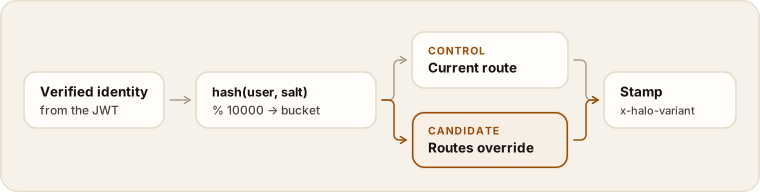
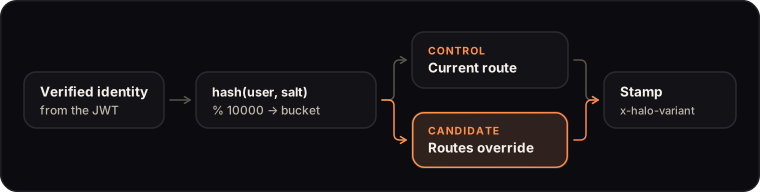
hash(user, salt) % 10000mapped over normalized variant weights.saltdefaults to the experiment name so experiments are independent. - Sticky per user. Because the variant is a function of the user, an agent session never switches model mid-task. Shadow sampling is keyed on the session id the harness sends (for example Claude Code’s
x-claude-code-session-id), so a whole session is either mirrored or not. - The cohort comes from the identity the gateway verified (OIDC JWT), never from a client header. A request with no verified identity is refused with 401; only with anonymous access enabled (
allow_unverified/ the proxy’sallowAnonymous) does it get default routing and no experiments. - At most one A/B or canary applies to a request (the first matching running experiment); any number of running shadow experiments can sample it.
Client-axis delivery
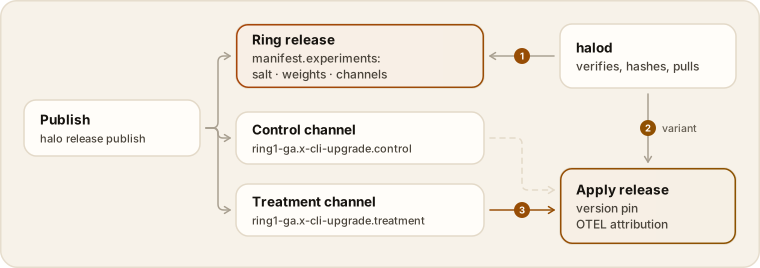
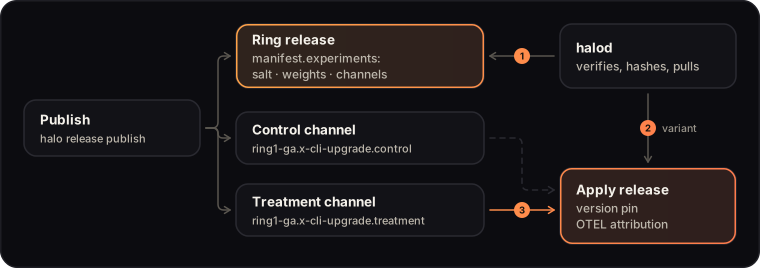
Section titled “Client-axis delivery”A client-axis variant is a release, not a route, so it has to reach the machine through the same signed path as any release. halo release publish --ring R builds the ring release plus one release per variant of the running client-axis experiment that enrolls R, and serves each on its own channel.
- Channel name:
<ring>.x-<experiment>.<variant>. If that exceeds 100 characters, the experiment/variant part becomes the first 20 hex characters ofsha256(experiment NUL variant)(<ring>.x-<hash>). A channel is published like a ring: a signed pointer atring-<channel>.pointer. - The ring manifest lists the experiment. Its
experimentssection (name, salt, per-variant weight and channel) is part of the release the signature covers.halodrecomputes each channel name and refuses a manifest that names a different one. - Same function as the gateway.
halodcomputes the variant withpolicy.Experiment.ResolveVariant, the functionhalo-proxyuses, from the signed salt and weights. The device and the gateway agree on the variant without talking to each other. - One running client-axis experiment per ring. A device applies one release, so two overlapping experiments cannot both deliver. Validation rejects the overlap.
- An older
halodignores theexperimentssection and applies the ring release, which is control.
Subject
Section titled “Subject”halod needs the user id the gateway hashes. It takes the first that is available:
subjectin the ring endpoint response (GET /api/v1/fleet/ringreturns{"ring", "subject"}, the enrolled user).subject:inhalod.yaml(for MDM: template the user id into the file). 1 to 256 characters, no control characters.- The last subject
halodsaved.
With no subject, halod applies the ring release, reports errorCode: no_subject_for_experiment and exits non-zero from halod once. It never guesses a variant.
Failure behaviour
Section titled “Failure behaviour”- A channel that fails verification keeps last-good. Bad signature, wrong org, replayed
seq, expired pointer, or a release for a different experiment/variant fails the whole cycle:keeping last-good <digest>.haloddoes not fall back to the ring release, because that would silently move treatment devices to control. - Each channel has its own anti-rollback mark in the
halodstate file, like a ring. - Pause and republish to revert. When the experiment is no longer
running, the nexthalo release publishwrites a ring release with noexperimentsand no channels. Devices converge to it on their next pull.
Variant guardrails
Section titled “Variant guardrails”A variant profile is held to the ring’s profile more strictly than a child is to its parent. These are errors (halo validate exit 2), not warnings:
| Rule | Error when |
|---|---|
| Exact version pins | a harness version is not exact semver (no ranges, no latest), or no harness is enabled |
| Telemetry | telemetry.enabled is false |
permissions.disableBypass |
not true |
| No widening | the variant adds permissions.allow, permissions.ask or egress.allowedDomains entries the ring profile lacks, or drops a ring permissions.deny or mcp.denied entry |
| No MCP changes | mcp.servers adds or changes a server the ring does not have |
| No weakening | sandboxRequired, mcp.managedOnly, hooks.managedOnly or models.enforce is true on the ring and not on the variant; permissions.sandbox is relaxed (read-only to workspace-write, or any sandbox to none/off) |
| Mode ordering | permissions.mode is more permissive than the ring’s, ranked plan < default < acceptEdits < auto (empty means default; an unknown mode ranks above auto) |
| Hooks are a subset | the variant has a hook (command and event) the ring profile lacks |
| Telemetry unchanged | telemetry.otlpEndpoint or telemetry.logPrompts differs from the ring’s, so a variant cannot redirect or start exporting evidence or prompts |
| Models are a subset | when the ring restricts models.allowed: the variant’s list is empty, adds a model, or its models.default is outside the ring’s list |
| Instructions and env equal | instructions or env differs from the ring profile’s |
| Unique channels | a channel name collides with a ring or another channel |
Attribution
Section titled “Attribution”The variant release carries the experiment and variant in its harness config. Claude Code gets halo.experiment and halo.variant in OTEL_RESOURCE_ATTRIBUTES (next to halo.ring and halo.release). Codex, Gemini CLI and Copilot CLI have no resource-attribute config key, and Halos renders no telemetry for Cursor CLI or OpenCode. On Linux, with telemetry enabled, Halos writes an /etc/profile.d shell function that runs the CLI with OTEL_RESOURCE_ATTRIBUTES including halo.experiment and halo.variant; it reaches login shells only, so an exec that bypasses the shell (timeout, env, xargs) runs the CLI unlabeled. On macOS and Windows Halos cannot set it, and halo render and halo release publish warn that CLI telemetry carries no halo.* attributes.
The gateway attributes a request (x-halo-experiment, x-halo-variant) to a client-axis experiment only when no traffic-axis experiment applies to it, so a client-axis experiment never displaces a traffic experiment’s routing. Client-axis experiments never route. halod status and fleet reports carry experiment and variant.
Walkthrough: A/B a CLI upgrade. Design: ADR-0010.
Metrics and stopping
Section titled “Metrics and stopping”metrics: primary: {metric: halo.edit.accept_rate, direction: increase} guardrails: - {metric: halo.cost.usd_per_session, direction: decrease, maxRegression: 0.10}stopping: {method: msprt, alpha: 0.05, minSamples: 300, maxDays: 14, maxSpendUSD: 500}- This snippet is for a client-axis experiment. A traffic-axis experiment must use gateway-sourced metrics (
halo.api.error_rate,halo.latency.p50_ms,halo.latency.p95_ms);halo.task.successis offline-eval only. msprt: mixture sequential probability ratio test, valid under continuous monitoring (no peeking penalty).fixed: fixed horizon.- Guardrail
maxRegressionis relative worsening that aborts the experiment (0.10 = 10%). When the control’s value is 0 (an error rate with no control errors), relative worsening is unbounded: any significant increase fails the guardrail, and two arms that are both exactly 0 pass it. maxDaysandmaxSpendUSDare hard ceilings so a non-converging experiment stops spending.- Analysis: mSPRT for sequential decisions and bootstrap confidence intervals (
internal/stats), with CUPED variance reduction available in the stats package.
Lifecycle
Section titled “Lifecycle”halo exp start|pause|conclude <name> edit the status field of the experiment YAML in place (use --policy-dir for the policy repo). Only running experiments affect traffic.
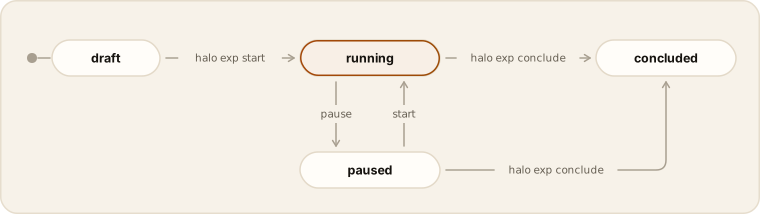
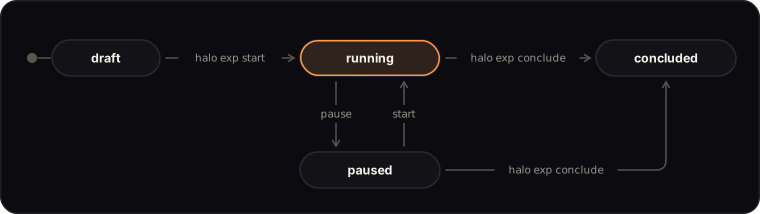
halo exp list and halo exp show <name> read them. The status change is a git change like any other: commit it, review it, merge it. The gateway reloads the compiled policy (halo gateway compile) on its next snapshot.
Verdicts
Section titled “Verdicts”halo exp analyze opus-5-5-canary --policy-dir policy --clickhouse http://clickhouse:8123 \ --verdicts-file verdicts.jsonThe verdict is one of promote, rollback, continue or expired (a maxDays or maxSpendUSD ceiling was hit without a decision). --verdicts-file upserts the result into a JSON file that halo-server serves (--verdicts-file). ClickHouse credentials come from --user and the HALO_CLICKHOUSE_PASSWORD environment variable.
A promote or rollback report carries source: gateway or cli, the evidence plane the deciding metric came through (halo exp analyze --output json shows it, and so does each metric). gateway is exact cohort attribution measured by halo-proxy and delivered over the authenticated gateway receiver; cli is telemetry from developer machines, which anyone who can reach the collector can forge. Only gateway evidence can trip the kill switch (evidence trust). Sources are never mixed within one analysis: a metric uses gateway rows when any exist, and falls back to CLI events otherwise.
halo exp promote <name> --ring <ring> --release <digest> requires a promote verdict and opens a PR that points the ring at the release (--dry-run prints the patch). It never merges.
The controller loop
Section titled “The controller loop”halo exp analyze is one evaluation you run by hand. The controller runs it for every status: running experiment on a timer and acts on the result. It is built into halo-server (--controller) and also available as a one-shot for CI or cron (halo controller run --once).
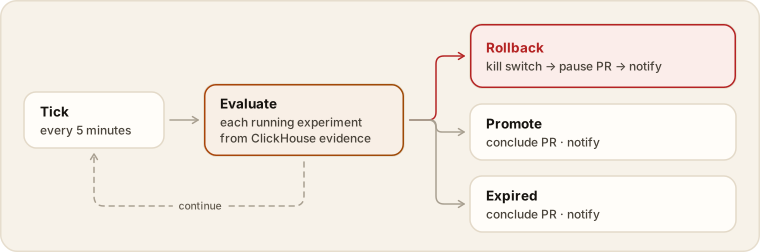
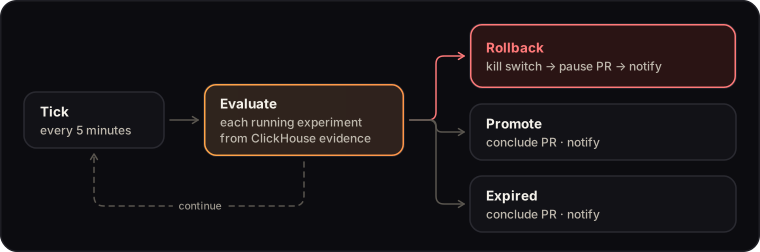
| Verdict | Controller action | Notes |
|---|---|---|
rollback |
If the deciding evidence is gateway-sourced and a kill list is served, trips the kill switch at once; always opens a PR setting status: paused with the evidence in the body and notifies |
The PR is never merged. On CLI-sourced evidence nothing is auto-killed (killOutcome: not_gateway_evidence): a human decides |
promote |
Opens a PR that sets status: concluded, notifies |
It does not roll the treatment out: before merging, a human adds the ring release (client axis) or model route (traffic axis). Concluding returns everyone to control |
expired |
Opens a PR that sets status: concluded, notifies |
The PR is never merged |
continue |
Nothing |
Rules that matter in operation:
- Each action happens once per experiment run. The record is
controller-state.jsonlin the data dir. When the experiment is next seen not running (someone merged the pause or conclusion), the record resets, so a restarted experiment starts clean. Ticks never duplicate PRs or notifications. - Kill first, but only on trusted evidence and only if something enforces it. On rollback the kill happens before the PR, and the notification goes out even if the kill or the PR failed, because people must know. The webhook event’s
killOutcomesays what happened:enforced,recorded_only(written, enforcement not guaranteed),not_configured,not_gateway_evidence, orfailed. The in-process controller kills only whenhalo-serverhas a kill key (-killswitch-key-file); without it nothing reads the list, so it does not pretend: the PR and notification say merge urgently.halo controller runalways writes the kill to<data-dir>/killswitch.jsonl, and says it is enforced only with--killswitch-served. - No evaluation after a rollback, or while killed. Once a run rolled back, the controller only finishes that rollback’s pending PR/notifications; a later
promoteverdict cannot conclude it. A running experiment found killed (admin kill, or a kill left from an earlier run) is not evaluated (its evidence is all-control); humans are told once per run to unkill before resuming (webhook verdictkilled). - Notifications are tracked per channel (
notify:slack,notify:webhook): a failing channel is retried on later ticks alone, the others are not re-posted. Each delivery has a 10-second timeout and does not follow redirects. - The controller never merges. Promotion and rollback PRs wait for a human. Automatic rollback (the kill switch) is the only automatic action that changes live traffic.
- Errors retry sooner than the interval: 15s, 30s, and so on, capped at the tick interval. Each tick is bounded to 2 minutes. The interval is at least 1 minute (default 5).
- Run one controller per data dir. Two controllers would race on the action log.
- Notifications go to a Slack incoming webhook and/or a generic webhook. Generic webhook bodies are signed and timestamped:
X-Halo-Timestamp: <unix seconds>andX-Halo-Signature: sha256=<hex HMAC-SHA256(secret, timestamp + "." + body)>, with the secret from--notify-webhook-secret-file. Receivers must verify the signature and reject timestamps more than 5 minutes off; verification snippets. Webhook URLs are secrets: read from files, never logged. - Audit is fail-closed for privileged actions. A controller kill is appended to the hash-chained
audit.jsonl(actorhalo-controller) with fsync. If the append fails the kill stays applied (fail safe) and the tick reports the audit gap as an error.halo controller runappends through the same chain, so it is a single writer: do not point it at a data dir a livehalo-serveris appending to; use the server’s in-process controller there.
Running it
Section titled “Running it”Inside halo-server (the usual way; kills reach gateways through the same data dir):
halo-server -policy-dir /srv/policy -token-file fleet.token -data-dir /var/lib/halos \ -controller -clickhouse-url http://clickhouse:8123 -clickhouse-user halo -clickhouse-password-file ch.pass \ -policy-repo-dir /srv/policy-writer -policy-repo-base main \ -killswitch-key-file killswitch.key -gateway-token-file gateway.token \ -notify-slack-url-file slack.url -metrics-listen 127.0.0.1:9100--controller requires -clickhouse-url and -data-dir. -policy-repo-dir must be a clone separate from -policy-dir; it may be the portal’s policyRepoDir (one clone and lock for console proposals and controller PRs). It is hard-reset to origin/<base> before each PR. Without it, the controller still evaluates, kills and notifies but opens no PRs. PRs need git and an authenticated gh.
As a one-shot (CI, cron):
HALO_CLICKHOUSE_PASSWORD=... halo controller run --once --policy-dir . \ --clickhouse http://clickhouse:8123 --user halo --data-dir /var/lib/halosCheck: exit code is non-zero if any experiment failed. PRs are opened from the git checkout that contains --policy-dir. Kills reach gateways only when --data-dir is the same directory halo-server uses as -data-dir (a shared volume); otherwise the kill is recorded but nothing serves it. Pass --killswitch-served only when that is true: without it, rollback PRs and notifications say the kill is merely recorded. Use --no-pr for verdicts, kills and notifications only. Flags: CLI reference.
Kill switch
Section titled “Kill switch”Merging a pause PR takes a review cycle plus a policy snapshot roll-out. The kill switch is the fast path for a bad treatment: a signed list of killed experiment names that gateways poll from halo-server. A killed experiment is treated as not running: its users get control routing and its shadow mirroring stops, at the gateway’s next poll (default every 10 seconds), with no PR and no merge.
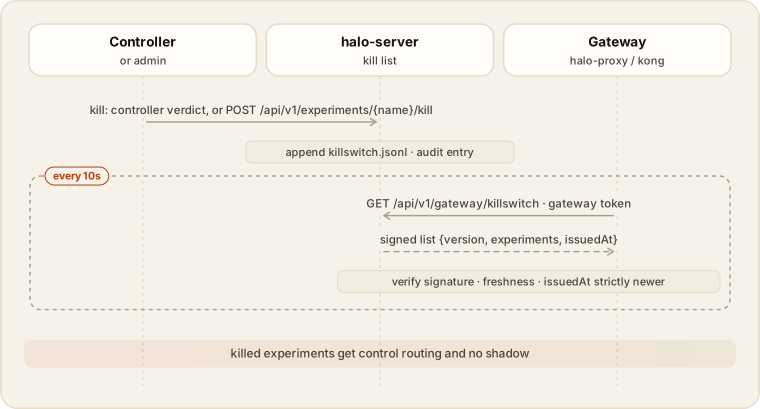
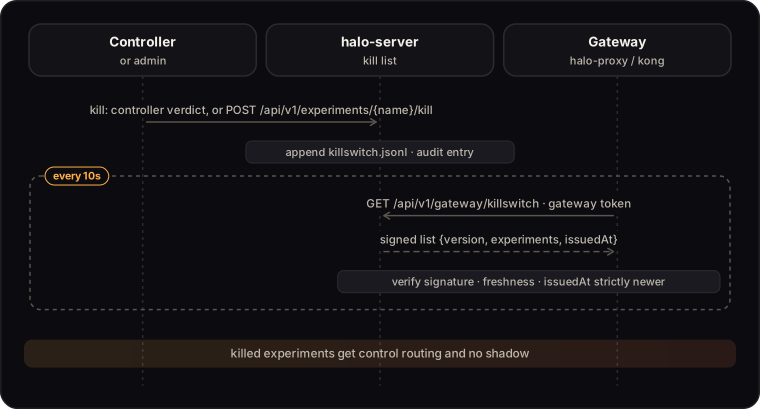
An admin can kill or unkill by hand (POST /api/v1/experiments/{name}/kill and /unkill; the console shows a Kill switch button when the server has one). Setup and the wire format: API reference, security model, ADR-0009.
Failure policy
Section titled “Failure policy”| Situation | What gateways do |
|---|---|
halo-server unreachable, or the list fails verification |
Keep the last accepted list. A kill never lapses because the control plane is down |
| The gateway has never fetched a valid list | Kill nothing. The policy snapshot’s status fields alone decide |
| A list is older than 10 minutes or more than 1 minute in the future | Rejected (last list stays) |
A list is not strictly newer (issuedAt) than the current one |
Rejected as a replay, so an old envelope cannot undo a kill |
Kills do not expire. Pausing or concluding the experiment in policy does not lift a kill. Unkill it explicitly before you restart the experiment, or it stays on control:
curl -X POST https://halo.acme.example/api/v1/experiments/opus-5-5-canary/unkill \ -H 'content-type: application/json' -d '{"reason":"fixed; restarting"}' # admin session requiredLimits: the client axis
Section titled “Limits: the client axis”The kill switch lives at the gateway, so it fully undoes a traffic-axis experiment (model routes). A client-axis experiment changes the release on the machine. Killing it always stops gateway-side effects (routing, mirroring and attribution). Whether it reaches machines depends on halod:
killSwitchconfigured inhalod.yaml:halodpolls the same signed list (GET /api/v1/fleet/killswitch, device token, default every 60 seconds) and treats a killed experiment as not running. The device applies the ring release (control) within one poll, without a republish, and reportskilled: true. Unkill returns it to its variant. The list is verified, persisted and replay-protected like the gateway’s; a failed fetch keeps the last list. Config:halod.yaml.- Not configured (the default for hand-written and MDM configs; portal enrollment adds it whenever
halo-serverhas a kill key): devices keep their variant until the experiment is paused or concluded in policy andhalo release publish --ring <R>republishes, orhalo rollbackpoints the ring and its channels at an earlier release. See client-axis delivery.
The controller’s notification text (“gateway traffic only; client-axis variants stay until the pause PR merges”) describes the second case.
Killed experiments also get no x-halo-experiment or x-halo-variant stamp (gateway headers).