

A/B a CLI upgrade
Axis: client. Type: ab. Half of a ring keeps the current CLI pin (control) and half gets the new one (treatment). Each device learns its variant from the signed ring release, pulls that variant’s signed channel, and reports it. Background: client-axis delivery.
The example repo ships the pieces: examples/acme-corp/experiments/claude-cli-2.1.3xx-ab.yaml (enrolls ring1-canary and ring2-early) with profiles engineering (control, Claude Code 2.1.280) and engineering-next (treatment, 2.1.312).
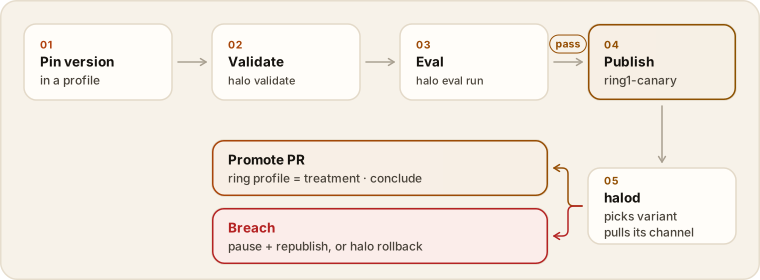
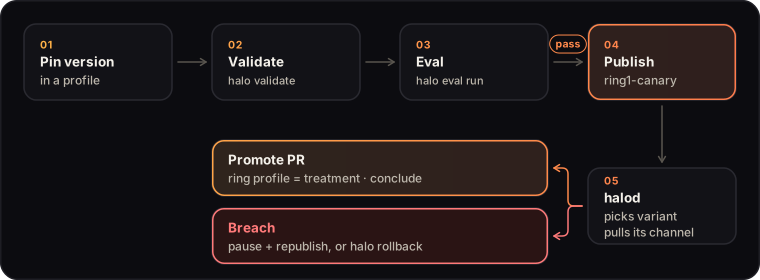
For a shorter, policy-only walkthrough (plan, rollout simulation, promote patch), see Roll out a Claude Code upgrade safely. make e2e (every PR, test/e2e/experiment_test.go) runs this flow with the real halo and halod against a local registry: publish, two enrolled devices landing in different variants, a tampered channel refused, pause and republish. It has not been run against a live fleet or the telemetry pipeline (UNVERIFIED at fleet scale).
0. Setup for a local try-out
Section titled “0. Setup for a local try-out”docker run -d --rm --name halo-reg -p 127.0.0.1:5055:5000 registry:2halo keys generate --out keys # keys/halo.key, keys/halo.pubP=examples/acme-corpREG=localhost:5055/acme/halosAgainst a real registry drop --plain-http and use your ghcr.io/... repository.
1. Pin the new version and validate
Section titled “1. Pin the new version and validate”apiVersion: halos.dev/v1kind: Profilename: engineering-nextextends: engineeringharnesses: claude-code: {version: 2.1.312}halo validate $PCheck: OK: policy valid. A client-axis variant profile is held to the ring profile by errors, not warnings: exact version pins, telemetry on, permissions.disableBypass, nothing widened, no MCP changes, no weaker sandbox or managedOnly/enforce, no more permissive permissions.mode, only hooks the ring already has, the ring’s telemetry endpoint and logPrompts, a models list that stays inside the ring’s, and identical instructions and env. Only one running client-axis experiment may enroll a ring. Full list: variant guardrails.
For Claude Code the release sets requiredMinimumVersion and requiredMaximumVersion to the pin, so the CLI refuses other versions. For Codex and Gemini CLI, halod installs the pin from a verified artifact and reports drift; their CLI metrics are not attributed to the experiment (attribution).
2. Eval gate
Section titled “2. Eval gate”halo eval run evals/suites/cli-upgrade.yaml --output json > scorecard.jsonRuns use Docker images ghcr.io/dshakes/eval-<harness>:<version> (built from evals/images; not published to ghcr.io), no network by default, and --pass-env to forward only the credentials the agent step needs. Check: no regression beyond your thresholds. See writing evals.
3. Start the experiment and publish
Section titled “3. Start the experiment and publish”The example experiment is status: running; to start a paused one use halo exp start claude-cli-2.1.3xx-ab --policy-dir $P. Publish the ring:
halo release publish --policy-dir $P --ring ring1-canary --release-version 2.1.300 \ --registry $REG --key keys/halo.key --plain-http --no-artifacts--no-artifacts builds offline; in production leave it off so halod gets verified install artifacts. Output (one signed release per variant, then the ring):
published localhost:5055/acme/halos tags v2.1.300, ring-ring1-canary (sha256:1ac9...) channel experiment claude-cli-2.1.3xx-ab variant control: tags v2.1.300-x-claude-cli-2.1.3xx-ab.control, ring-ring1-canary.x-claude-cli-2.1.3xx-ab.control (sha256:b085...) channel experiment claude-cli-2.1.3xx-ab variant cli-next: tags v2.1.300-x-claude-cli-2.1.3xx-ab.cli-next, ring-ring1-canary.x-claude-cli-2.1.3xx-ab.cli-next (sha256:7470...)Check: a channel line per variant. With --output json, channels lists ring1-canary.x-claude-cli-2.1.3xx-ab.control and ...cli-next. Channels and the ring’s signed experiments section: rings and releases.
4. See who gets what
Section titled “4. See who gets what”halo whoami --policy-dir $P --user dev45@acme.com # ring1-canary, claude-cli-2.1.3xx-ab = cli-nexthalo whoami --policy-dir $P --user dev26@acme.com # ring1-canary, claude-cli-2.1.3xx-ab = controlCheck: the variant line. This is the function the gateway and halod both use, so it predicts what each device applies. Those two user ids are in ring1-canary, one per variant, for the example policy.
5. A device picks its variant
Section titled “5. A device picks its variant”An enrolled device gets its ring and subject (the user id) from halo-server’s ring endpoint. For a device without an endpoint (MDM-managed, or this try-out) set both in halod.yaml:
registry: localhost:5055/acme/halosorg: acme-corppubkey: /etc/halos/release.pubring: ring1-canarysubject: dev45@acme.com # MDM: template the user id hereplainHTTP: true # local registry onlysudo halod once --config /etc/halos/halod.yamlsudo halod status --config /etc/halos/halod.yamlExpected for dev45 (dev26 shows control, pin 2.1.280):
{ "ring": "ring1-canary", "experiment": "claude-cli-2.1.3xx-ab", "variant": "cli-next", ... }Check: status has experiment and variant, and on Linux /etc/claude-code/managed-settings.json has requiredMinimumVersion and requiredMaximumVersion equal to 2.1.312 and OTEL_RESOURCE_ATTRIBUTES containing halo.experiment=claude-cli-2.1.3xx-ab,halo.variant=cli-next. The same attributes label Claude Code’s OTEL metrics, which is how halo exp analyze splits arms.
If the device has no subject, halod applies the ring release and reports no_subject_for_experiment (exit non-zero). If the variant channel fails verification, it keeps the last-good release and does not fall back to control.
6. Keep pointers fresh
Section titled “6. Keep pointers fresh”halo release refresh --ring ring1-canary --registry $REG --key keys/halo.key --plain-httpok refreshed ring-ring1-canary: version 2.1.300, seq ..., digest sha256:1ac9..., expires 2026-10-07T22:54:14Zok refreshed ring-ring1-canary.x-claude-cli-2.1.3xx-ab.control: version 2.1.300-x-claude-cli-2.1.3xx-ab.control, seq ...ok refreshed ring-ring1-canary.x-claude-cli-2.1.3xx-ab.cli-next: version 2.1.300-x-claude-cli-2.1.3xx-ab.cli-next, seq ...Before each signature, stderr prints Signing ring <ring or channel> → version V (digest D, seq S), one line per pointer. refresh also refuses a pointer that has expired and, through the signer state file (--state-file, default $XDG_STATE_HOME/halos/pointers.json), a registry that serves an older pointer than this signer wrote; see pointer refresh.
Check: one line for the ring and one per channel. Run it daily, like any ring: a channel pointer expires after 7 days too. Client-axis changes apply on the next halod pull (15 minutes by default), so allow for lag when choosing maxDays.
7. Decide
Section titled “7. Decide”halo exp analyze claude-cli-2.1.3xx-ab --policy-dir $P --clickhouse http://clickhouse:8123halo exp promote claude-cli-2.1.3xx-ab --policy-dir $P --clickhouse http://clickhouse:8123 \ --ring ring2-early --release sha256:... --dry-run # drop --dry-run to open the PRTo ship the treatment, a human merges a change that points the ring’s profile at engineering-next (and sets the experiment concluded), then publishes the ring. halo release promote --from-ring A --to-ring B points B at the release A’s signed pointer names and moves only the ring pointer: A’s experiment channels stay with A, and B’s devices get the release as control.
8. Stop or roll back
Section titled “8. Stop or roll back”| Goal | Command | Effect on devices |
|---|---|---|
| Stop the experiment | halo exp pause claude-cli-2.1.3xx-ab --policy-dir $P, merge, then halo release publish ... --release-version 2.1.301 |
The new ring release lists no experiment and no channels; devices converge to it on their next pull |
| Undo a release | halo rollback --ring ring1-canary --to 2.1.300 --registry $REG --key keys/halo.key --plain-http |
Ring and every channel re-point to the snapshot published with 2.1.300, each with a higher seq. --to <version> is refused unless the release’s signed manifest carries that version; --to sha256:<manifest digest> is content-addressed |
| Stop it now | Kill switch | See below |
Check (pause): after halod once, status has no experiment and halo.release=2.1.301 appears in OTEL_RESOURCE_ATTRIBUTES. Check (rollback): the output has ok rolled back for the ring and each channel.
Kill switch on devices
Section titled “Kill switch on devices”Gateways read the signed kill list and stop attributing a killed client-axis experiment immediately. A device reverts to the ring release (control) only if its halod.yaml enables the kill list; it polls the list every minute by default and does not wait for a republish:
killSwitch: pubkey: /etc/halos/killswitch.pub # the kill-switch key, not the release key # url: defaults to <ringEndpoint origin>/api/v1/fleet/killswitch # interval: 60sIt needs deviceToken or deviceTokenFile (the endpoint is device-authenticated). Portal enrollment adds this block when halo-server has a kill key; for MDM or hand-written configs, add it to the halod.yaml you distribute. status then shows "killed": true for the experiment. Unkilling returns the device to its variant at the next poll. Without killSwitch configured, a kill reaches gateways only, and devices revert on pause and republish.
The ClickHouse steps need the telemetry pipeline running (halo telemetry collector-config).