

Security overview for buyers
This page answers the questions a vendor security review asks, in the order those questionnaires ask them. Every answer links to code, an ADR, a test or a CI job. Where the honest answer is “no”, it says no.
Halos is Apache-2.0 open-source software that you run. There is no Halos-operated service and no vendor hosting your data: your security posture is the posture of your deployment. The deeper documents are the security model (the design) and the threat model (assets, attackers, controls). Companion pages: control mapping and data flow and PII inventory.
At a glance
Section titled “At a glance”| Question | Answer |
|---|---|
| Hosted by the vendor? | No. Self-hosted: you run halo-server, the gateway, the collector and the registry |
| Independent assurance? | None. No third-party penetration test, code audit, SOC 2 report or ISO certificate. SECURITY.md states it |
| Release integrity | ed25519- or ECDSA P-256-signed releases and ring pointers (key in a file, AWS KMS or an HSM via an external signer); cosign-signed checksums and images; build-provenance attestations; SBOMs |
| Authentication | OIDC (console and gateway), SAML 2.0 (console, ADR-0039), SCIM 2.0, short-lived workload and agent credentials |
| Encryption in transit | Not terminated by Halos services. Put TLS in front of them. Outbound calls use Go’s TLS defaults |
| FIPS 140-3 cryptography | FIPS builds, no Halos certificate. _fips archives and -fips images are built against the Go Cryptographic Module v1.0.0; every algorithm on the signing path is inside it. See FIPS 140-3 builds |
| Audit | Hash-chained, tamper-evident audit log with SIEM export |
| Customer data in prompts | Passes through the gateway to the model provider you chose; not stored by Halos unless you enable shadow or prompt telemetry |
| Vulnerability reporting | GitHub private vulnerability reporting; 3-business-day acknowledgment |
Architecture and trust boundaries
Section titled “Architecture and trust boundaries”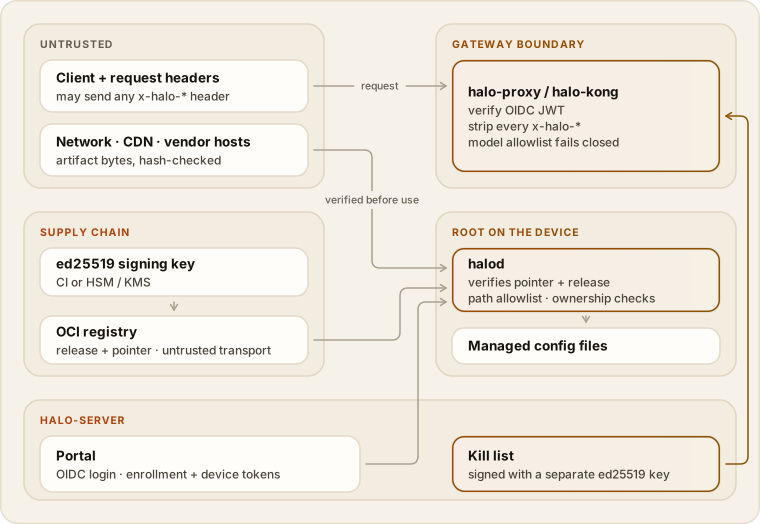
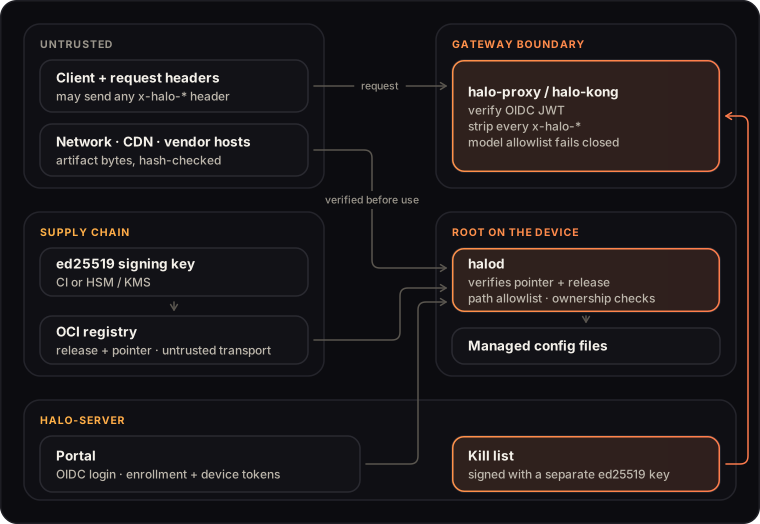
Components (package map, architecture):
| Plane | Components | Trust note |
|---|---|---|
| Control | halo CLI, policy repo (git), OCI registry, halo-server |
The policy repo’s merge gate and the release signing key are the root of trust. Halos does not prevent a malicious merge |
| Client | halod (root, on laptops and workspaces), the coding CLIs |
halod applies only releases that verify against its pinned key, writes only to an allowlist of paths and runs no shell installers by default |
| Traffic | halo-proxy or halo-kong, halo-shadow |
Cohort comes from the verified identity only; client x-halo-* headers are stripped; unknown models fail closed |
| Evidence | OTel collector, ClickHouse | The client-reachable receiver is untrusted; only the authenticated gateway receiver can drive an automatic kill |
Boundaries and the control at each are tabulated in the security model. Four design invariants hold across the codebase (AGENTS.md): no permission-bypass modes are ever rendered; adapters warn rather than silently drop a setting; client-supplied identity headers never choose a cohort; and no auto-merge or auto-promote exists, so a human owns every irreversible step. The MCP server has no tool that publishes, retags, merges or pushes to main (internal/mcpserver/write_safety_test.go).
Multi-tenancy: Halos is an organization-scoped tool, not a multi-tenant SaaS. One deployment serves one org; org units scope policy and ownership inside it (ADR-0018).
Authentication and authorization
Section titled “Authentication and authorization”| Subject | Mechanism | Detail |
|---|---|---|
| Developer, console | OIDC authorization-code login against your IdP | 12-hour session in an HttpOnly, SameSite=Lax cookie, Secure over https; state-changing requests refused when Origin or Sec-Fetch-Site says cross-site; failed logins rate-limited per client IP (internal/server/auth.go) |
| Developer, gateway | OIDC JWT verified at every request | iss, aud, exp, nbf; RS256, ES256 or EdDSA only; none and HS* rejected; JWKS refetch throttled to once per 30 seconds per issuer (internal/identity/oidc.go) |
| Gateway behind your own gateway | trusted_header |
Honored only from trustedProxyCIDRs; fails closed without a pin |
| Laptop | Single-use enrollment token (15 minutes), then a device token, stored as SHA-256, revocable, expiring after 90 days | internal/server/portal.go, devices.go |
| CI job or cloud workload | RFC 8693 exchange of the job’s OIDC token for a credential of 15 minutes by default, 1 hour at most; per-issuer claim rules that must pin the tenant | ADR-0023 |
| Subagent or A2A caller | Delegated credential with an act chain, scope that only narrows |
ADR-0024 |
| IdP provisioning | SCIM 2.0 with a dedicated bearer token held as SHA-256 | ADR-0022 |
Gateway to halo-server |
Per-capability bearer tokens (kill list, posture, budget, directory, DLP); 32+ characters and 128+ bits of estimated entropy, enforced at startup | cmd/halo-server/main.go |
Authorization is one table: five roles (viewer, operator, approver, auditor, admin) mapped from IdP groups, recomputed on every request, deny by default, with every denial audited. A test fails when a route is added without an entry (TestRoutePermsCoverMux in internal/server/rbac_test.go; ADR-0015).
MFA, password policy and conditional access are the IdP’s. Halos adds nothing to them.
Cryptography
Section titled “Cryptography”Every algorithm Halos uses, from the source:
| Purpose | Algorithm | Where |
|---|---|---|
| Release and ring-pointer signatures | ed25519 over the digest, or ECDSA P-256 over its SHA-256 (ADR-0038); the manifest records the algorithm and key id; halod verifies either against its configured keys, each under its own algorithm only, and never shells out to cosign |
internal/bundle/sign.go, keys.go, pointer.go |
| Signing key custody | file:// PEM (default), awskms:// (AWS KMS asymmetric key, private half never leaves KMS) or exec:// (external signer: PKCS#11 HSM, GCP/Azure KMS, Vault). Every remote signature is verified against the key before use |
internal/signer/, key management |
| Optional co-signature on releases and pointers | cosign: key file, KMS URI or keyless (Fulcio and Rekor) | cmd/halo/cmd_release.go (--cosign-key, --cosign-keyless) |
| Artifact (skill, hook, plugin) signatures | ed25519 (halo artifact sign) or a cosign key |
agent supply chain |
| Kill list | ed25519 or ECDSA P-256 over halo-killswitch-v1\n plus the payload, with a key separate from the release key (file or key URI) |
internal/gateway/killswitch.go |
| Workload and delegated-agent credentials | EdDSA JWTs (halo-workload+jwt, halo-agent+jwt) signed with a third, dedicated key |
internal/identity/workload.go, delegation.go |
| Inbound IdP and CI token verification | RS256, ES256, EdDSA | internal/identity/oidc.go (AllowedAlgs) |
| Remote AgentCard signature verification | ed25519, ECDSA, RSA (PKCS#1 v1.5 and PSS, SHA-256) | internal/a2a/card.go |
| Console session cookie | HMAC-SHA256 over base64 JSON. Integrity only: the cookie is not encrypted and carries the subject and groups | internal/server/auth.go (seal) |
Webhooks (controller notifications, SIEM webhook sink) |
HMAC-SHA256 over timestamp + "." + body; 5-minute replay window for receivers |
internal/controller/notify.go, internal/server/audit_export.go |
| Inbound GitHub cloud-agent webhooks | HMAC-SHA256 verification | internal/cloudagents/task.go |
| Audit chain | SHA-256 over every other field of each entry | internal/server/audit.go (sum) |
| Token storage | SHA-256 (device, enrollment, SCIM) | internal/server/devices.go, portal.go |
| Pseudonyms | HMAC-SHA256 under a salt: halo.unit, ledger path and repository hashes |
internal/telemetry/gwmetrics/gwmetrics.go, internal/ledger/ledger.go |
| Shadow pairs at rest (optional) | AES-256-GCM with a module-generated random 96-bit nonce, 32-byte key from a file | internal/shadow/shadow.go |
| Binary integrity | sha256 or sha512 pinned in the signed manifest | cmd/halod/install.go |
| Upstream auth | AWS SigV4 for Bedrock (gateway’s own identity); service-account JWT signed RSA-SHA256 for Vertex | internal/gateway/upstreamauth/ |
TLS:
halo-server,halo-proxyandhalo-shadowhave no TLS listener. Terminate TLS at your ingress or load balancer; the Helm chart’s own comments say so (deploy/helm/halos/values.yaml). Only the standard library’scrypto/tlsis used, in two places, both setting a TLS 1.2 minimum: the SIEM syslog sink (internal/server/audit_export.go) and AgentCard fetches (internal/a2a/card.go).- Other outbound HTTPS (providers, GitHub, vendor consoles, the registry) uses Go’s default client configuration for the Go version in
go.mod(1.25). Halos sets no cipher suites. - Credentials and tokens go only over https; http is accepted only to loopback for the vendor admin, ROI and copilot clients. The kill-list URL must be https unless explicitly marked in-cluster.
- Postgres to a non-loopback host requires
sslmode=verify-full(internal/pgstore/pgstore.go).
At rest:
halo-serverdoes not encrypt its own data at the application layer. The--data-dirJSONL logs (fleet, devices, audit, requests, revocations) and the Postgres tables hold identifiers, group names, hostnames and token hashes, never token or key plaintext. Encryption at rest is the storage layer’s job: an encrypted PVC (CSI driver or cloud disk encryption) for--data-dir, and your managed Postgres’s storage encryption (RDS, Cloud SQL and Azure Database encrypt by default) for the Postgres backend. State this reliance in your own control evidence.- Shadow pairs, the one store that holds prompt and response text, are encrypted by Halos itself when
-pair-key-fileis set (table above).
Key management:
- The release signing key is the root of trust. Keep it in AWS KMS (
--key-uri awskms://...), in an HSM behind an external signer (--key-uri exec://...), or as a file in CI secrets (key management, ADR-0038). Rotation, revocation (revokedKeys) and compromise handling are in key management and production deployment. There is no threshold signing and no key revocation list in the protocol beyondrevokedKeysin eachhalodconfig. - Three keys are kept apart on purpose: release, kill switch, workload credential. A stolen kill key cannot sign a release. The release and kill-switch keys can live in a KMS or HSM; the workload-credential key is still a file.
- FIPS 140-3: builds, not a certificate. The
_fipsarchives and-fipsimages are built withGOFIPS140=v1.0.0, Go’s frozen FIPS 140-3 module (the version the Go team submitted for CMVP validation; check the CMVP listing for its current status), so the module runs its self-tests andfips140=onis the default. Every algorithm on the signing, verification, TLS, session and encryption paths (ed25519, ECDSA P-256, SHA-256, HMAC-SHA256, AES-256-GCM) is inside the module, and those packages pass their tests underGODEBUG=fips140=onlyin CI. Halos itself holds no FIPS certificate, and the standard (non-_fips) artifacts make no FIPS claim. Details and the operator requirements (HMAC secrets of at least 112 bits) are in FIPS 140-3 builds.
Logging and monitoring
Section titled “Logging and monitoring”- Audit log. Privileged actions append to a hash chain (
seq,prev,hash), fsynced before the response, and fail closed with HTTP 500 if the append fails. Verify withhalo audit verifyorGET /api/v1/audit. Tail truncation is undetectable from the log alone: the SIEM copy closes that gap (audit log). - SIEM export. Every entry, at least once and in order, to Splunk HEC, a signed webhook (Datadog and others) or syslog over TLS, native or OCSF (SIEM export).
- Session ledger. One redacted record per agent session, who and what and on whose evidence (session ledger).
- Gateway request log. Method, path, status, bytes, duration, ring, remote address, experiment, variant, upstream, model. Never bodies, headers or query strings (
cmd/halo-proxy/proxy.go). - Metrics. Prometheus on
halo-server,halo-proxy,halo-shadowandhalo-kong(reference); example alert rules in the operations guide. - Not provided: log retention policy enforcement, time synchronization, log review. Retention defaults are in the inventory.
Vulnerability management
Section titled “Vulnerability management”Of Halos itself:
| Control | Where |
|---|---|
govulncheck on every PR and push to main |
vuln job in ci.yml; make vuln locally |
golangci-lint, go vet, go test -race, go mod tidy drift check |
lint, test, tidy jobs |
| Native Go fuzz targets over parsers of untrusted input: 10 seconds per PR, 10 minutes per target nightly | fuzz job; fuzz-nightly.yml; scripts/fuzz.sh |
OpenSSF Scorecard, weekly and on main; results kept as a workflow artifact for 5 days, not published |
scorecard.yml |
GitHub Actions pinned to full commit SHAs in every workflow; workflows default to contents: read |
.github/workflows/*.yml |
Web and docs builds with npm ci --ignore-scripts in the release path; the npm build runs in an unprivileged job with no signing credentials |
web job; release.yml |
| Private vulnerability reporting, severity by CVSS v3.1, fix targets | SECURITY.md |
Gaps: there is no Dependabot or Renovate configuration in the repository, so dependency updates are manual and govulncheck is the detective control. Scorecard results are not published or tracked. There is no third-party penetration test.
For your estate: versionGate and rollouts get a patched coding CLI to the fleet in stages and refuse unpinned versions (reliable upgrades). Halos does not scan your hosts.
How the code gets written and merged, stated plainly.
- Agents write and review code. The project is developed with AI coding agents in the loop. AGENTS.md is the instruction file for contributors’ agents, and the
sdlc-*workflows run Claude as a builder (on an@claudecomment), a reviewer on every PR, a QA pass and a security pass. The repository holds no measure of what share of the code agents wrote. - Agents do not merge. The workflows can push only to a
claude/-prefixed branch and open a PR. An optional policy-gated auto-approve step (sdlc-autoapprove.yml) is off unless the repository variableSDLC_AUTOAPPROVE=on, only labels a PR, never authors an approval and never merges. The/approvecommand queues auto-merge only whenSDLC_AUTO_MERGE=trueand after branch protection is satisfied. The same rule is a product invariant: Halos itself has no auto-merge or auto-promote. - Agent review is a check, not a reviewer of record. The review and QA jobs are LLM-driven. CONTRIBUTING.md lists
reviewandqaas required to merge andsecurityas advisory, and says a maintainer merges. That a status check is required is a GitHub branch-protection setting, which is not in the repository: UNVERIFIED here. Verify it in the repository settings before relying on it. - One maintainer today. CODEOWNERS lists a single owner for every path, and GOVERNANCE.md says the
MAINTAINERSfile will be added with the first external maintainer. Load-bearing changes need an ADR and, with one maintainer, a 5-business-day comment window. There is no independent second approver for the maintainer’s own changes. - Gates every change passes (CI). Build and vet,
go test -raceacross the module, lint,govulncheck, cross-OS builds (Linux, macOS, Windows), end-to-end tests on real binaries, a kind (Helm) UAT suite, real-CLI and Kong OSS UAT suites, fuzzing, docs and console builds, and a generated-docs drift check (ci.yml,docs-gen.yml). - Releases. A tag on
mainrunsgate(strict SemVer, tag onmain, CHANGELOG section,go vet,go test -race), an unprivileged web build, GoReleaser with SBOMs, cosign keyless signatures and image signing, a build-provenance attestation, thenverify, which downloads what was published and checks the signature, checksums, attestation, image signatures andinstall.shthe way a user gets them (release.yml, RELEASING.md). Halos’ own artifacts are signed keyless with the workflow identity, so no long-lived signing key for them exists to steal. - Design records. Load-bearing changes get an ADR first (
docs/adr/); every claim in the security model is bound to a named test that CI fails on if it is renamed or removed (internal/docgen/security_model_test.go). - Developer Certificate of Origin. Contributors sign off commits (
git commit -s); nothing in CI was found that enforces it.
Incident response and disclosure
Section titled “Incident response and disclosure”- Report through GitHub private vulnerability reporting. Acknowledgment within 3 business days, triage within 10, a fix or mitigation plan within 30 days (critical and high: target 7 days), then a patched release, a published advisory and a CVE request. Coordinated disclosure up to 90 days. No bug bounty (SECURITY.md).
- Supported versions: the latest
0.xrelease andmain; older releases are not patched (support policy). - There is no Halos-operated service, so there is no vendor-side breach of your data to notify you about. A flaw in the software is announced through the advisory channel.
- Your incident levers in the product: kill switch, incident freeze, session, device and credential revocation, each requiring a reason and written to the audit log (security model). The incident plan around them is yours.
Availability and recovery
Section titled “Availability and recovery”halo-server runs as several replicas on Postgres with a fenced controller lease (ADR-0021). Clients keep the last good release. Gateways keep the last accepted kill list and policy snapshot; their directory and posture lookups follow the configured fail mode and grace window (SCIM provisioning, gateway gates). Backup, restore and the files you cannot lose are in operations. No recovery time or availability figure is promised; the example SLOs there are targets for you to set.
Known gaps
Section titled “Known gaps”Stated so you do not have to find them.
| Gap | Detail |
|---|---|
| No third-party assurance | No penetration test, code audit, SOC 2 or ISO certification. The threat model is the maintainers’ own |
| No Halos FIPS certificate | _fips builds use the Go Cryptographic Module v1.0.0, but Halos is not itself validated; fips140=only is tested on the crypto packages, not the whole tree (a FIPS build refuses to start with an HMAC salt or webhook secret under 14 bytes). The workload-credential key has no KMS backend (FIPS 140-3 builds) |
| One built-in KMS | awskms:// is built in; GCP, Azure, Vault and PKCS#11 need an exec:// adapter you supply (key management) |
| SAML for the console only | Gateways authenticate OIDC tokens; no SAML single logout (ADR-0039) |
| No TLS in the services | Terminate TLS in front of halo-server, halo-proxy and halo-shadow. No mTLS, no per-user rate limiting |
| Single signing key | No threshold signing; compromise is fleet-wide (residual risk) |
| Cookie not encrypted | The console session cookie is signed, not encrypted, and carries the subject and groups |
| Audit retention unbounded, tail truncation undetectable alone | Pin the chain head or use the SIEM copy |
| Root can defeat client enforcement | Gateway gates (posture, versionGate) are the backstop; posture is halod’s self-report |
| DLP is pattern-based | Misses secrets with no recognizable format; injection scoring is a tripwire, not a guarantee |
| Single maintainer; branch protection unverified here | See SDLC |
| No dependency-update bot | Dependencies move by hand |
| Not validated at scale | Tested with unit tests, the compose demo, and kind, real-CLI and Kong OSS UAT suites in CI. Not validated on a real fleet, Kong Enterprise, real AWS Bedrock, or Windows fleets; release binaries are not Authenticode-signed |
Questionnaire answers
Section titled “Questionnaire answers”Short answers for a SIG or CAIQ response, by domain. “N/A” means Halos is not the system of record for it.
| Domain | Question (paraphrased) | Answer |
|---|---|---|
| Governance, risk and compliance | Independent attestation? | No. See known gaps |
| Application and interface security | Secure SDLC, code review, SAST, dependency scanning? | Yes, with the caveats in SDLC: CI lint, race tests, fuzzing, govulncheck; agent plus human review; no automated dependency updates |
| Application and interface security | Input validation on untrusted data? | Yes. Parsers of untrusted input have fuzz targets; request bodies are size-limited; gateway fails closed. Tests |
| Change control | Formal change management, approvals, rollback? | Yes for the managed fleet: PR, plan, eval, rings, human merge, quorums, freezes, rollback by re-pointing (change governance). For the Halos project: PR and release gates above |
| Cryptography, encryption and key management | Algorithms, key custody, rotation? | Cryptography. Customer holds the keys (file, AWS KMS or HSM via an external signer). Rotation procedure documented. FIPS 140-3 builds on the Go Cryptographic Module; no Halos certificate |
| Identity and access management | SSO, MFA, RBAC, least privilege, deprovisioning? | OIDC SSO; MFA at the IdP; five-role RBAC, deny by default; SCIM deprovisioning revokes immediately. Authentication |
| Logging and monitoring | Tamper-evident logs, SIEM integration, retention? | Hash-chained, SIEM export native or OCSF; retention is yours (inventory) |
| Threat and vulnerability management | Scanning, patch SLAs, pen test? | govulncheck per PR, weekly Scorecard, fuzzing; disclosure SLAs in SECURITY.md; no pen test |
| Supply chain management | SBOM, signed artifacts, provenance, third-party risk? | SBOMs, cosign signatures, build-provenance attestations, SHA-pinned Actions. For your fleet: AI-BOM and SLSA-format provenance per release (control mapping) |
| Security incident management | Incident process, breach notification, disclosure? | Disclosure per SECURITY.md. No hosted service, so no vendor-side data breach path. Your IR plan uses the product levers above |
| Data security and privacy | Data inventory, classification, retention, residency, deletion? | Data flow and PII inventory. Residency is where you deploy. Some stores are unbounded by default and have no erasure API |
| Data security and privacy | Is customer content used to train models? | Halos does not train models and sends nothing to its maintainers. The model provider’s terms govern what the provider does with prompts |
| Business continuity and resilience | HA, backup, DR? | HA on Postgres; documented backup and restore; gateways and clients degrade to last good state. No tested DR figures |
| Datacenter and physical security | Physical controls? | N/A, self-hosted |
| Human resources | Background checks, training? | N/A for the software; see the project’s Code of Conduct only |
| Interoperability and portability | Open formats, exit? | Apache-2.0; policy is YAML in your git; releases are OCI artifacts; audit is JSONL or OCSF; AI-BOM is CycloneDX 1.6 |
| Infrastructure and virtualization security | Network segmentation, hardening? | Helm NetworkPolicy is provided; non-root, read-only filesystem and the like are in the chart values; segmentation is yours |